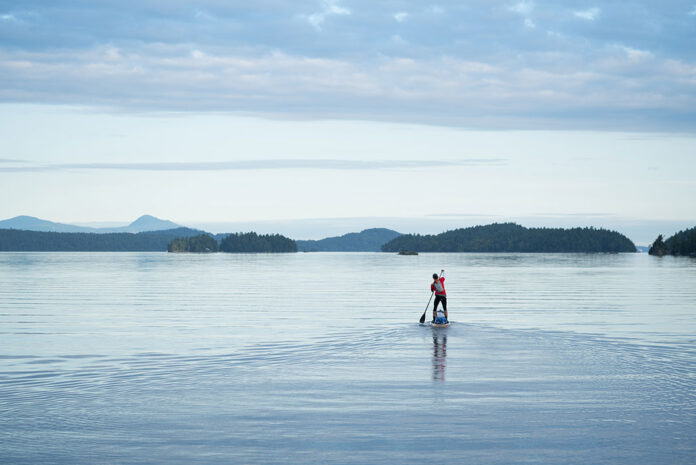
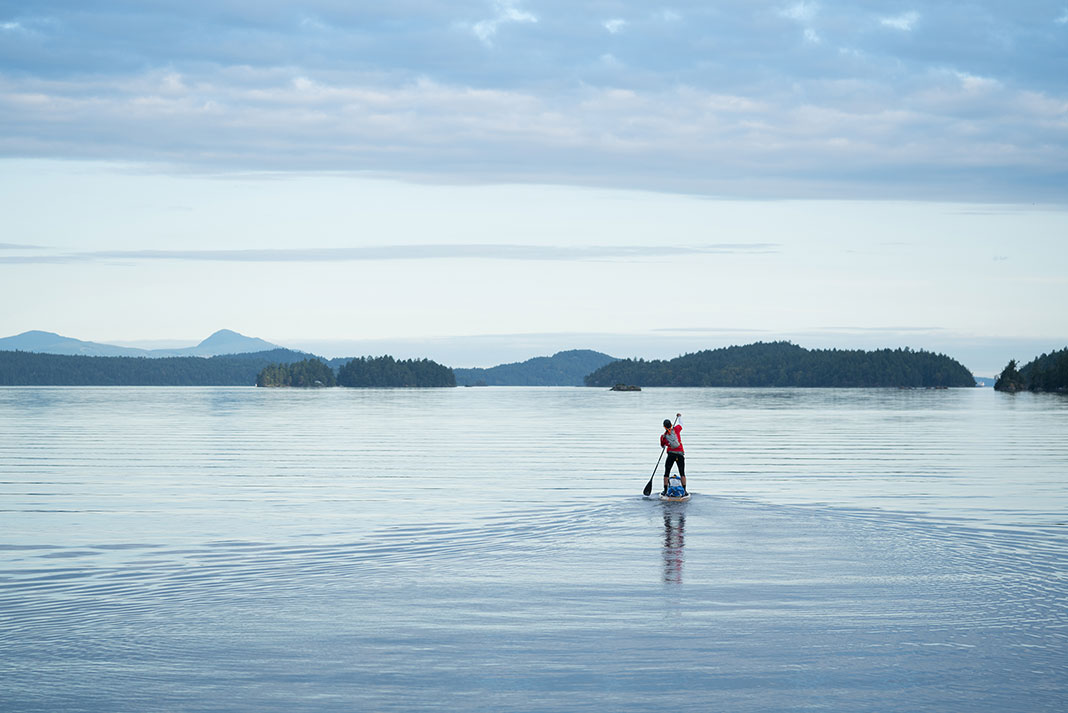
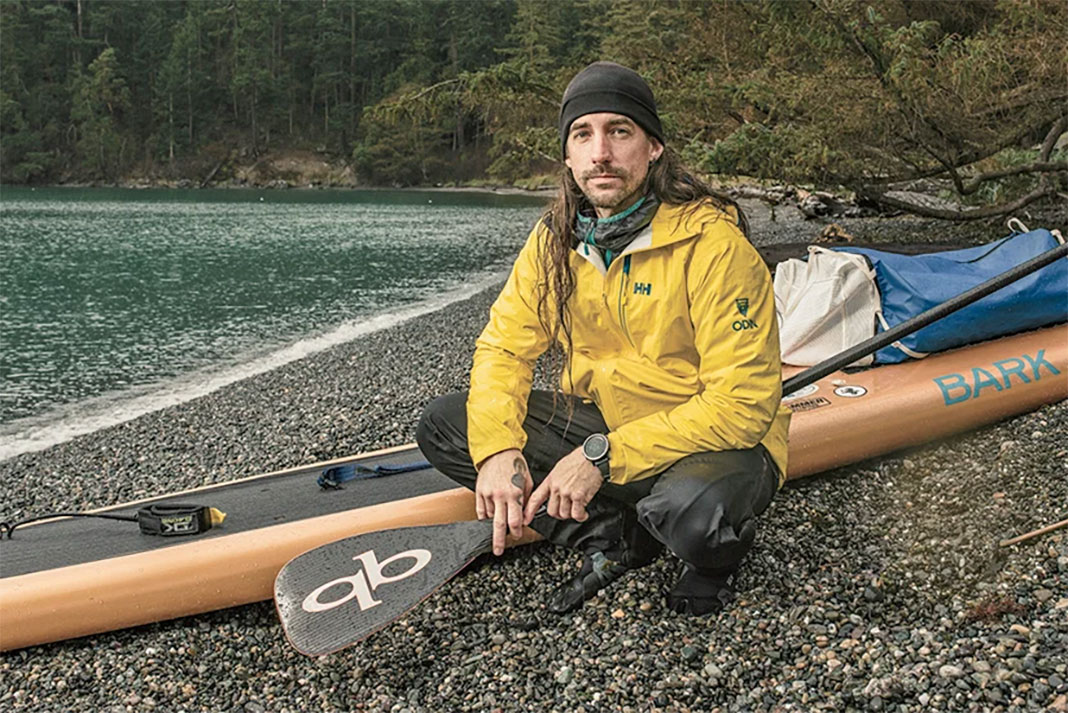
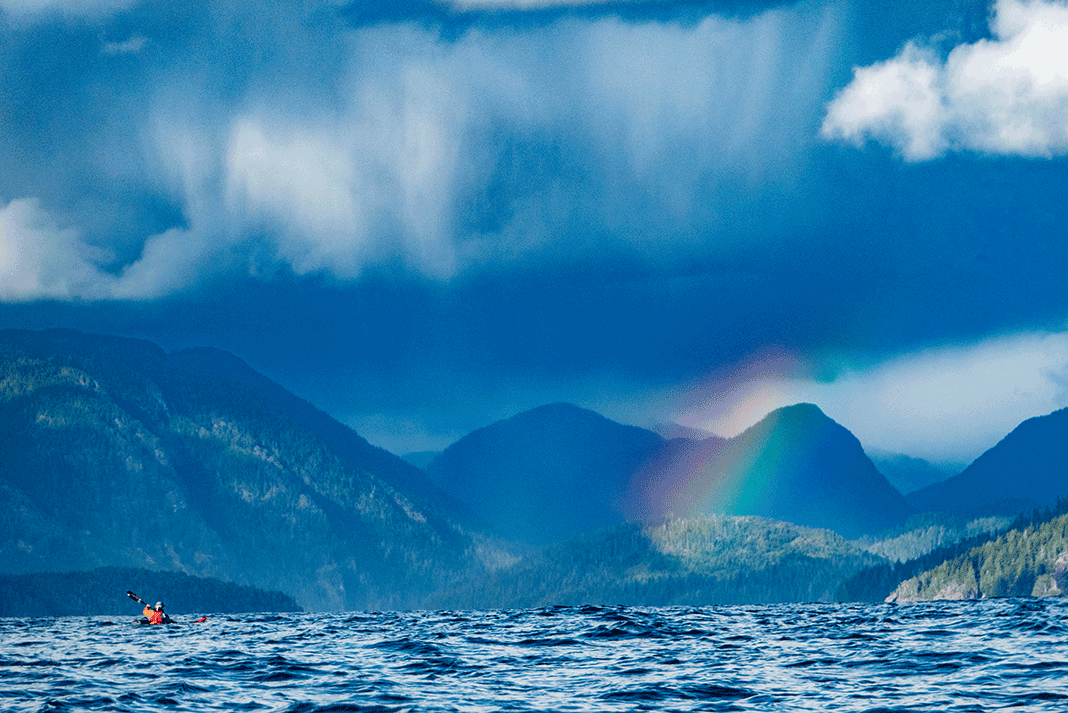
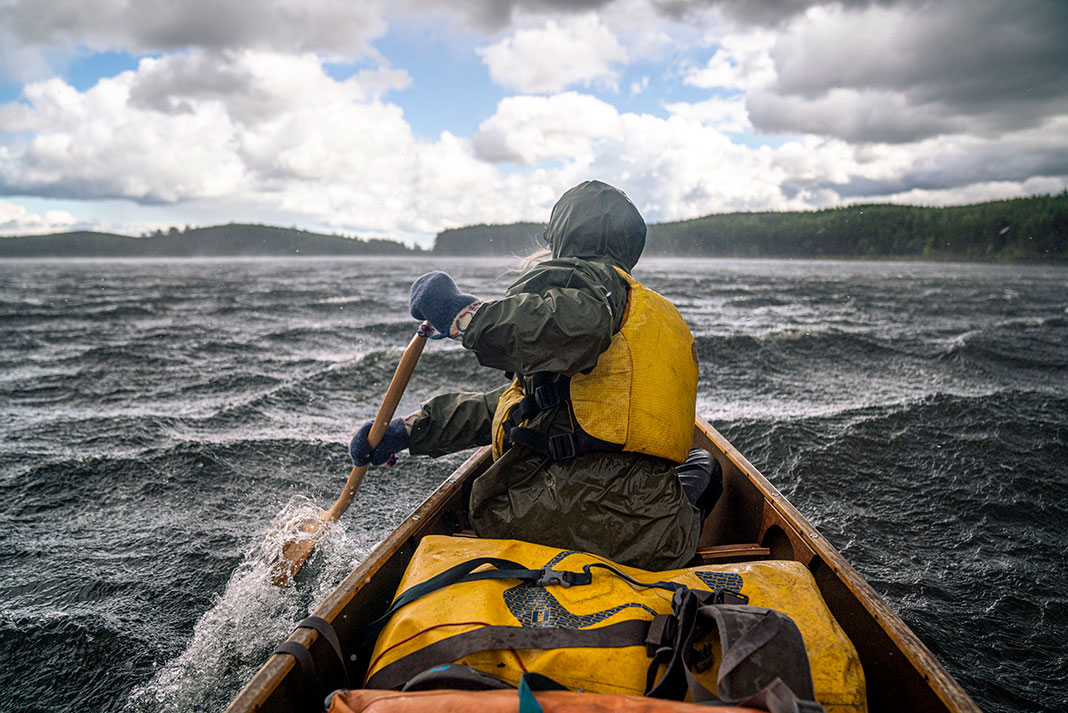
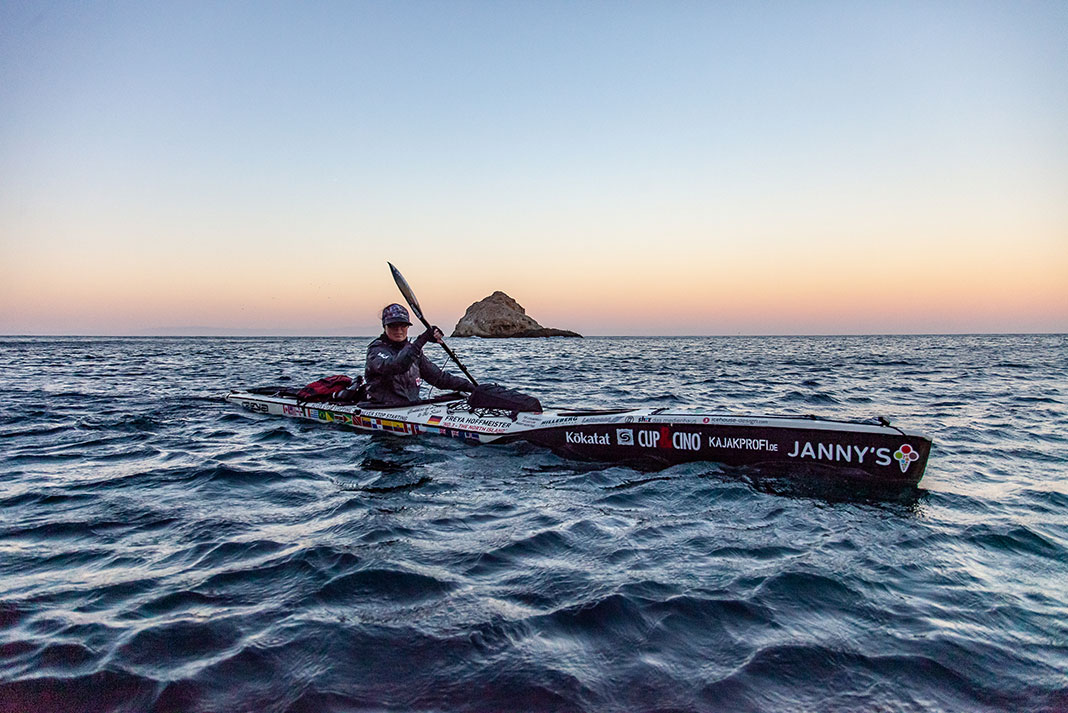
What can run but never walks, has a mouth but never talks, has a head but never weeps, has a bed but never sleeps? | Feature photo: Daniel Stewart
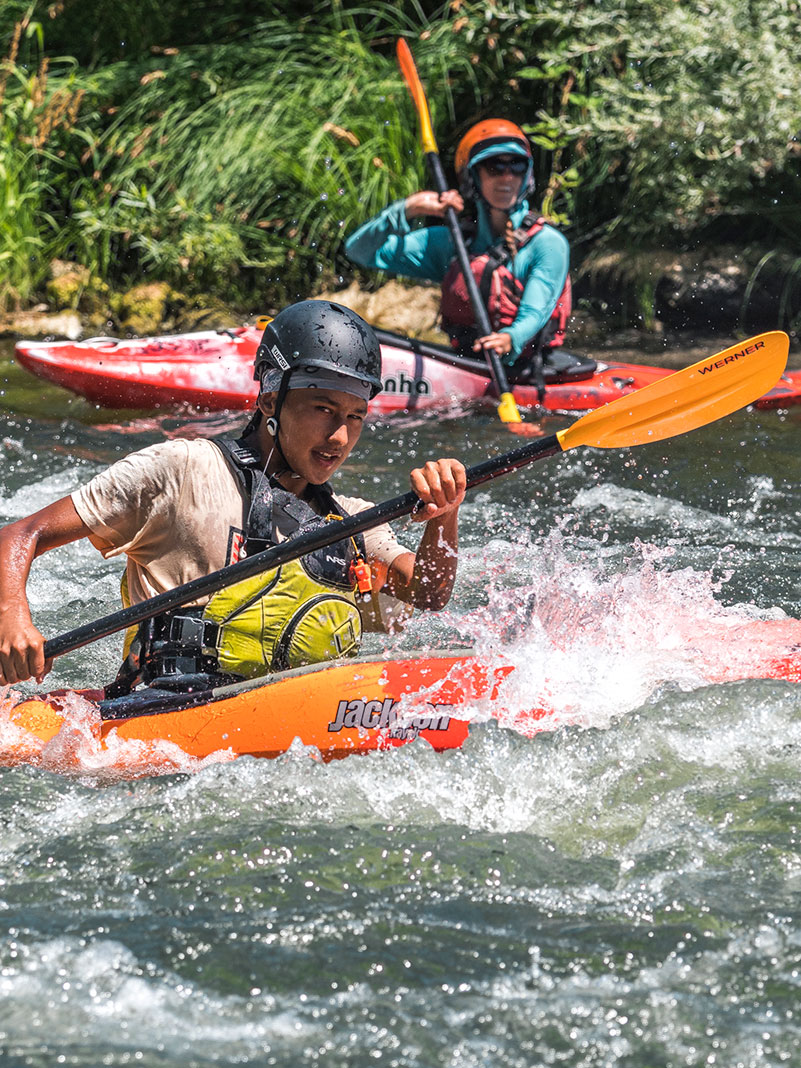
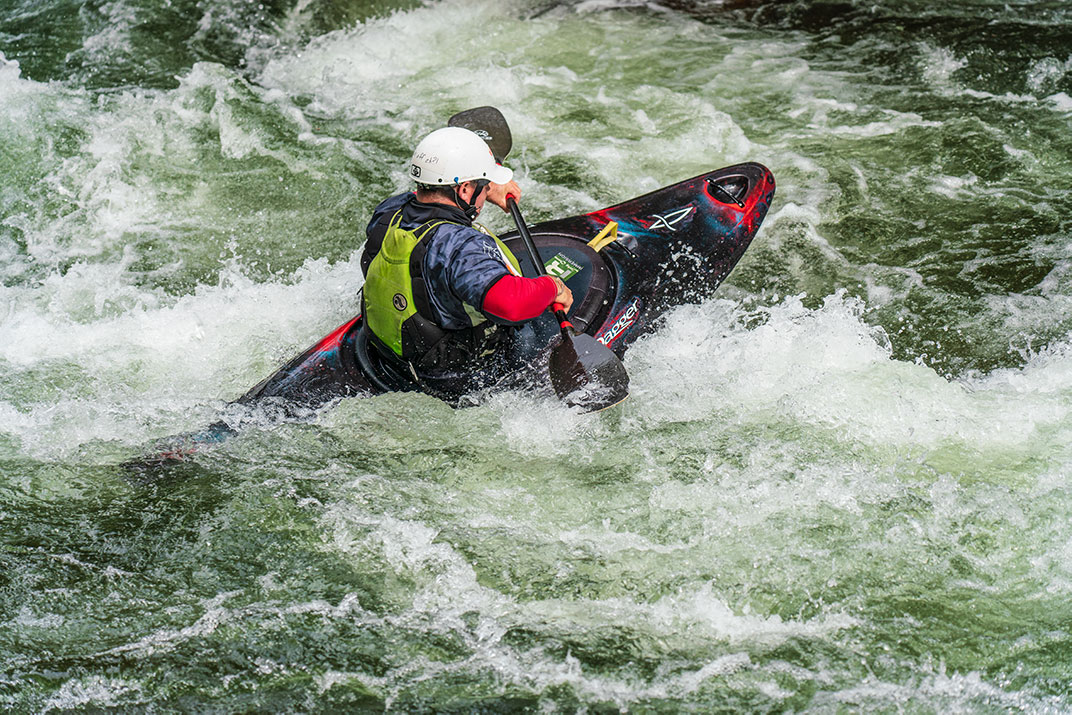
Feeling stressed about nailing that new freestyle trick? Rest assured, no matter your skill level you’re not alone—expert whitewater paddlers still struggle with advanced moves and even some basic ones. But what’s the most difficult trick to master? We quizzed ten pro boaters on the river moves that still make them sweat.
10 pros on the hardest river moves you’ll ever make
“I have been working on the air screw since 2016. I still fall on my face all the time!”
— Brooke Hess
“For me, it was the tricky woo. And then trying to work out how to do it the other way.”
— Ottilie Robinson Shaw
“To pull out and be in the front, paddling your own true lines.”
— Mariann Saether
“It’s a skill to be able to bring the mission together. The remote location, the right gear, a committed and experienced crew, logistics permits and scenario planning and then just stepping over the line.”
— Mike Dawson
“The hardest move is to win over your small ego.
Don’t listen too much to that little bastard.”
“Bad habits can get in the way of any trick. The straight air screw is hard not because the move is hard, but because I have years of a bad habit I naturally go to.”
— Emily Jackson
“In small freestyle features, probably the tricky woo. On waves, it’s doing combos out of the air screw. On waterfalls, probably the cobra flip.”
— Dane Jackson
“The Rush Sturges version of the ear dip. And everything in modern hole boating looks impossible to me.”
— Benny Marr
“Your very first roll. It is at the very start of your kayaking career and there are so many different aspects of this move paddlers need to overcome. Understanding movement in a 360-degree sphere, in a dynamic environment, all the while you take away the ability to breathe. Once you’ve mastered this move, everything else builds upon it.”
“For me, it’s to be patient and let go. If I had to pick the hardest though, it would be the forward stroke. We often take it for granted and believe we know how to paddle forward when it takes constant questioning and readjustment to be as efficient as one can be.”
— Nouria Newman
What can run but never walks, has a mouth but never talks, has a head but never weeps, has a bed but never sleeps? Answer on page 8. | Feature photo: Daniel Stewart
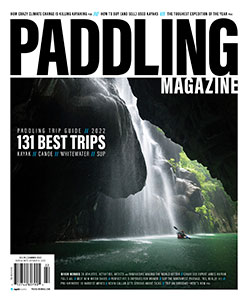
This article was first published in the Summer 2022 issue of Paddling Magazine. Subscribe to Paddling Magazine’s print and digital editions, or browse the archives.
What can run but never walks, has a mouth but never talks, has a head but never weeps, has a bed but never sleeps? Answer on page 8. | Feature photo: Daniel Stewart
Southold, NY (October 19, 2022) – Rapid Media, publisher of Paddling Magazine, Kayak Angler, Paddling Business and the Paddling Film Festival, was recently recognized as a winner of the 2022 National Boating Industry Safety Awards as the Top Marine Media Outlet.
The awards program sponsored by the Sea Tow Foundation, in conjunction with their Boating Safety Advisory Council, recognizes efforts to promote boating safety within the for-profit sector of the boating industry.
Rapid Media received the award via a special online awards ceremony taking place after the cancellation of IBEX 2022 due to Hurricane Ian.
This is the second year Rapid Media has won the top prize in this category, this time for a completely new project, Strategic Search Engine Content Marketing Targeting America’s Highest-Risk, Most Difficult-To-Reach Paddlers.
As a contractor for the Water Sports Foundation, Rapid Media developed the targeted boating safety marketing campaign focused on the highest risk, most difficult-to-reach boaters—new paddlers, many of whom purchase from non-specialty retailers who lack boating safety and educational expertise. Reaching and influencing this most-at-risk audience required “out of the box” thinking. Multiple media platforms were used with impressive results including 5.6 million paddling safety impressions.
“Winning this award is important to us. It’s recognition and appreciation, but really it’s an indicator we’re on the right track, not only for this project but for everything else we’re doing. It reinforces we’re putting our energy into something that really matters,” says Marketing Director Cristin Plaice. “If we want to create a positive cultural shift, we need efforts at every single level. This campaign targets new paddlesports consumers weaving in best practices and safety messaging when and where they are doing their initial research.”
“We received a record number of applications this year, making Rapid Media’s win an exciting accomplishment,” says Gail R. Kulp, executive director of the Sea Tow Foundation. “Rapid Media’s award-winning project is a great example of how for-profit companies can promote boating safety through innovation, creativity and passion.”
For more information about the National Boating Industry Safety Awards and the Sea Tow Foundation’s Boating Safety Advisory Council, visit https://www.boatingsafety.com/.
ABOUT SEA TOW FOUNDATION
The Sea Tow Foundation—a 501(c)(3) nonprofit organization—was started in 2007 by Captain Joe Frohnhoefer, founder of Sea Tow Services International, after he witnessed too many preventable accidents and fatalities on the water. Through its flagship programs which include the Life Jacket Loaner Program, Sober Skipper Campaign, and the National Boating Industry Safety Awards, the Sea Tow Foundation strives toward its vision of a world where boaters are safe and responsible.
NRS founder Bill Parks on the past and present of the half-century-old river supply company. | Feature photo: Courtesy NRS
In the early 1970s, while teaching at the University of Oregon College of Business, I found my somewhat unorthodox management theories were often met with a familiar refrain: “Interesting ideas, but have you ever had to meet a payroll?”
I started NRS in no small part to prove that I could.
What NRS founder Bill Parks has learned after 50 years
I believed then, and believe even more strongly today, that a business that puts people first can not only succeed, but can outperform conventionally operated firms. At that time, the prevailing business wisdom—espoused by economist Milton Friedman and his acolytes—was that a business’ sole responsibility was to generate profits for its shareholders. I respectfully disagreed with that philosophy.
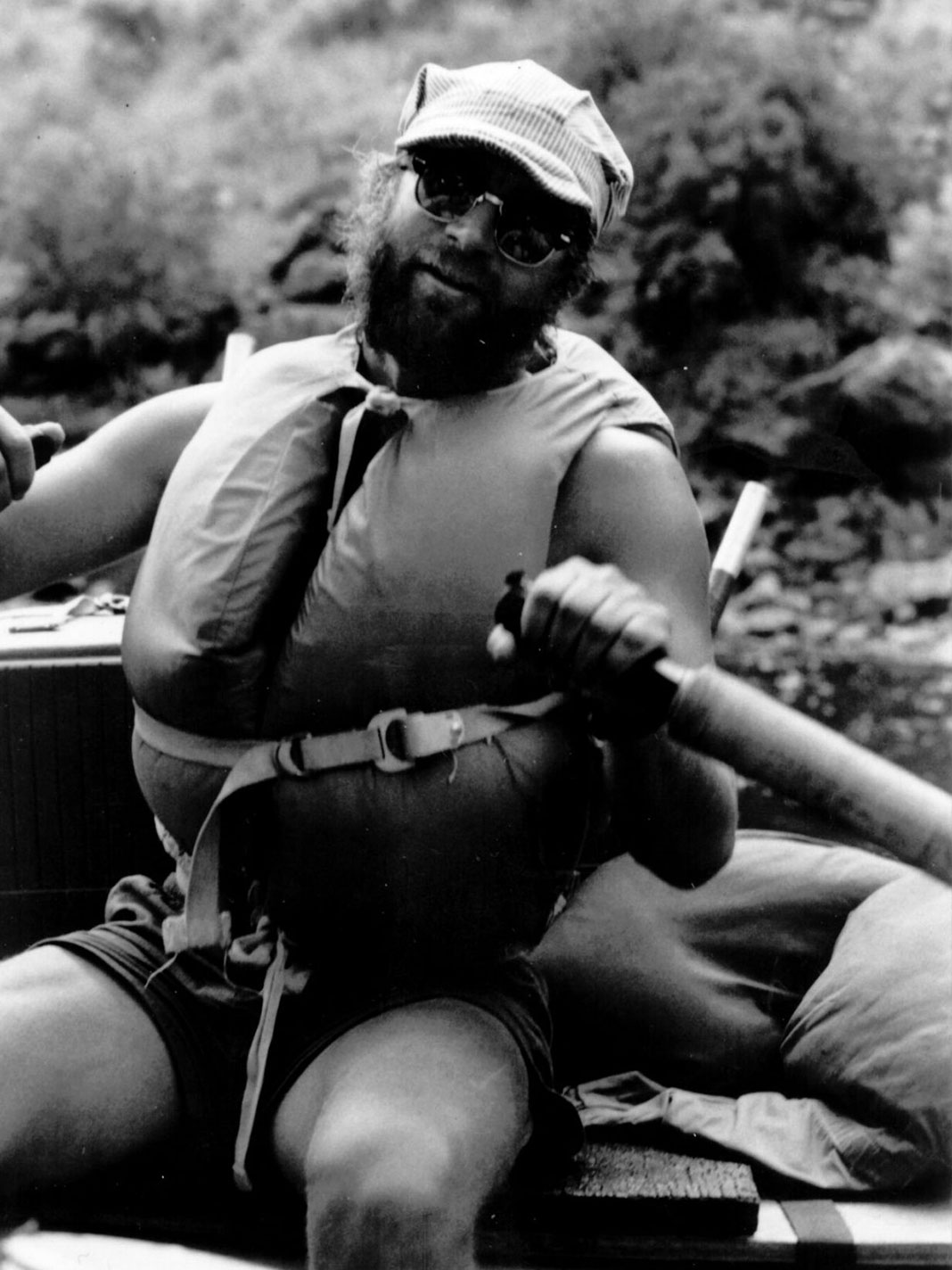
A young Parks manning the oars. | Photo: Courtesy NRS
I believed that financial success would result from positively contributing to people’s lives, including customers, employees, suppliers and other stakeholders. I regarded profit as a means to an end: financial success would help grow the business to generate more value for people, creating loyal, lasting relationships that would, in turn, lead to more success.
[ Paddling Buyer’s Guide: View all products from NRS ]
Keeping the right kind of company
I founded NRS in 1972 with the mantra that I would treat my customers the way I would like to be treated and focus on providing them with outstanding service. As the company grew, I quickly learned that if I wanted to build the kind of company I would like to do business with, it also needed to be the kind of company I would like to work for.
It is difficult for an employee to make customers feel valued if they do not feel valued. I began to focus not only on caring for our customers, but on caring for our employees. I worked to promote a fun, supportive and nurturing workplace culture where people could be themselves, feel secure and develop as individuals. As that culture flourished, the benefits of this approach surprised even me. Valuing employees not just as human resources but as human beings turned out to be our “secret sauce.”
I continued to teach business for 22 years before retiring from the University of Idaho in 1994. Holding down a day job allowed me to reinvest profits in the company (and occasionally loan it money). It also meant that, even though I worked long days and through vacations, I often had to trust employees to manage without me. I learned the hard way that trusting the wrong people could have dire consequences.
However, if I hired talented, trustworthy and hardworking people—and then got out of their way—NRS would basically run itself. It became standard protocol to interview every new hire as though they might someday run the company. It turned out to be a good policy. Today, many of those hires are running the business after staying with us for their entire careers.
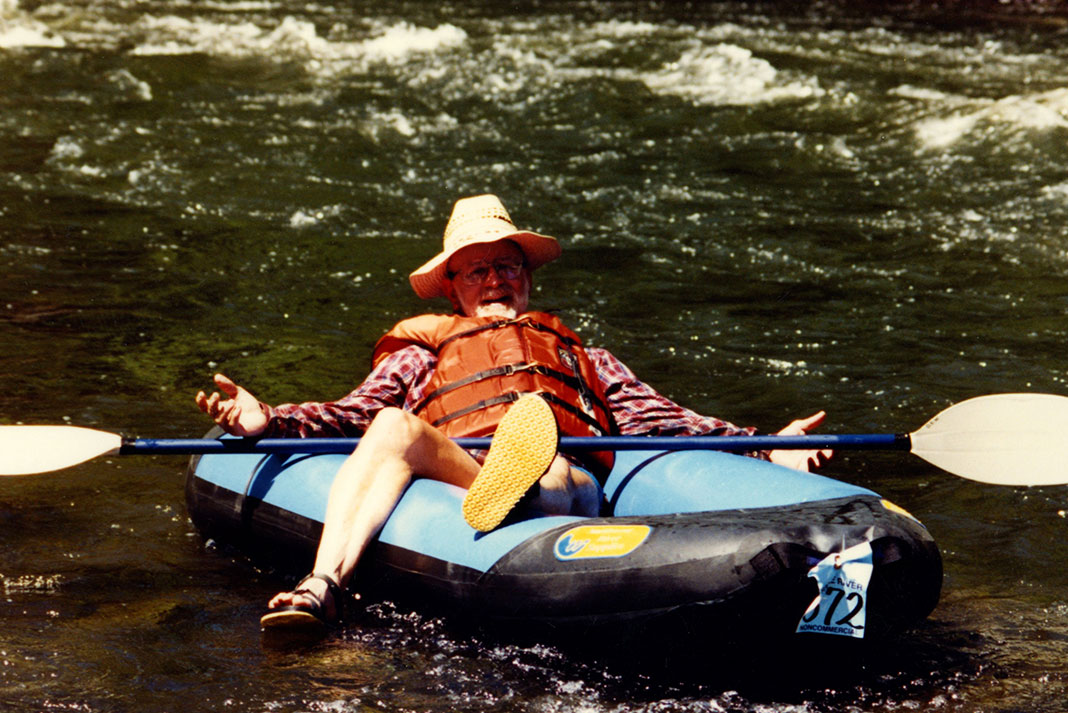
Outside the office, Parks attacks the rapids… | Photo: Courtesy NRS
…and relaxes on the flats. | Photo: Courtesy NRS
A promising, people-driven future for NRS
In 2013, as I neared my 80th birthday, I knew it was time to think about succession. Over the years, I’d had plenty of interest from investors looking to buy NRS, but I didn’t want to see the company and culture we’d built fall to the wayside under ownership that didn’t share our values. I also wanted to share the success we’d had more equitably, so I sold the company to the people most responsible for that success: the employees.
As we celebrate our 50th anniversary, I’m proud to say that NRS is truly led by its people. Thanks to them, I’m still proving the doubters wrong.
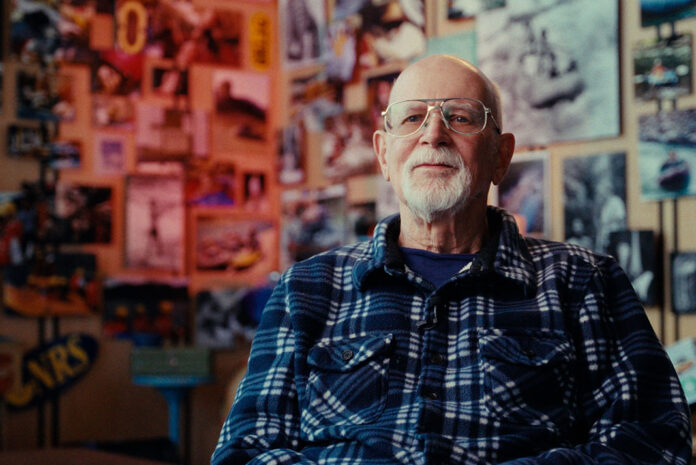
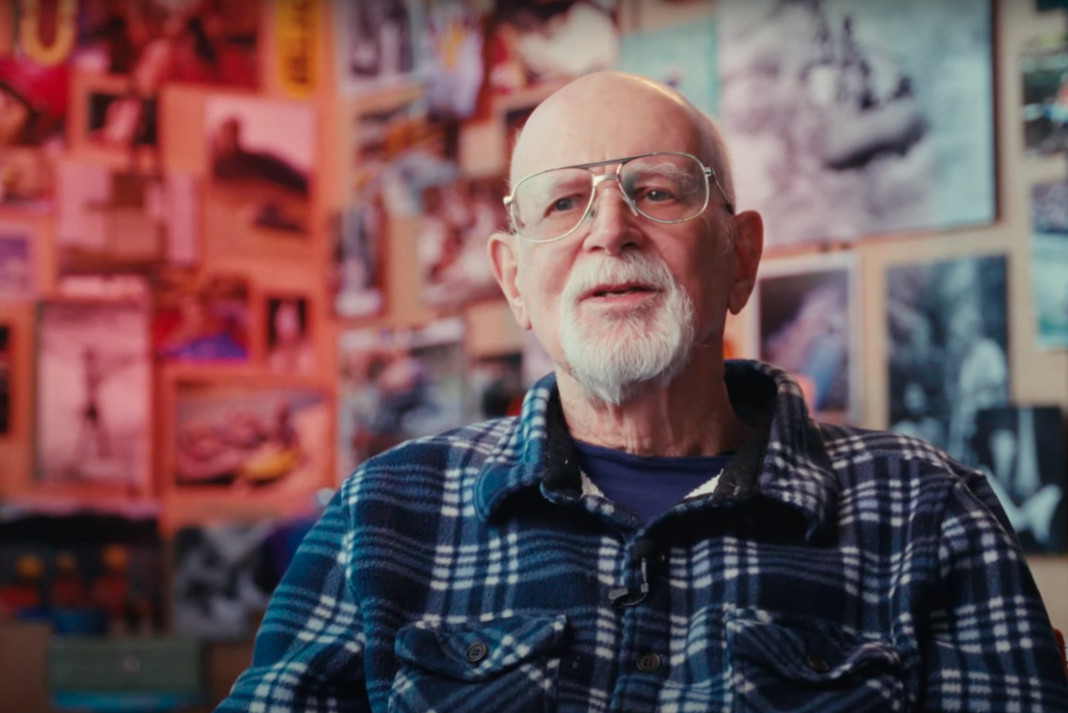
Bill Parks is the founder and president of Northwest River Supplies (NRS), a company based and built from the ground up in Moscow, Idaho. At 88 years old, Bill is still active in the NRS business. Paddling Business is celebrating the 50th anniversary of paddlesports, as we know it, in the annual 2023 Product Guide.
NRS founder Bill Parks on the past and present of the half-century-old river supply company. | Feature photo: Courtesy NRS
Central Texas has a vibrant paddling scene, from urban lakes to rivers and the Gulf Coast. | Feature photo: Courtesy Crescent Kayaks
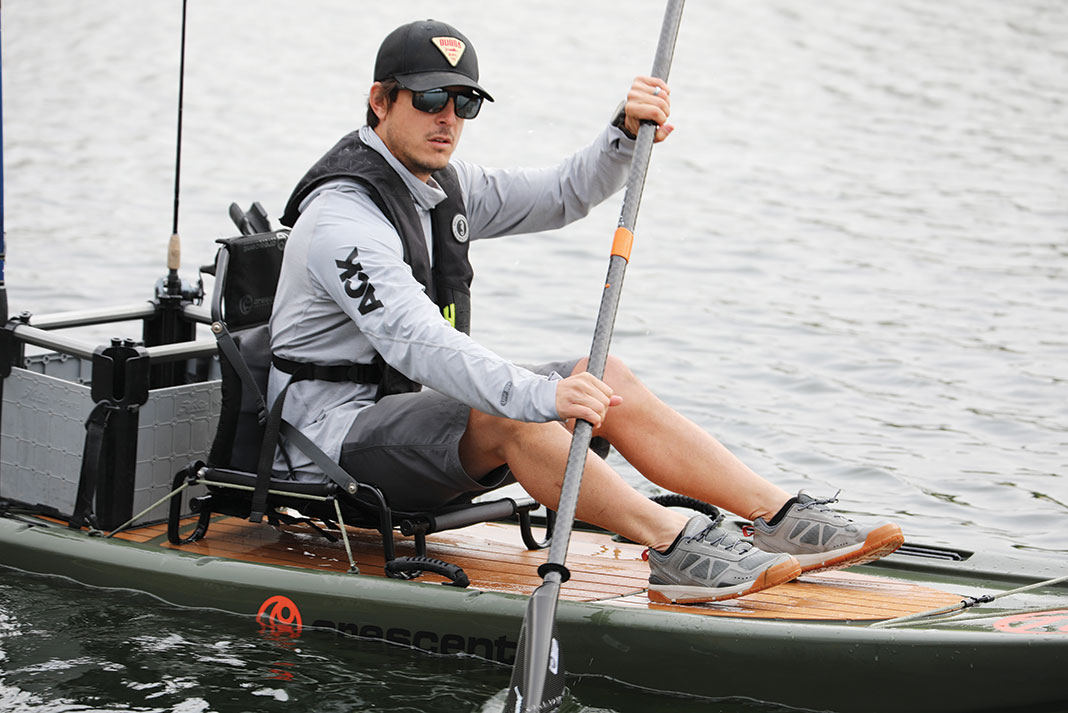
More than half a year has elapsedsince Texas-based retailer Austin Canoe and Kayak abruptly shuttered on New Year’s Eve. Stunningly, the regional powerhouse stretching its e-commerce tentacles from coast to coast collapsed in the midst of a pandemic-fueled paddling boom. Even those inside the industry privy to the warning signs wondered how the once high-flying retailer managed to fail so spectacularly.
Austin Canoe and Kayak had secured an $8.2 million line of credit, but didn’t order any boats during the critical fall 2021. By that time, some manufacturers were refusing to ship new inventory for lack of payment. Still, ACK’s frontline workers and customers were caught unaware when the doors slammed closed. Customers were left with unfilled orders or holding holiday gift cards the retailer sold right up to the end. They weren’t the only ones. While the piles of unpaid invoices are closely guarded, multiple sources confirmed on background that kayak manufacturers also took a hard hit to the pocketbook.
The House, a subsidiary of Camping World, scooped up the remains of ACK’s inventory from five Texas retail stores and four affiliated Summit Sports locations in Michigan, together with intellectual property, lists and web domains. It did not assume any of ACK’s or Summit Sport’s liabilities, leaving both customers and vendors in the cold.
Everything’s big in Texas: Kayak angler Denny Greif finds a bit of structure on the Gulf Coast. | Photo: Matt Murphy
As of August 2022, ACK’s website still redirects to The-House.com, where shoppers will find a mishmash of boats, but none of the frontline Hobie, Native, Old Town or Wilderness Systems products that once flew out of the ACK warehouse. Former customer Cesar Miranda put it best on social media: “What happened with ACK? I was going to buy some stuff and it looked like I was on Alibaba.”
It was a stunning fall from grace for ACK. In little more than a decade, it had grown from a single storefront to a regional powerhouse with national e-commerce reach. Since its founding by brothers Steve and Peter Messana in 2005, ACK had seen its fortunes rise with the growing popularity of kayak fishing.
Austin Canoe and Kayak cracked the code of 21st century specialty retail, combining brick-and-mortar specialty knowledge with the reach and efficiencies of e-commerce.
The company owed much of its success to grassroots marketing and a robust events schedule. But the real secret sauce was shipping rates no competitors could match. From that foundation ACK carved out market share nationwide, using a strategy of low margins and massive volume to build an e-commerce paddlesports empire.
Back to the glory days
It wasn’t all about price in those days, says former ACK General Manager Juan Carlos Andreu. He joined the company during its heyday, when its 46,000-square-foot warehouse was full of boats, coming and going. Andreu says the Messana brothers cultivated a company culture in which customer service was a priority, and that drove loyalty.
“They treated the customers right,” Andreu says.
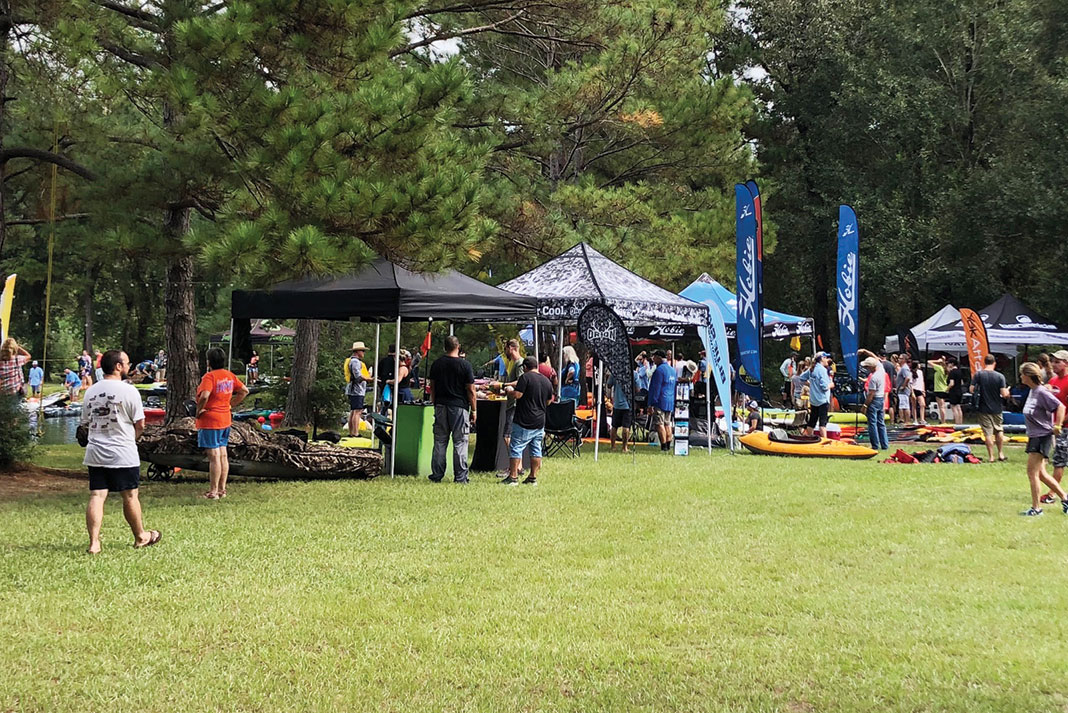
The strategy included a robust schedule of demos and support for the local paddling community through the Kayak Angler’s Tournament Series—a forerunner of today’s kayak bass fishing tournament trails. ACK supported the series for 15 years, knowing the substantial investment would be returned in goodwill and a bigger customer base. In those years, ACK’s demo days were legendary paddlesports festivals with live music and wall-to-wall vendors.
“We’d have 250, 300 people show up on a weekend,” Andreu says. “It was a way of exposing newcomers to the sport and a service to the community.”
Even as ACK’s retail footprint grew to five stores throughout Central Texas, online sales became an increasingly important bedrock of the business.
Online sales eventually accounted for more than 40 percent of total revenue. The company’s online business took off after the Messana brothers offered free or low-cost shipping on kayaks nationwide. The formula worked thanks to a combination of low overhead, volume orders from manufacturers and sweetheart shipping deals—and it came about by accident, Steve Messana told Paddling Business in a January 2022 story breaking the news of the company’s closure.
Former ACK general manager Juan Carlos Andreu testing product. | Photo: Courtesy Crescent Kayaks
Demos like this one helped fuel ACK’s rise. | Photo: @RexDelRey
When they launched the ACK website in 2005 the brothers didn’t think anyone would want to order kayaks online, so they offered a nominal shipping fee of just $75. “We literally made that number up,” Messana said, even though the true cost ranged to several hundred dollars per kayak. As the order volume ramped up ACK was barely breaking even. The breakthrough came when the brothers negotiated a discount deal with Estes Express Lines to ship boats on top of the other freight loaded on the shipper’s trucks. The arrangement reduced ACK’s freight costs enough that it could eventually offer kayak shipping at no cost to the consumer. The company was eating as much as $150 to $170 in shipping costs for every sale, and making up the lost revenue per sale on volume.
Covid changed the calculus.
As difficulties reverberated through the supply chain, shipping costs to the customer escalated. ACK was forced to charge for kayak shipping. By 2021, ACK was charging $199 to ship a kayak.
Appomattox River Company competed directly with ACK throughout its rise and fall. Founded by Bob Taylor in 1977, the Virginia-based company has boasted as many as 2,000 paddlecraft in its diverse and sizable inventory, according to current General Manager Brian Vincent. I caught up with him as he was helping his crew unload a couple of trucks full of new Hobies. The day we talked, he had about 1,400 boats in his warehouse, making him a big player in the specialty retail market. Although, everything is relative; he’s no big box retailer such as REI, L.L. Bean or Bass Pro Shops.
Vincent holds a dim view of subsidizing freight for boats. And always has.
“Everybody loses on that,” he says. “Kayak business margins aren’t normal margins, they are a little smaller.”
Vincent is blunt when it comes to the competitive strategy ACK employed to drive volume. “They pursued market share in a way that was not sustainable,” he says.
Even before ACK shut down, Vincent says Appomattox had shifted its boat pricing strategy. “With Covid on the radar, we took the opportunity to reacclimate customers to the true cost of freight. It was a conscious effort. I decided I didn’t care about market share as much as making good money and paying my employees well. We started holding tight to that stuff really early. They didn’t.”
Subsidizing shipping was the old game. Now, the paradigm has shifted, even for e-commerce.
Don’t follow me. I am the peddler of road not taken. So if u get lost, don’t just blame me. —Mary Elis Gansalves | Photo: Courtesy Johnson Outdoors
The new game is who is best at being a qualified resource for paddlers. Retailers, Vincent says, have to convert what customers love about brick-and-mortar shops into the digital space. Digital storefronts should offer the same atmosphere as a physical shop. They should be rich in critical and authentic know-how and offer the same excellent customer service as brick-and-mortar.
“If you can’t do that you won’t be successful,” Vincent says.
Toward the end, ACK was selling inventory they couldn’t deliver, Vincent says. Appomattox saw the pandemic supply issues coming and was well prepared with boats in hand—thanks in no small part to supplier relationships nurtured for years.
“My father-in-law who started the business will say that’s what happens when you pay your bills on time,” says Vincent. He won’t sell a boat until it’s in his warehouse. When trucks come in, his staff fires off emails to waiting customers.
“It’s like the Wild West in a way,” Vincent says. “The first one to the spot gets the boat.”
Private equity plays destabilizing role
No examination of Austin Canoe and Kayak’s ultimate failure can be divorced from its January 2016 merger with Summit Sports, a Michigan-based snowsports retailer boasting a significant e-commerce presence. To the private equity investors who backed the merger, the companies looked like two peas in a pod.
ACK had seemingly cracked the code of 21st century specialty retail, combining brick-and-mortar specialty knowledge with the reach and efficiencies of e-commerce. Except instead of replicating the ACK success in a complementary new market, the Summit Sports partnership did the opposite. Accounting, marketing and buying for the combined companies were all handled in Michigan and seemingly by people who’d come up in snowsports, or worse, had no outdoor industry experience.
It was a culture clash from the start. It took only two years for the Messana brothers to depart. Andreu stayed to the bitter end. He hoped his passion—he’s an avid kayak angler—might make a difference in the ultimate outcome for the retail brand. It was a forlorn hope.
“A lot of people say this type of merger is a recipe for disaster,” Andreu says.
Snowsports are very different from paddlesports when it comes to seasonality, product sourcing and vendor relations. At Summit, interacting with vendors and customers was merely transactional. Andreu says this was a tremendous problem.
As Andreu sees it, kayak fishing is still in its infancy. The sales categories are moving so quickly it’s critical to understand the mindset and wishes of the customers. It’s technical, it’s niche, with an extremely engaged community sensitive to authenticity.
“The consumer can tell who is a friend and who is a foe,” Andreu says. “It seemed they [Summit] looked down on paddlesports.”
Bottom line? For Austin Canoe and Kayak and Summit, selling to private equity was a fatal mistake. Andreu says the legacy ACK management tried to defend the special sauce that built the previously independent company’s success. Private equity was looking to squeeze out every last drop.
Brian Vincent of Appomattox sees it that way too.
“Private equity does what private equity does,” Vincent says. “It works for people in that business, but it doesn’t always work out for the companies they acquire. It’s a shame too.”
Vincent is glad to see the days of digging into the bottom line to compete on shipping are gone, at least for now. He counts it as a plus for the paddlesports industry. Still, it’s never good when outsiders run a paddlesports business into the ground, especially one with the stature of ACK in its prime. People get hurt: customers, employees, vendors. People like Andreu, who has gone on to found the new fishing lifestyle apparel brand, Chanoc.
“I have tremendous respect for Carlos, I love that guy,” Vincent says. “It’s a bummer to see guys like that have their talents wasted. The people controlling the levers at the top weren’t doing their due diligence.”
That’s a cautionary note to those who are sure they know better. In enthusiast-driven paddlesports, there’s no substitute for authentic grassroots knowledge.
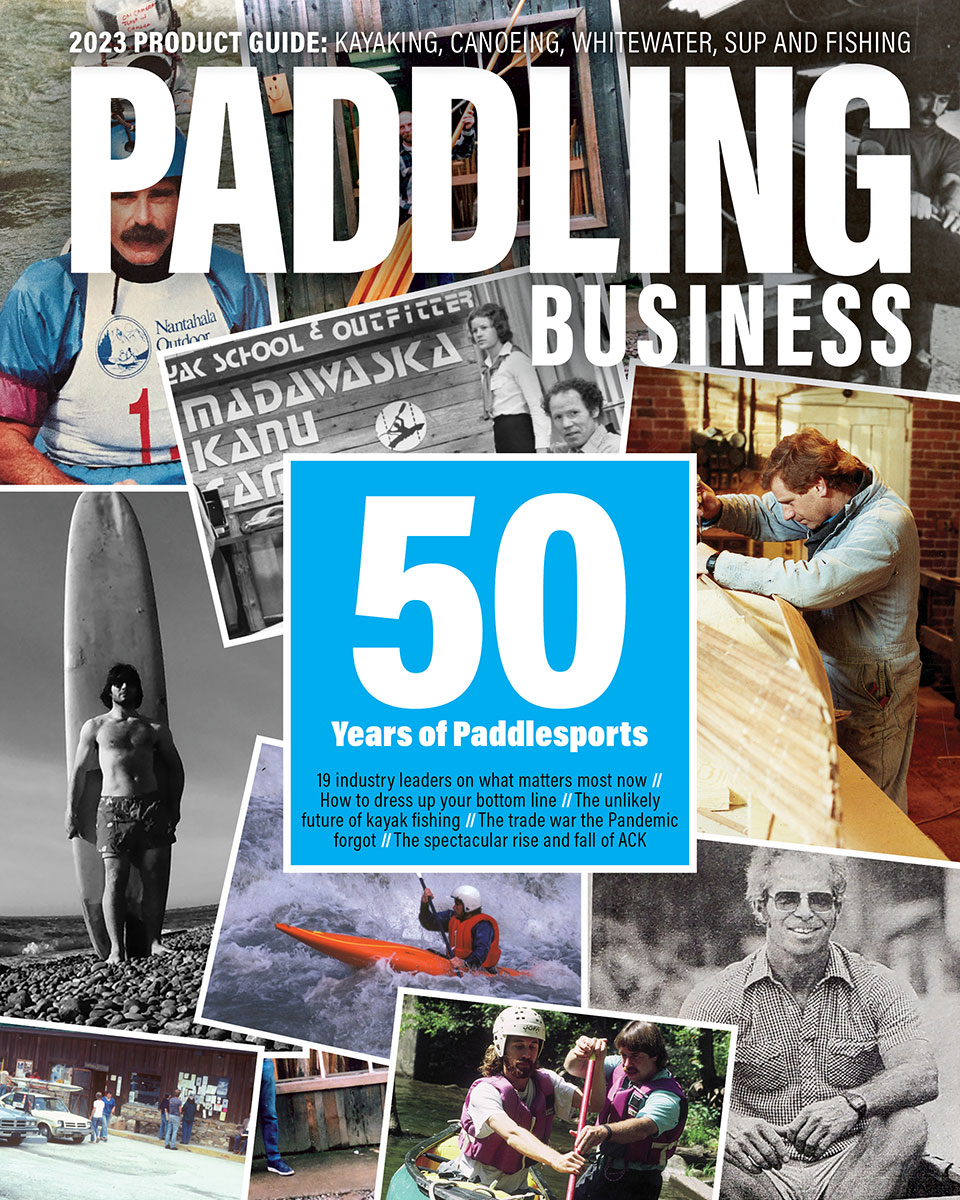
This article was first published in the 2023 issue of Paddling Business. Inside you’ll find the year’s hottest gear for canoeing, kayaking, whitewater and paddleboarding. Plus: Industry leaders on the post-pandemic landscape, 50 years of paddlesports, the rise and fall of ACK and more. READ IT NOW »
Central Texas has a vibrant paddling scene, from urban lakes to rivers and the Gulf Coast. | Feature photo: Courtesy Crescent Kayaks
Karl Kruger, seen here training, will travel with 75 pounds of gear strapped to his 29-pound board. | Feature photo: Liv von Oelreich
This summer, Karl Kruger drove north until he ran out of road at Tuktoyaktuk, a tiny hamlet at the edge of the Arctic Ocean. With his windshield framing a view of the Beaufort Sea and an 18-foot SUP on his roof, he likely found it to be a familiar feeling.
He was here before, after all. Kruger made the same drive in 2019, planning to paddle 1,900 miles east through the Northwest Passage. But he aborted before setting out due to what he calls “unfinished psychological business.”
In short, his professional and personal life were in disarray. Kruger doesn’t paddle to get away from things; he paddles to get closer to things—nature, mostly, and maybe himself—so he turned around and waited until he was ready.
Karl Kruger attempts to paddleboard the Northwest Passage
Kruger has spent the last two years preparing, which meant clearing the mental decks by finalizing a divorce and temporarily shutting down his construction business. His preparation was less about what he would take on his trip and more about what he wouldn’t take.
You could say he’s traveling light, both psychologically and provisionally, especially when put in a historical context.
Karl Kruger, seen here training, will travel with 75 pounds of gear strapped to his 29-pound board. | Feature photo: Liv von Oelreich
In the 15th century, European explorers first started poking around Canada’s Arctic archipelago, looking for a way to Asia. The effort saw its nadir in 1849 when Sir John Franklin set off with 128 men aboard two 105-foot ships. The battle-tested ships were laden with, among other things, 8,000 tins of preserved food, 7,000 pounds of tobacco, 3,000 books, mahogany writing desks, engraved silverware and one pet monkey.
Compare to Kruger, with 75 pounds of gear strapped to his 29-pound board.
Franklin and his men all perished. Kruger likes his odds.
“I believe the less surface area you present for nature to work against, the better off you are,” says Kruger.
“Light equals fast,” says the former mountain guide. Kruger will use the light and fast alpine ethos in place of the siege mentality employed so stubbornly by the many multi-year expeditions conducted by the British Navy in the 19th century.
“I can exploit small leads in the ice and pull out onto the beach or ice very easily,” says Kruger. And pulling over is just what he plans to do.
Though his two-week effort in the 750-mile Race to Alaska up the Inside Passage in 2017 convinced Kruger he can sustain a pace of about 50 miles a day, he’s not out to set a speed record.
Photo: Suzanne Rothmeyer
“I enjoy paddling, and also really enjoy pulling up on the beach and getting to know a place. When I finished the Alaska race, I asked, ‘Where can I go deeper, longer?’ I mentally roved the planet thinking about long stretches of water that would allow me to find solitude and wild places to explore. When the idea of the Northwest Passage came to me, it was like a lightning bolt,” says Kruger.
Regardless of his pace, Kruger knows he will need to stop paddling the first week of September. That’s about when the British Navy men would find a harbor to settle in for long winters stuck in the ice. Kruger, with only a SUP to worry about, will be unencumbered enough to make a quick getaway.
A brief history of non-motorized attempts to cross the Northwest Passage
Whether seeking riches, fame, or both, explorers have been attempting a route along the top of mainland Canada for centuries.
The Inuit didn’t employ archivists like the Hudson Bay Company of the 19th century nor publicists like the expeditions of the 21st, so it’s difficult to pinpoint early achievements.
The first known notable success was Peter Warren Dease and Thomas Simpson, two HBC men who led a 12-man, three-year trip by oar and sail. Overwintering inland between 1836-1839, they confirmed the navigable channel along the mainland between the Mackenzie River Delta in the west and the Boothia Peninsula base in the east (1,243 miles distant).
The first successful passage from the Atlantic to the Pacific through the Northwest Passage was by Norwegian Roald Amundsen between 1903-1906 aboard the 70-foot sloop named Gjoa, powered by sail and a 13-horsepower paraffin engine. Once conquered, the passage was viewed as a dead end, promising few riches to anyone. Whatever fame was available would have to be earned by pulling oneself by paddle.
Notable expeditions
1989–1992 Over four years, Haans Memminger paddled and sledged his kayak from Greenland to the Boothia Peninsula, traversing roughly the eastern half of the route.
1990–1993 Don Starkell and Victoria Jason, both from Manitoba—which was where they started paddling, so full points for ambition—set out together to kayak the passage. They didn’t finish it together, but over the next four years both completed it. Starkell lost a few fingers and toes to frostbite during the effort.
1993 Paddling Magazine contributor Philip Torrens was 186 miles into his west-east passage when a polar bear attack convinced him to head back south.
1995 Kayaker Martin Leonard’s route from Tuktoyuktuk to Hudson Bay included a 72-km (45-mile) portage.
1997–1999 Jonathan Waterman didn’t just paddle, sail and ski the 2,200-mile route; he produced a stellar travel journal in the book Arctic Crossing.
2007 French sailor Sébastien Roubinet and one other crew member left Anchorage, Alaska, in Babouche, a 25-foot ice catamaran designed to sail on water and slide over ice. Following a four-month journey of 4,500 miles, Roubinet reached Greenland, completing the first Northwest Passage voyage made in one season without engine.
2010–2011 Mathieu Bonnier rowed solo from Greenland to Resolute the first summer, and then from Resolute to King William Island in 2011.
2013 Sebastien Lapierre and Olivier Giasson pushed a tandem sea kayak from Tuktoyaktuk to Gjoa Haven in just 60 days, but eventually ran into ice.
2022 Karl Kruger will have company on the passage this summer. Two other teams are attempting to paddle from Pond Inlet on Baffin Island west to the Beaufort Sea. The self-styled Arctic Cowboys trio led by adventurer West Hansen will be wrangling kayaks and attempting to become the first kayakers to paddle it in a single season. Meanwhile, a crew of 16 will cram into two 44-foot rowboats to attempt the route. Kruger can try waving but shouldn’t expect a shore lunch with the shift-work rowers. They don’t plan to stop.
This article was first published in the Summer 2022 issue of Paddling Magazine. Subscribe to Paddling Magazine’s print and digital editions, or browse the archives.
Karl Kruger, seen here training, will travel with 75 pounds of gear strapped to his 29-pound board. | Feature photo: Liv von Oelreich
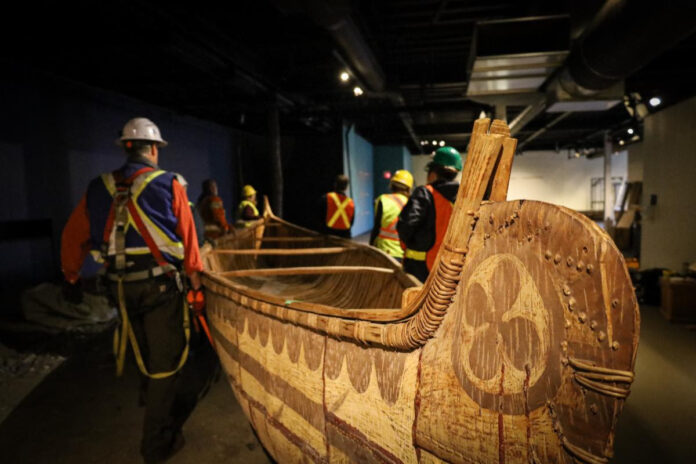
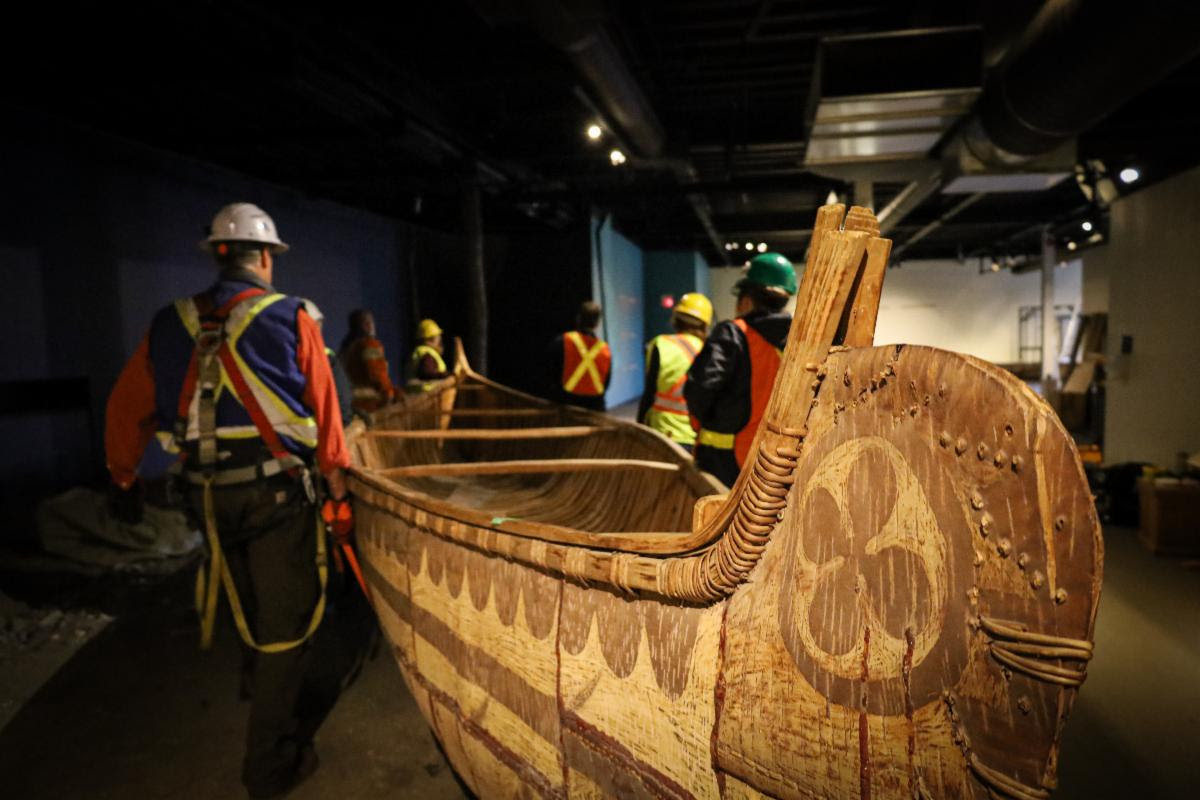
Feature Image: Making the "Big Lift" of one of the Canadian Canoe Museum's 600 boats to be transported to their new location. Image Canadian Canoe Museum
A grand portage is underway at the Canadian Canoe Museum in Ontario. Since the museum’s beginning in 1997, the growing collection of floating watercraft has made its home in a former outboard motor factory within the town of Peterborough. Now, after years of planning, the Canadian Canoe Museum is beginning to haul the world’s most extensive canoe collection with over 600 crafts across town to a new location most befitting on the eastern edge of Little Lake along the Otonabee River in a campaign called, “Move the Collection.”
The Canadian Canoe Museum recently completed its first, “Big Lift,” removing a 450-pound replica of a fur trade-era Montreal canoe. Within the months ahead, the museum will be preparing and beginning to move every craft plus 500 paddles, among other items, to the site on Little Lake.
Making the “Big Lift” of one of the Canadian Canoe Museum’s 600 boats to be transported to their new location. | Feature photo: Courtesy Canadian Canoe Museum
The Canadian Canoe Museum’s big move
“The move to the water is transformational,” shares Executive Director Carolyn Hyslop, who has led the museum since 2016.
The new home of the Canadian Canoe Museum will provide enough space to display the entirety of its collection to the public, who previously only saw 20 percent of the watercraft and paddling artifacts warehoused. This includes ancient dugouts, and centuries-old birch bark canoes, which Hyslop admires for the Indigenous craftsmanship making use of surrounding resources to produce designs of near perfection. Peterborough itself sits within the traditional territory of the Williams Treaties First Nations.
The new building also provides museum-purpose conditions, with the ability to regulate temperature and humidity.
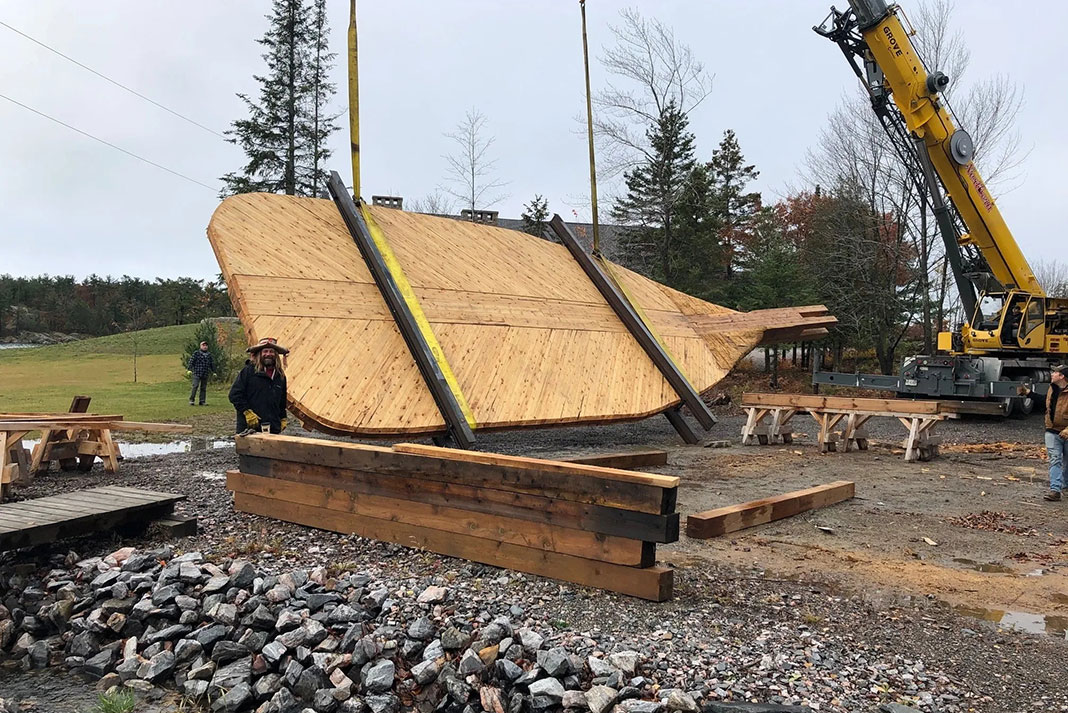
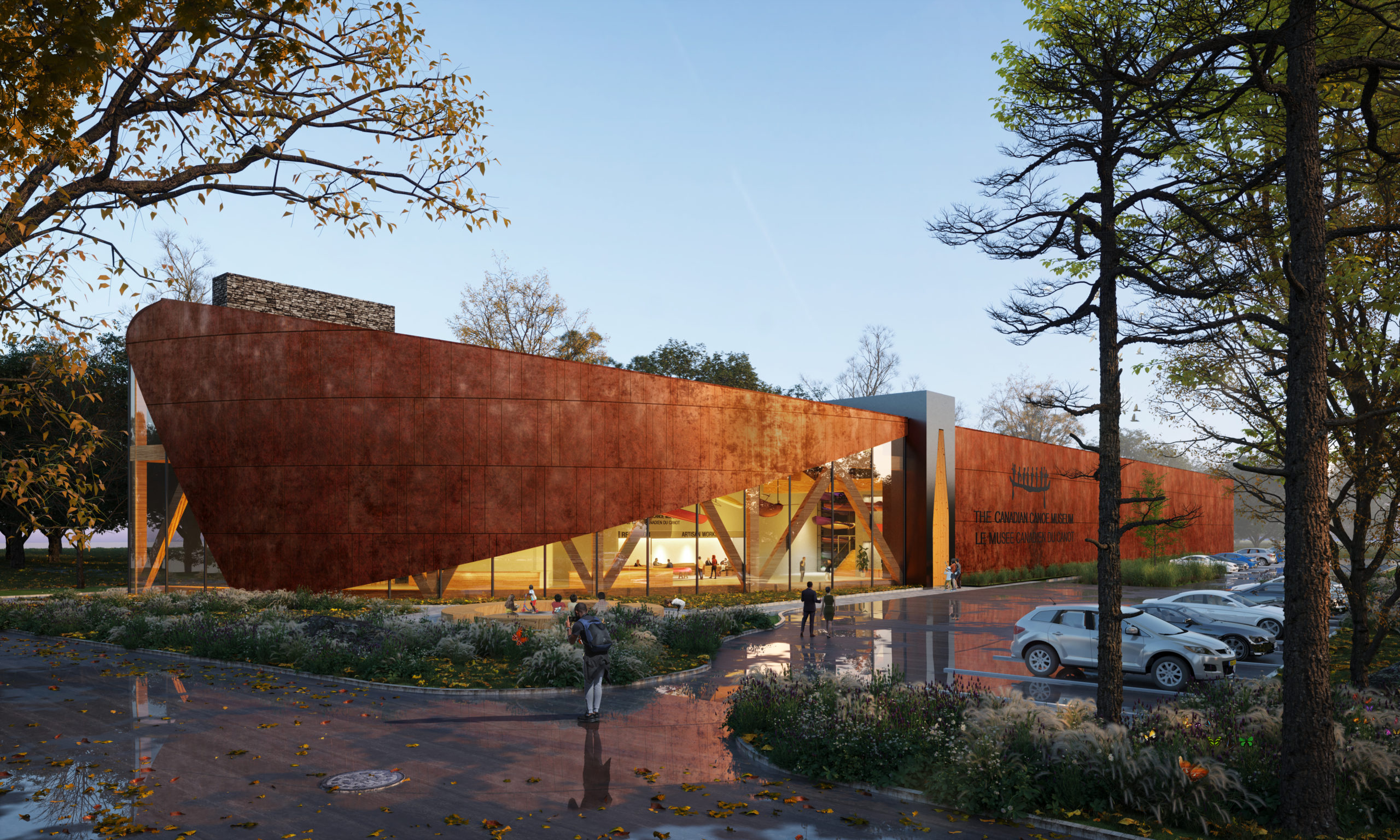
The new Canadian Canoe Museum’s unique curved façade and use of weathered steel make for an impressive view from the street. | Photo: Courtesy Canadian Canoe Museum
For Hyslop, perhaps the most significant direct benefit to visitors of the new museum will be the setting on the shore of Little Lake. This will allow the Canadian Canoe Museum to expand its programs taking place on the water and adjacent land. Bridging visitors to the paddling artifacts through more participatory experiences.
“We will be able not just to immerse people in the collection but directly to the outdoors,” Hyslop adds.
To do so, Hyslop and the museum must first undergo the task of transporting 600 canoes across town. This includes watercraft over 53 feet long and weighing 1,000 pounds. You may have the same idea we do of making a trek to Ontario, rolling up our flannel sleeves and hoisting boats overhead to form a two-mile-long portage party. But as artifacts, each canoe is assessed individually for its proper packaging and transporting needs.
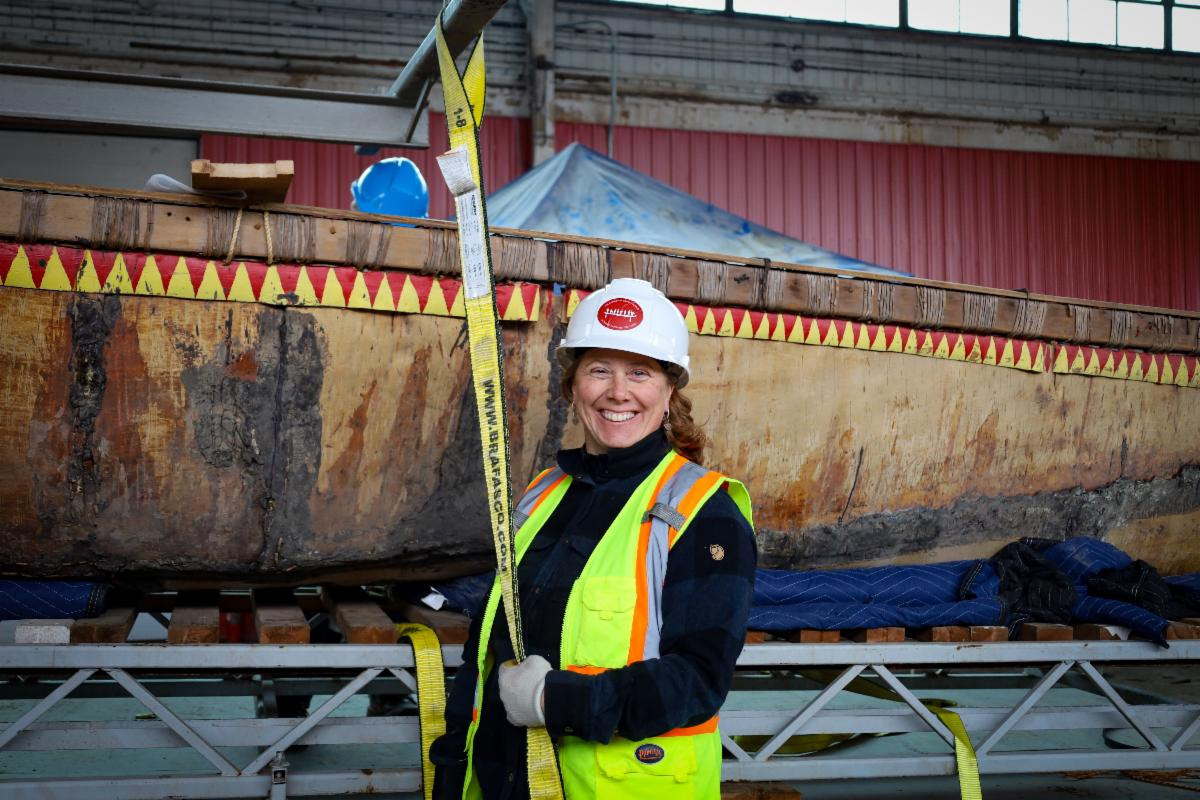
Canadian Canoe Museum Executive Director Carolyn Hyslop. | Photo: Courtesy Canadian Canoe Museum
The first Big Lift of the 450-pound canoe from the soon-to-be former museum site required a crane, as others will. Every boat too big to get through the front doors of the canoe museum has to be hoisted out of a second-story hatch of the old outboard motor factory. That’s how the fur trade-era canoe entered the building 22 years ago and recently made its exit.
“It’s a place of story. Canoes and kayaks connect us to heritage, art and language.”
A team of movers hoisted the canoe by pulley at three points for even distribution. Then placed a cart and set of tracks under it. This allowed them to push it outside the second story onto an aptly named “shuttle” on a set of scaffolding.
The crane lowered the canoe shuttle from the scaffolding onto a trailer which was then towed to a storage facility for documentation and temporary holding until the new museum is ready to receive the canoes.
The immeasurable value of a place of story
Moving the collection is a time-consuming and costly endeavor within the opening of the new location. The Canadian Canoe Museum has raised 95 percent of the overall museum project’s $40 million funding goal. At this point, Hyslop implores that the most significant contribution the paddling community can provide to Move the Collection are donations to help them reach the project’s financial milestone and secure the new museum opening for future generations of paddlers to visit.
To Hyslop, the Canadian Canoe Museum serves as a unique place of value to the past, present and future of not just canoeing but the culture surrounding it.
“It’s a place of story,” Hyslop says. “Canoes and kayaks connect us to heritage, art and language. Through the collection, we strive to be a platform for voices and stories to be shared from Indigenous communities. And it provides a place of finding community.”
According to the Canadian Canoe Museum collection preparations have been ongoing since last summer and now increasing substantially. In the next three months, the museum team will begin moving the collection to the new museum.
Making the “Big Lift” of one of the Canadian Canoe Museum’s 600 boats to be transported to their new location. | Feature photo: Courtesy Canadian Canoe Museum
Approximately 10 percent of Iceland is covered in glaciers. The opportunity to paddle where these glaciers meet the sea and icebergs litter the bays is one few paddlers would pass up. In this video in partnership with NRS, a group of instructors from Online Sea Kayaking give us a 360-degree view of the experience of paddling Iceland’s glacial bays.
[ Take a glacial cruise of your own with help from the Paddling Trip Guide ]
The video is just a clip from Online Sea Kayaking’s longer documentary called Sleeping Giants, following their trip to the island where fire and ice meet, making for one of the world’s most impressive paddling destinations.
All smiles at Outdoor Afro’s 2021 Paddle Camp. Photo: Jameson Redding // Courtesy: NRS and Outdoor Afro
From entrepreneurs and explorers to game changers and artists, the wide world of paddlesports is enriched by those who see a need and step up to fill it. Whether welcoming underserved communities, mentoring new paddlers or protecting waterways at risk, here’s who (and what) is changing paddling for the better this year.
Connecting Indigenous youth with heritage and traditional skills via river trips
For the Shoshone-Bannock Tribes, the Middle Fork of the Salmon River has been home since time immemorial. Its people remain inextricably linked with the waters even after a history of forced removal from the land. Through River Newe, cofounders Jessica and Sammy Matsaw reintroduce Indigenous youth to the river on free rafting trips, promoting traditional Shoshone-Bannock knowledge.
The Matsaw family on a river expedition while filming the documentary River of Return. | Photo: Skip Armstrong
“My greatest hopes are to take more of our tribal youth down the river… I just know the river would change their lives,” said Jessica Matsaw in River Of Return, a documentary by Skip Armstrong.
River Newe interweaves past generations’ teaching with the present. In 2022, “we are continuing to expand on what we offer to tribal youth. This past spring, we hosted a salmon spear making class. Tying hooks has many perspectives on how to do it and how those get mounted to spears. The class was a great success.”
Event series with a mission to get underrepresented paddlers on the water
After the success in its inaugural year in 2020 with two free community events in northern Colorado, Diversify Whitewater went national. Dedicated to introducing more Black and Indigenous folks and people of color to whitewater kayaking and rafting, this year Diversify Whitewater is holding 13 events in nine states.
Diversify Whitewater’s third annual community river float. Diversify Whitewater cofounder Lily Durkee paddles the kayak (left). | Photo: Courtesy Kaycee Mass
In addition to increasing the size, breadth and frequency of events, the goal is to provide more consistent programming for participants to improve their skills year-round. “We are working on developing gear closets to provide boats and equipment for participants to use on a more regular basis and creating a mentoring network for newer paddlers to be matched with more experienced paddlers,” said cofounder Lily Durkee.
America’s leading network celebrating Black leadership in nature
Now in its 13th year, Outdoor Afro has welcomed more than 60,000 people outside through over 1,200 outdoor events, fostering participant networks in 56 cities. The not-for-profit is dedicated to inspiring Black leadership in the outdoors. To do this, Outdoor Afro provides skills training to equip volunteer leaders with essential tools to guide their local communities in nature safely and sustainably.
All smiles at Outdoor Afro’s 2021 Paddle Camp. | Feature photo: Jameson Redding // Courtesy: NRS and Outdoor Afro
In July, Outdoor Afro Paddle Camp welcomed 20 volunteer leaders on a weeklong course to become certified canoeing or kayaking instructors. This cohort is double in size from 2021. After Paddle Camp, volunteer leaders guide trips in their own communities. Last year, 109 people learned how to paddle after volunteer leaders hosted follow-up paddling activities in their local communities.
“Some people had never been kayaking, so seeing the joy and excitement on their faces as their fear of the water went away was thrilling and eye-opening,” said Antonio Simmons, who participated in the 2021 Paddle Camp cohort.
Additionally, Outdoor Afro’s Making Waves program partnered with Keen Footwear and The Y to provide 100,000 swim lesson scholarships to kids and caregivers over the next 10 years. “Research shows Black youth, ages 5 to 19, are six times more likely to drown in swimming pools than white children. This public health disparity is due largely to historic prohibition of Black access to public pools and beaches. We’re working to reclaim our legacy in water,” said Outdoor Afro founder and CEO Rue Mapp.
When four aging dams are removed from Oregon’s Klamath River in 2024, it’ll be a cohort of 16 Indigenous youth who will lead its first descent by kayak. This is the goal of Paul Robert Wolf Wilson and his team’s Paddle Tribal Waters initiative, which will celebrate the years of work the tribes in the Klamath Basin have done to get the dams removed.
When Paddling Magazine caught up with Wilson in July, he was just starting Paddle Tribal Waters’ first two-and-a-half-week training program. Participating were 14 youth, ages 12 to 19, from the Klamath, Modoc, Karuk, Hoopa, Yurok, Quartz Valley Ranchería, Wiyot, Warm Springs, Hopi, Navajo, Inupiaq and Apache tribes.
“The kids are just two days in and already getting their rolls, which is insane,” Wilson told us. The Paddle Tribal Waters program is as much about building whitewater skills as it is about storytelling and river advocacy, including teachings on water rights, tribal sovereignty and environmental stewardship. The program is an initiative of Maqlaqs Paddle Club—which Wilson and his sister co-founded in 2018— and Rios To Rivers. It’s also supported by World Class Kayak Academy, Otter Bar Kayak School, and Rush Sturges’ River Roots.
Photo: Paul Robert Wolf Wilson
Photo: Paul Robert Wolf Wilson
With the Klamath River expedition still two to three years in the future, “A lot of participants ask, ‘How do I keep this going at home? I want to do this with my family and friends.’ That’s exciting because it’s a call for us,” said Wilson, who is a Klamath Tribal Member and lives near the headwaters of the Klamath River. “Over the next two years, we want to support local paddling clubs on tribal lands as a by-product of larger expeditions.”
This article was first published in the Summer 2022 issue of Paddling Magazine. Subscribe to Paddling Magazine’s print and digital editions, or browse the archives.
All smiles at Outdoor Afro’s 2021 Paddle Camp. | Feature photo: Jameson Redding // Courtesy: NRS and Outdoor Afro
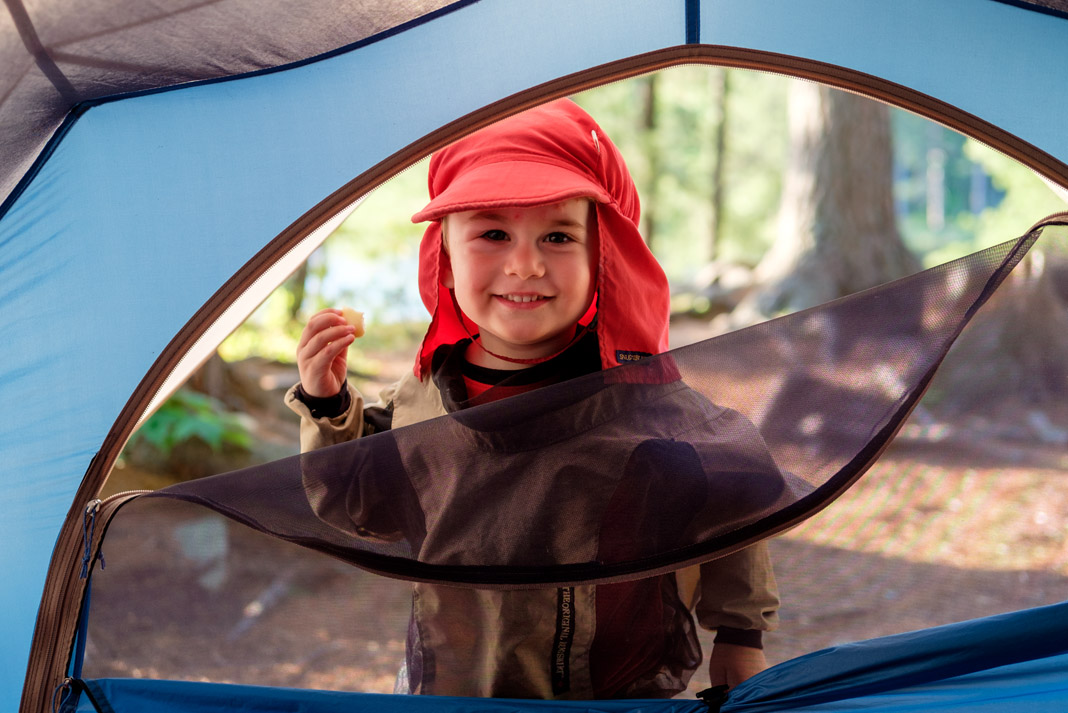
Home is where you stake it. | Feature photo: Wyatt Michalek
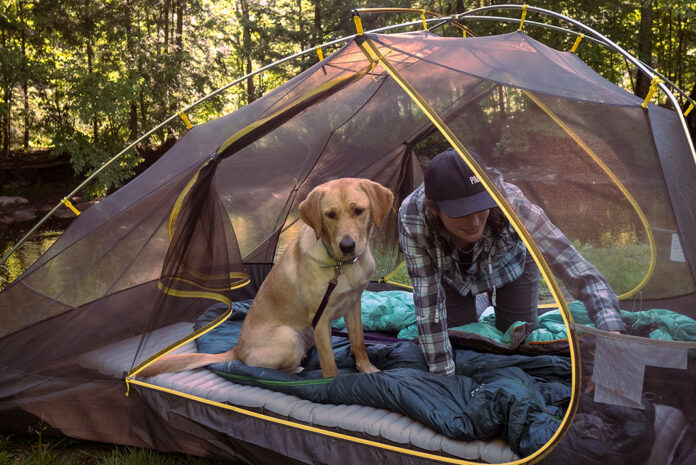
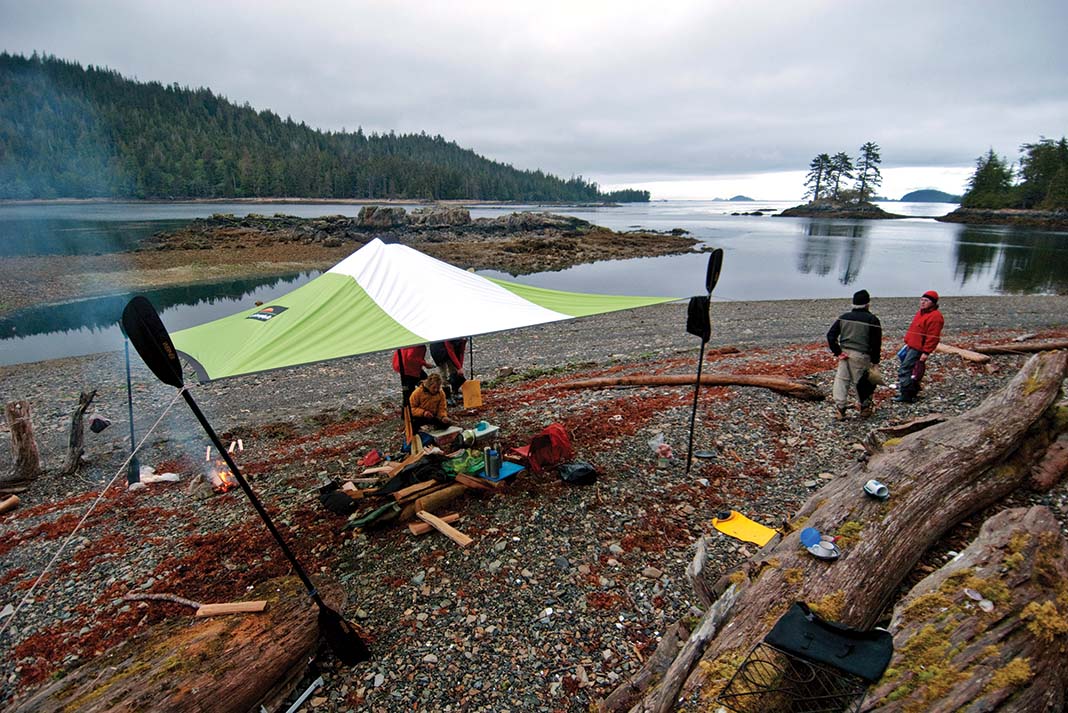
To stake a claim in the hyper-competitive tent market, modern shelters must be comfortable, lightweight, durable, weatherproof and easy to set up. So, which new models make the cut? Here are six of the best tents to serve as home away from home on your next canoe camping trip.
Affordable, spacious and reasonably lightweight—the Meteor 3 from Sierra Designs offers the tent trifecta. It boasts a great space-to-weight ratio and reliable durability, all at a budget-friendly price that doesn’t compromise quality.
Pre-bent pole architecture increases the steepness of the exterior walls, resulting in 41 square feet of usable living space. The Meteor 3 is roomy enough so it doesn’t feel cramped for car camping but is still light enough at five pounds and six ounces, so it doesn’t feel burdensome on the trail.
When it’s time to break down camp, forget fighting with the stuff sack. One of our favorite features is Sierra Designs’ burrito-style stuff sacks. The bag opens wide to make fitting in the tent body, fly and poles easy. Then, just cinch the cords and stow.
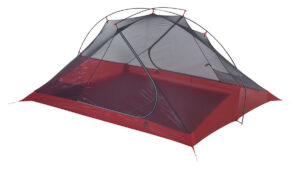
The roomy Carbon Reflex 3 from MSR packs into such a small and tidy silhouette, we’d forgive you for mistaking it for an inflatable sleeping pad. Weighing just two pounds and 10 ounces, the Carbon Reflex 3 is one of the lightest three-person tents available. During its decade on the market, the Carbon Reflex 3 has found a strong following amongst thru-hikers, bikepackers and packrafters.
Easton carbon fiber poles form a minimalist, semi-freestanding structure needing to be staked out tautly. The second secret to its weight savings is the ridiculously light tent and body material: an eyebrow-raising seven-denier ripstop nylon fly, 10-denier micromesh canopy and 15-denier nylon floor. Buy a footprint with this one.
The Carbon Reflex also features a zipper-free vestibule design. How? Each vestibule is secured with Velcro strips and a metal hook closure. Skeptical? It took a little leap of faith to test the design during a multiday shoulder season storm, but the vestibule and inner body stayed admirably dry with some guy line management. However, those miniature metal clasps are a bit fussy for midnight exits. Bottom line? It’s perfect for weight-conscious gearheads willing to baby the marvelously ultralight space-age fabric.
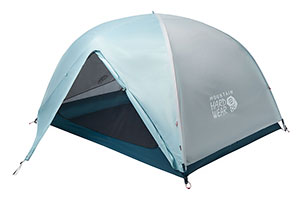
Positioned solidly in the Goldilocks zone, the Mountain Hardwear Mineral King 3 inhabits what many paddle campers consider the sweet spot intersect for price, durability and performance. Its seven-pound heft for a three-person design is adequate for paddlers and car campers but might be a stretch for backpacking, which is the only factor preventing the Mineral King 3 from being a true all-rounder.
Our testers loved the Mineral King 3’s easy two-minute setup. Its oversized doors create an opulent double-wide view, and its luxurious 90-inch length and 48 inches of headroom make sharing with three campers feel spacious. This is the only tent in the lineup coming standard with the recommended footprint, though with its hardy 68-denier polyester bathtub floor, this is arguably the model least needing it. The Mineral King was more than a match for a surprise early season thunderstorm and its interior stayed bone dry throughout the night.
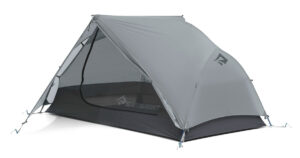
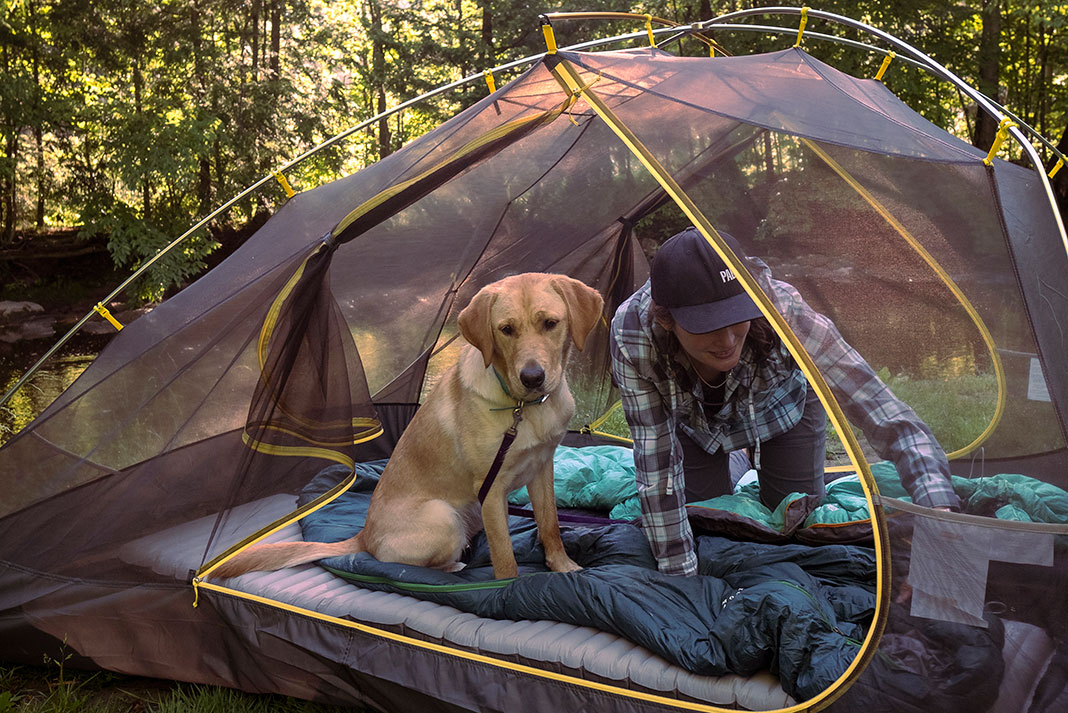
Since Sea To Summit entered the tent market in 2021, the Australian brand has created some of the industry’s most talked about designs. Available in one- and two-person models, the new Telos 2 is getting buzz for its light weight and innovative features.
You’ll be struck by the tent’s compact package first, which separates the fly, inner body and poles into three individual sacks, which have the option to nest together. The unique design allows weight to be distributed amongst partners—or so you can pack each sack into whichever crevices of empty space remain in your canoe pack.
Though the Telos 2 was designed with weight-conscious backpackers in mind, it doesn’t hold back on a few bells and whistles. Noteworthy features include the pole bag doubling as a Lightbar—snap it to the tent’s ceiling and insert a headlamp in either end to create a diffused nightlight. And use the teeny snaps in the interior corners of the tent to clip in the fly and tent body stuff sacks and stash small essentials in them overnight.
The interior size of the Telos 2 is standard for a two-person tent—which is to say, tight but doable for two campers.
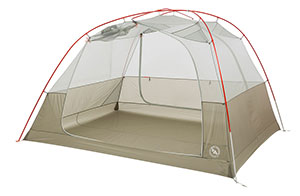
It’s hard to imagine getting a good night’s sleep with five campers tucked in one tent, but if it were to happen, we can almost guarantee it’ll be in the spacious Big Agnes Copper Spur HV UL5. Newcomer to the award-winning ultralight Copper Spur series, this high-volume shelter manages to defy the laws of physics by feeling even bigger on the inside than the outside.
After a dead-easy setup, large double-zipper, awning-style vestibules help this family compound maximize living space. Most impressively, even with its 65-square-foot interior and 60-inch headroom, this palatial abode weighs only seven pounds and six ounces. Packed, its two-foot by nine-inch stuff sack is more in line with the size and weight of many three-person tents. The Copper Spur series manages this feat thanks to exceptionally lightweight materials, which you’ll pay extra for, so you’ll want to use a life-extending footprint with this one.
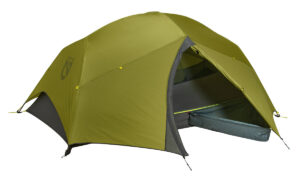
Nemo pegs its Dagger OSMO as a quintessential one-tent wonder: compact and lightweight enough for backpacking, yet roomy enough for comfort. With 31 square feet of elbow room inside, it is a roomy fit for two smaller campers.
First released in 2019, this newly updated Dagger features fabrics free of fire-retardant chemicals. The new fabric boasts four times more water repellency and three times less stretch, which means less sag in the rain and a faster dry time afterward.
The Dagger’s redesign also includes D-style doors (two zippers that come together) instead of the previous incarnation’s continuous C zipper, which can be more prone to snagging and requires two hands to close. Two large vestibules provide plenty of dry gear storage. The Dagger OSMO also comes with a Landing Zone attachment, which is like a mini ground tarp for your vestibule to keep gear off the wet ground.
Home is where you stake it. | Feature photo: Wyatt Michalek
This article was first published in the Summer 2022 issue of Paddling Magazine. Subscribe to Paddling Magazine’s print and digital editions, or browse the archives.
Home is where you stake it. | Feature photo: Wyatt Michalek
Our favorite paddling films of 2022 took us to waterways far away and close to home. And they shared with us creative perspectives on how our beloved pastimes intersect with the world around us.
These 9 films are currently screening as part of the Paddling Film Festival, which has been showcasing the very best paddling films since 2006.
A Quality Of Imagination
In a culture seemingly full of adrenaline junkies and going bigger, Benny Marr contemplates the ultimate form of self-expression, and the subtle moments defining one’s style.
Seeking a deeper encounter with the territory of the Inuit, six paddlers plan to make the first recorded descent of a little-known river in northern Quebec. Tradition survives in the life and language of the Inuit. Their knowledge of the physical world and the seasons guides the team in its journey. Set against an imposing background of snow, tundra and whitewater rapids, this documentary is a call to go beyond: out onto the land, and inward into ourselves.
This is the story of a 90-year-old Balinese fisherman, Wayan, who can no longer fish because of the vast amount of plastic pollution in the ocean. Wayan instead uses his fishing boat and net to collect trash from the ocean in hopes of one day being able to fish again. The story is a glimpse into how one human uses his resources to make a difference and a reminder that if we all play our part, we can accomplish something much greater than ourselves.
Director: Dana Frankoff Producer: Dana Frankoff, Eric Ebner
Iceland is the land of fire and ice, and also one of the places with the highest concentration of waterfalls. This makes it one of the most popular places for extreme kayaking. Even so, given the inaccessibility of its rivers and the harsh climate, there is still a lot of territory left to explore. Three friends enter new valleys to explore rivers and waterfalls never descended before.
Sheri Tingey defied the odds by starting a company at age 50 that revolutionized the outdoor industry. This film is about the hurdles she overcame to launch the company and how she hid from view so people would judge the boats and not her role in creating them. At this watershed moment of reckoning around equity and inclusion for the industry and paddling lifestyle, Sheri’s story will warm hearts while also challenging the audience to grapple with presumptions about who belongs.
Director: James Q Martin Producer: Sheila Smithson
For whitewater dory lovers, there’s no better place than Idaho. The state’s miles of wild, free-flowing rivers are home to the country’s deepest gorges and some of the best big water rapids. In 1972, renowned conservationist and Grand Canyon Dories founder Martin Litton asked Curt Chang if he’d like to take some boats and a crew to Hells Canyon. After an initial scouting trip, Curt started up the Idaho operation. Since then, Curt has fostered a community of guides who care deeply about rivers, running good trips and the legacy of dories.
Following two rivers, one drain, one sea and one creek, it turns out paddling to work—which ends up being mostly a drag over four full days—is bloody hard work. The Commute is an intimate view into the good and bad of humanity. Told with award-winning filmmaker Beau Miles’ trademark mix of humor and philosophy, what started as a stunt turns out to be the hardest, most insightful four days of travel he’s ever done.
Director: Beau Miles Producers: Beau Miles, Mitch Drummond
Rumors emerged from Angola about a river the size of the Zambezi laden with rapids, but hidden behind an iron layer of bureaucracy and the aftermath of a 27-year civil war that raged across wild savannahs. Those rumors lured three expedition kayakers on the adventure of a lifetime. Kwanza is the story of Mike Dawson, Dewet Michau and Jake Holland, who embrace the challenge of the wild Kwanza River and race against time to kayak its mighty rapids before dams drown them.
Director: Mike Dawson Producers: Mike Dawson, Jake Holland
American Whitewater is proud to release a new series of river safety films. These films offer up-to-date and easily digestible tips to help keep you safe on the water. Designed to simply and effectively communicate the most basic elements of whitewater safety, these films provide a basis for essential, but not always readily available, river knowledge anyone wishing to spend time in a river environment should know.
Director: Brendan Wells Producers: Evan Stafford, American Whitewater
Watch the 17th annual Paddling Film Festival at one of the many stops along the World Tour, or screen at home all year round by renting one of our virtual programs.
The 2022 Paddling Film Festival is brought to viewers with the support of our festival partners: Spectacular Northwest Territories, Aqua Bound, Black Feather, Aire, Kokatat, the Canadian Canoe Museum, Nova Craft Canoe, Ottawa Valley, Thomas Rivers University, Trak and the Water Sports Foundation.
Find more information on screening as well as how you can submit to next year’s Paddling Film Festival.


 This article was first published in the Summer 2022 issue of Paddling Magazine.