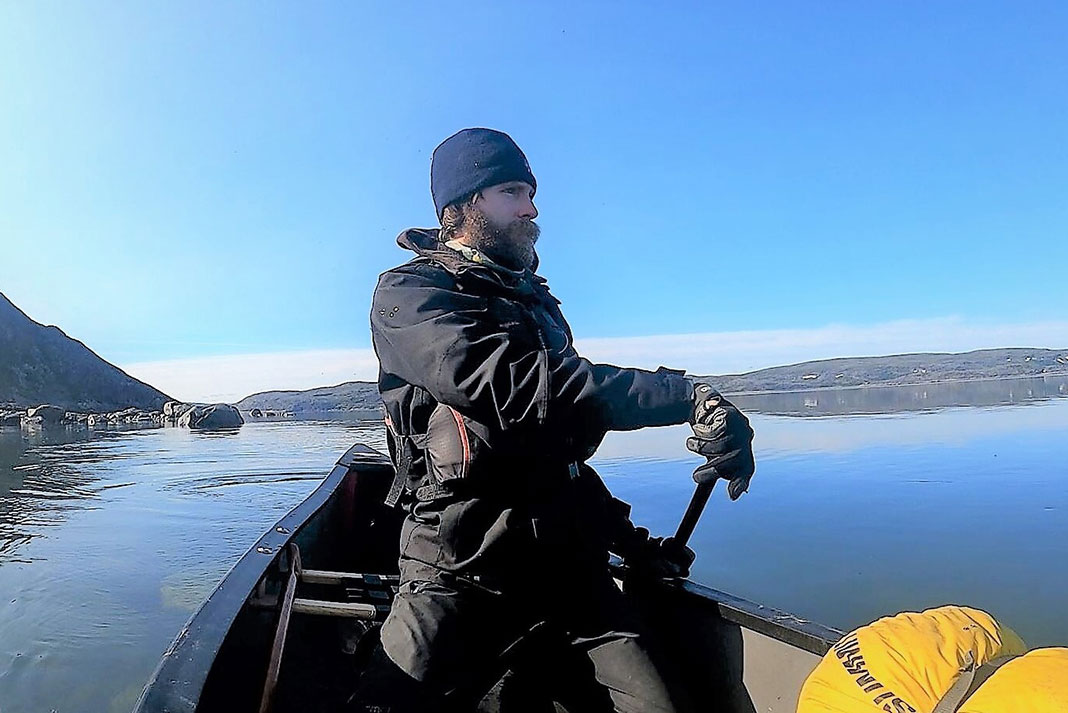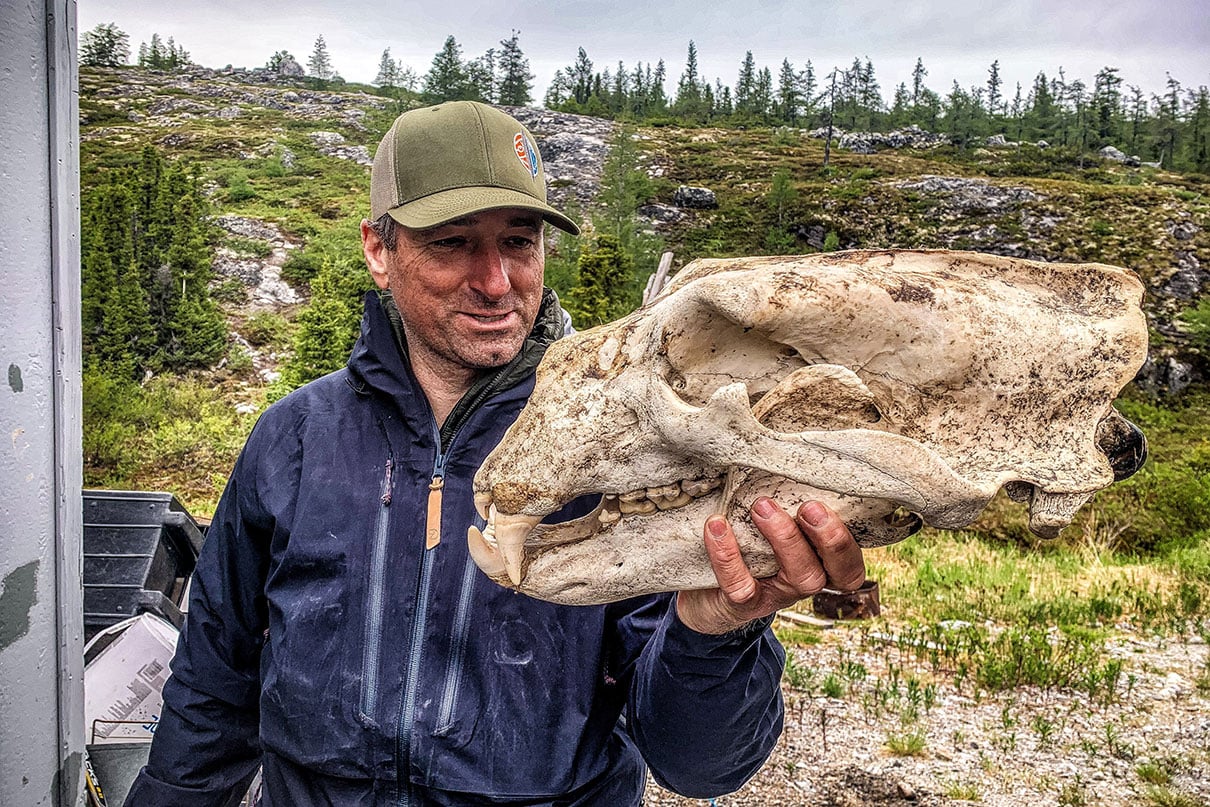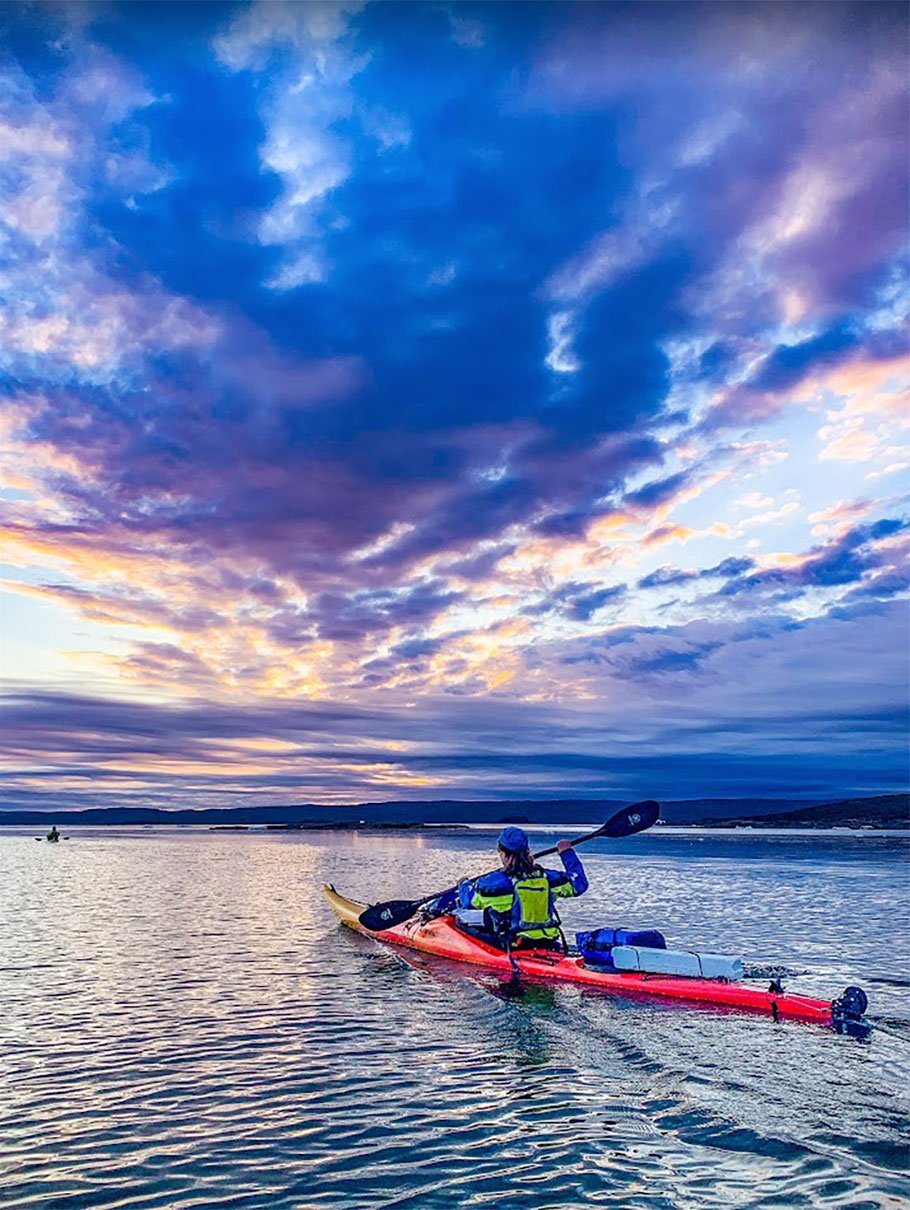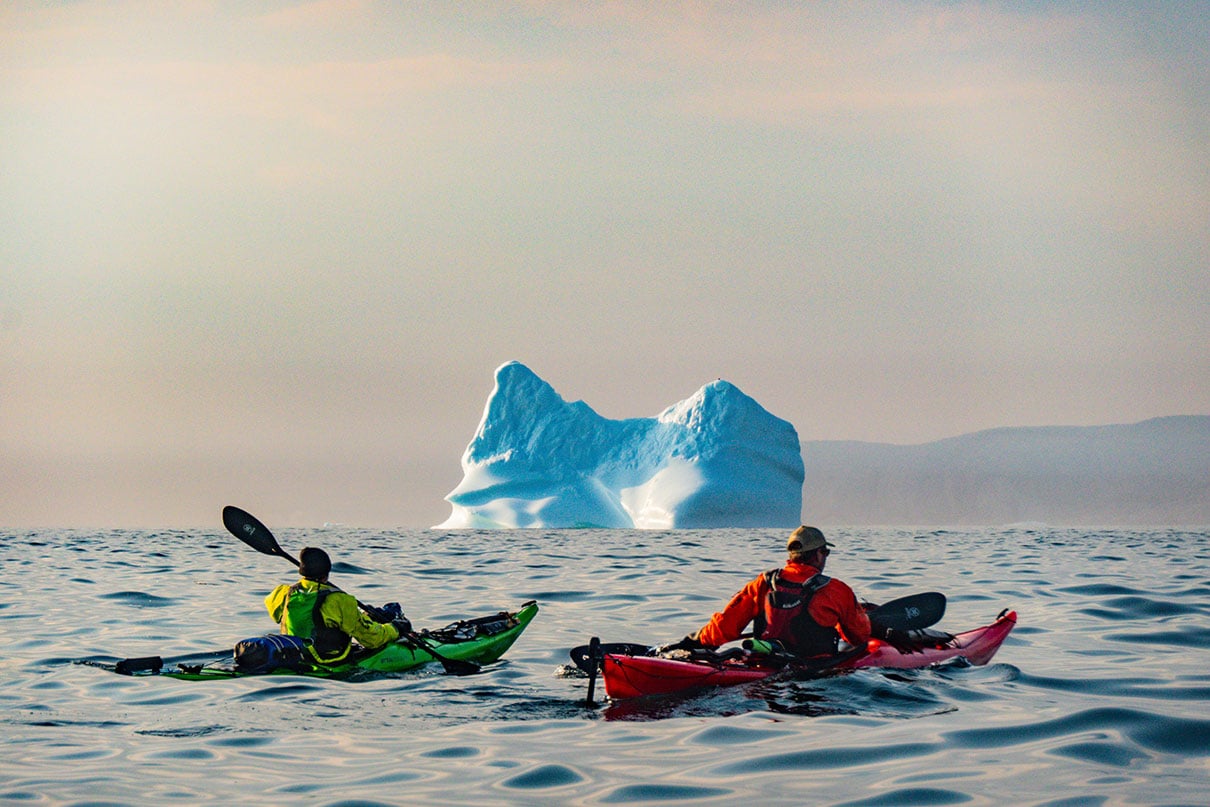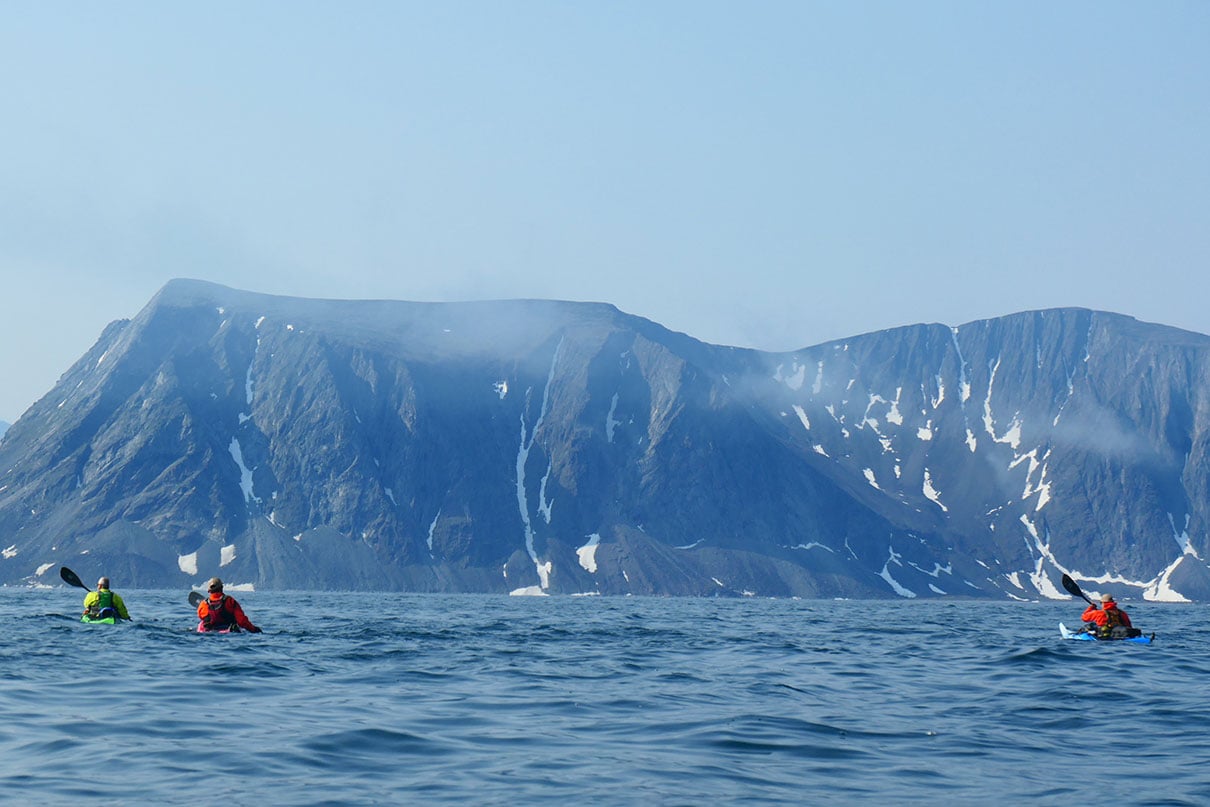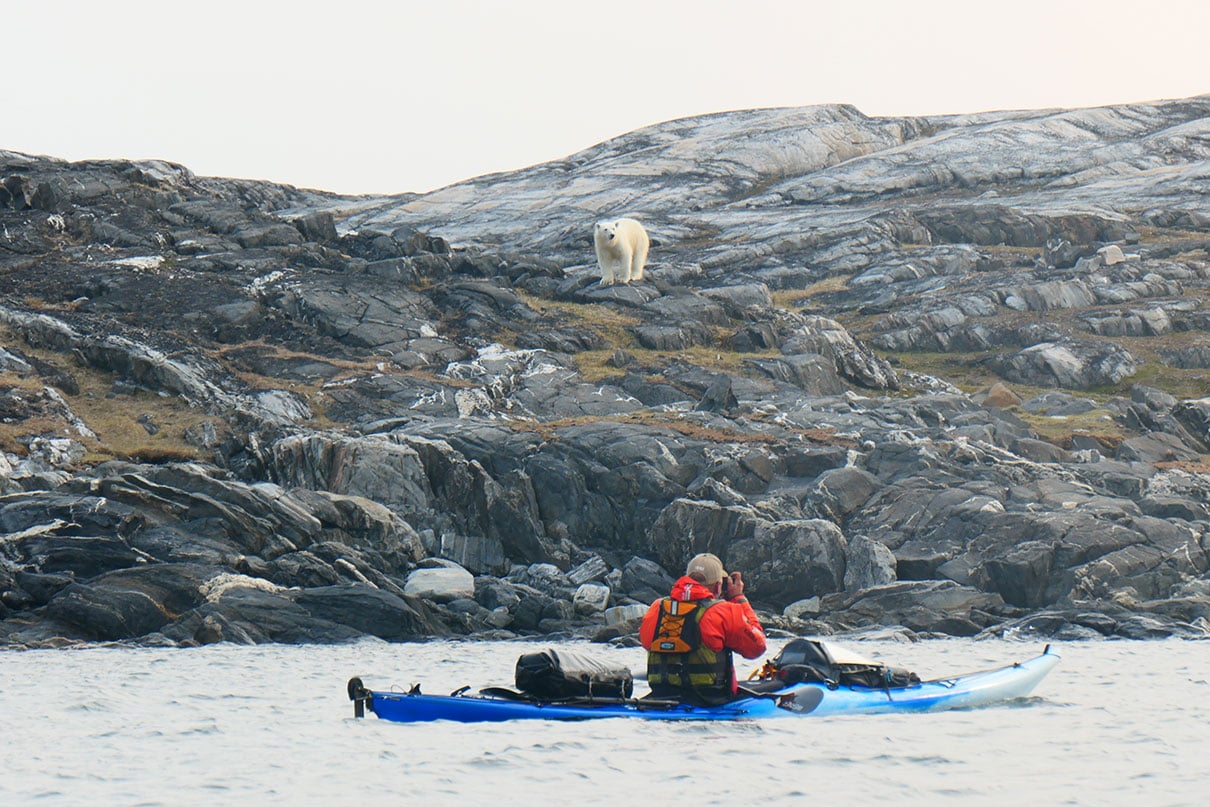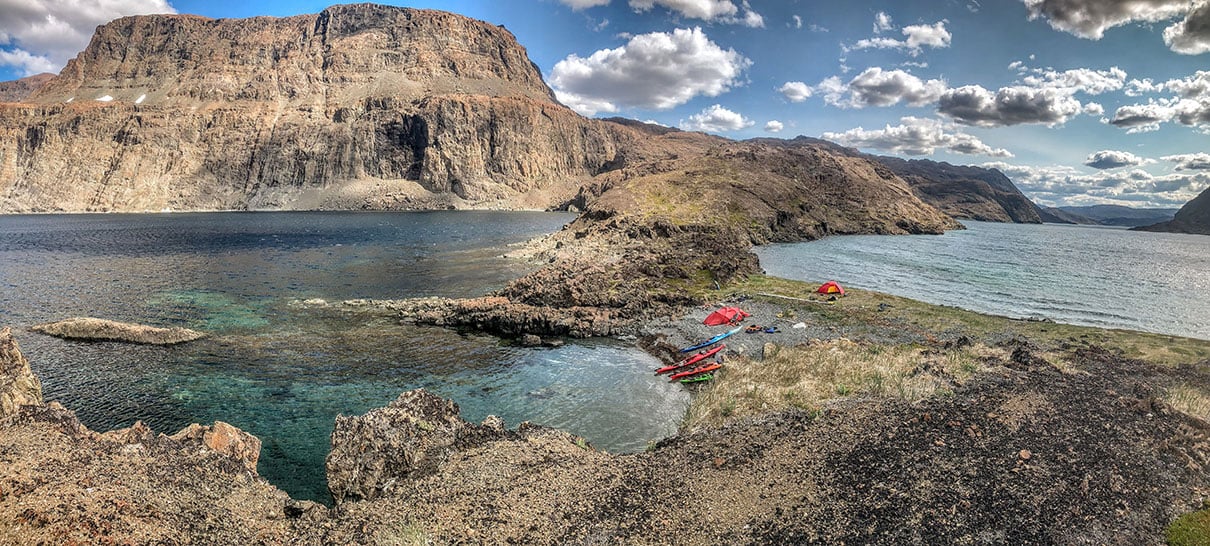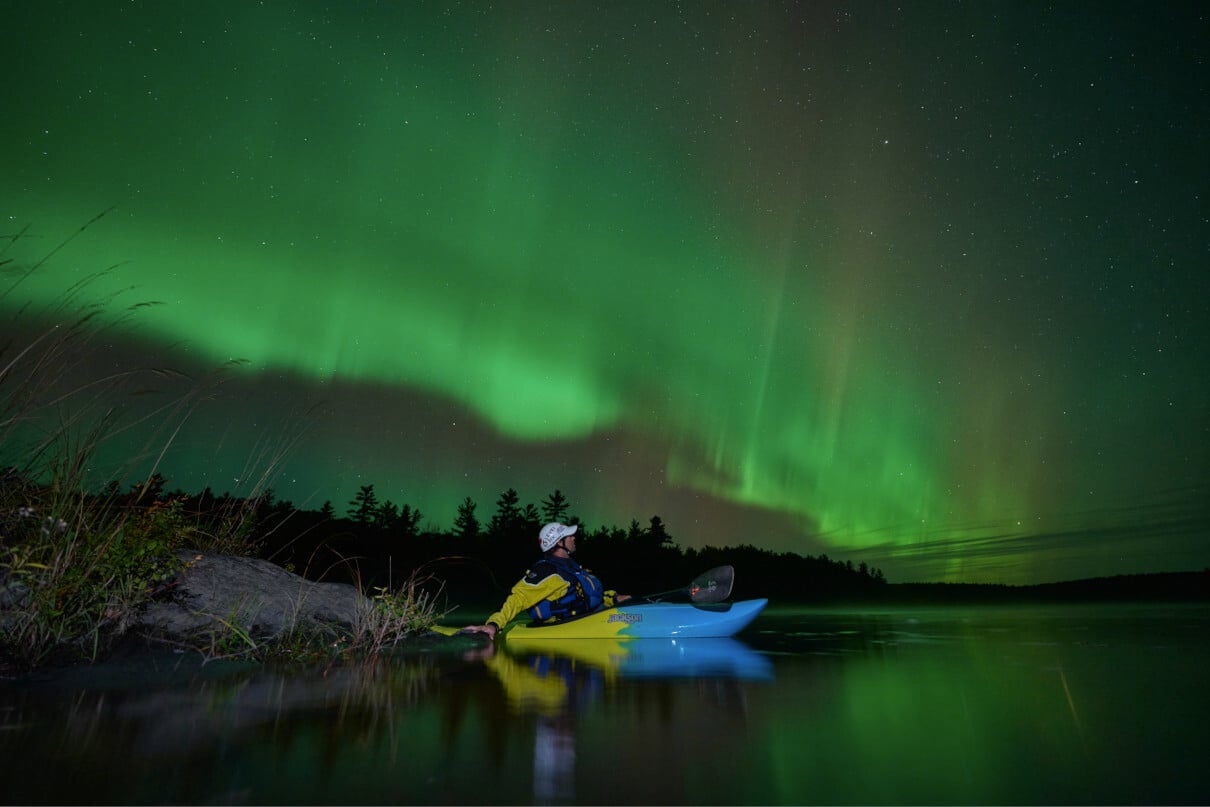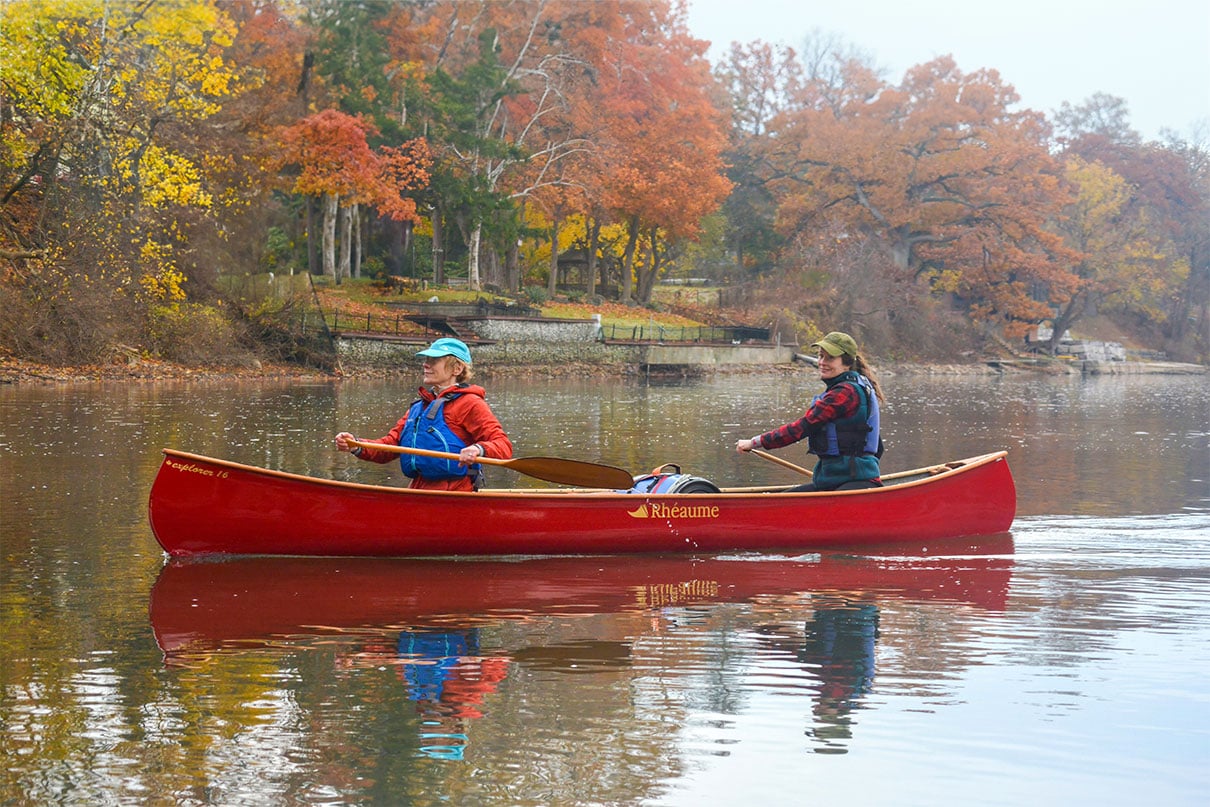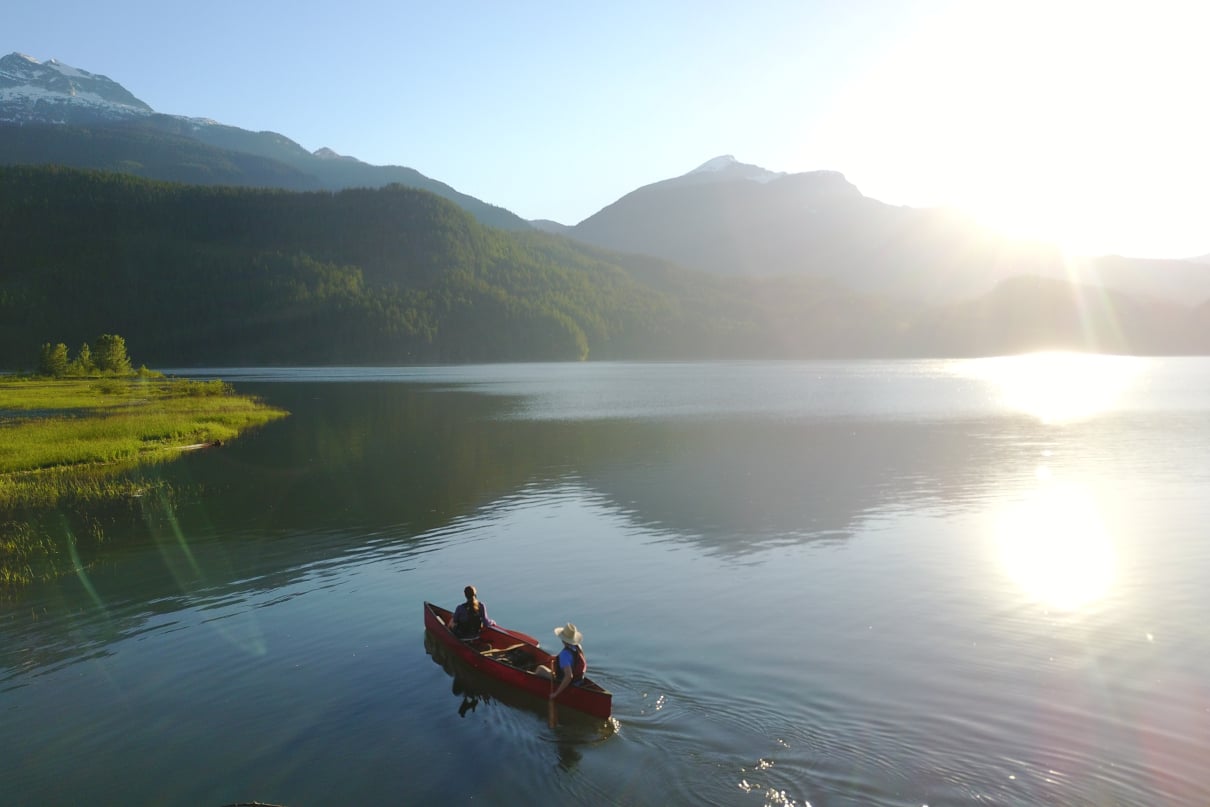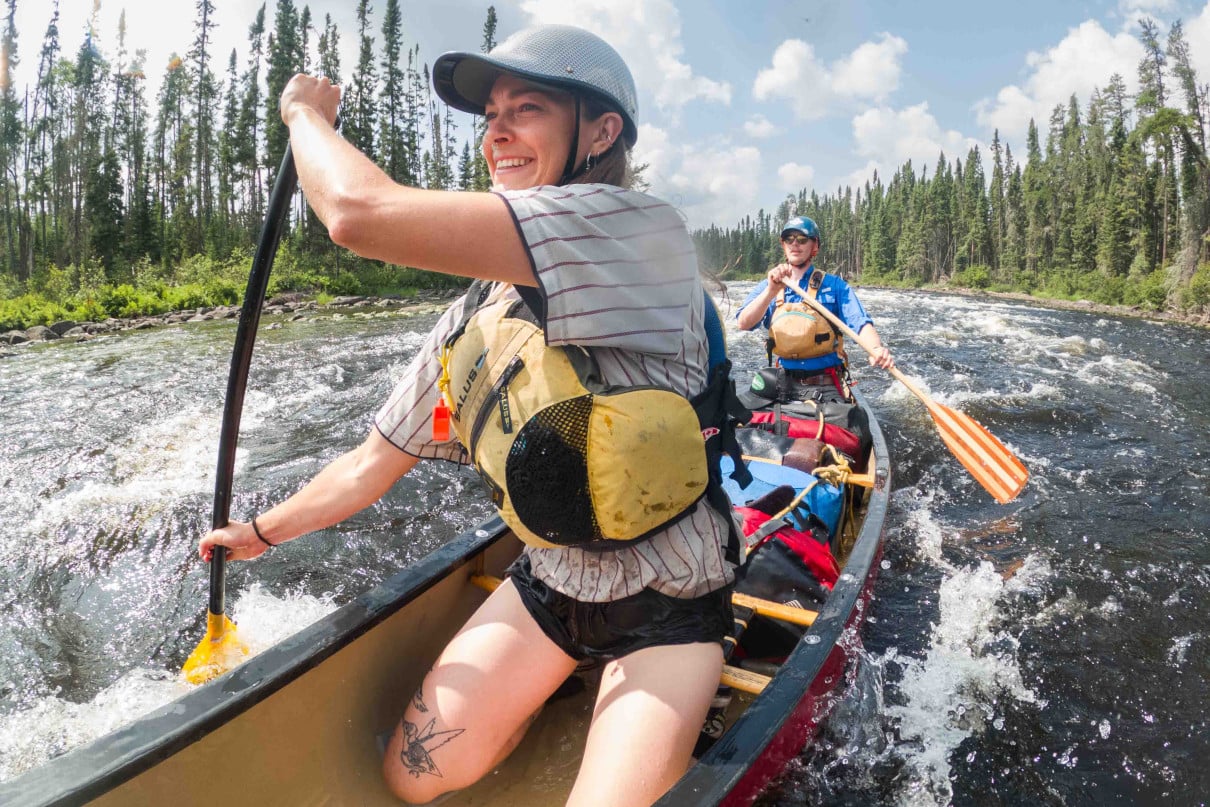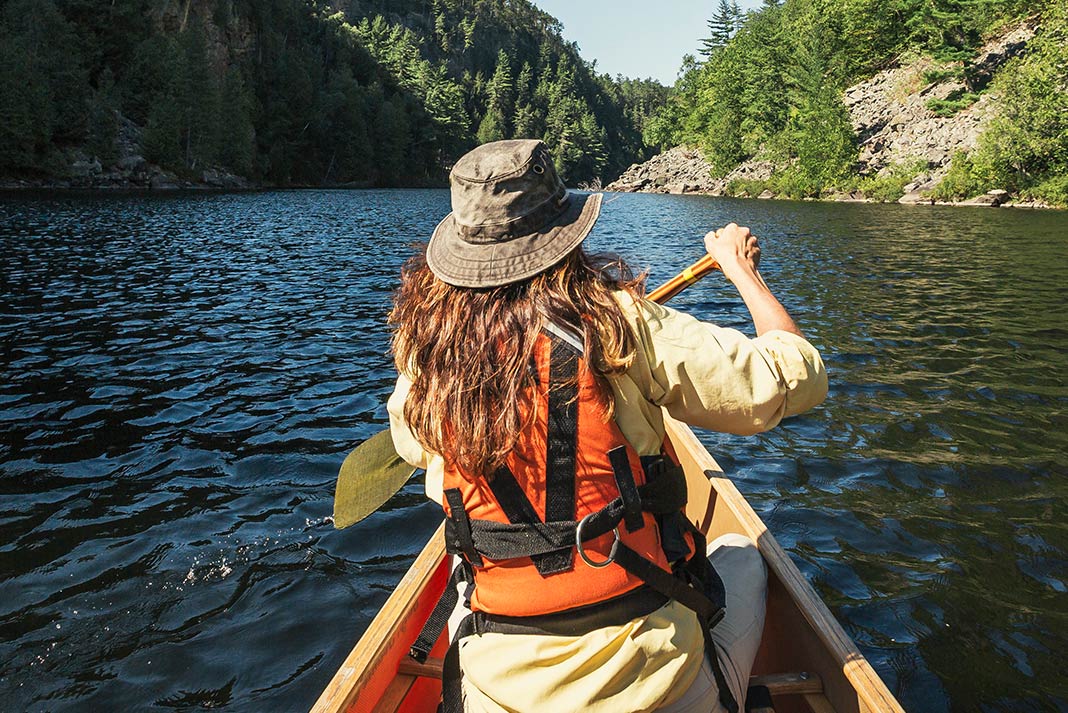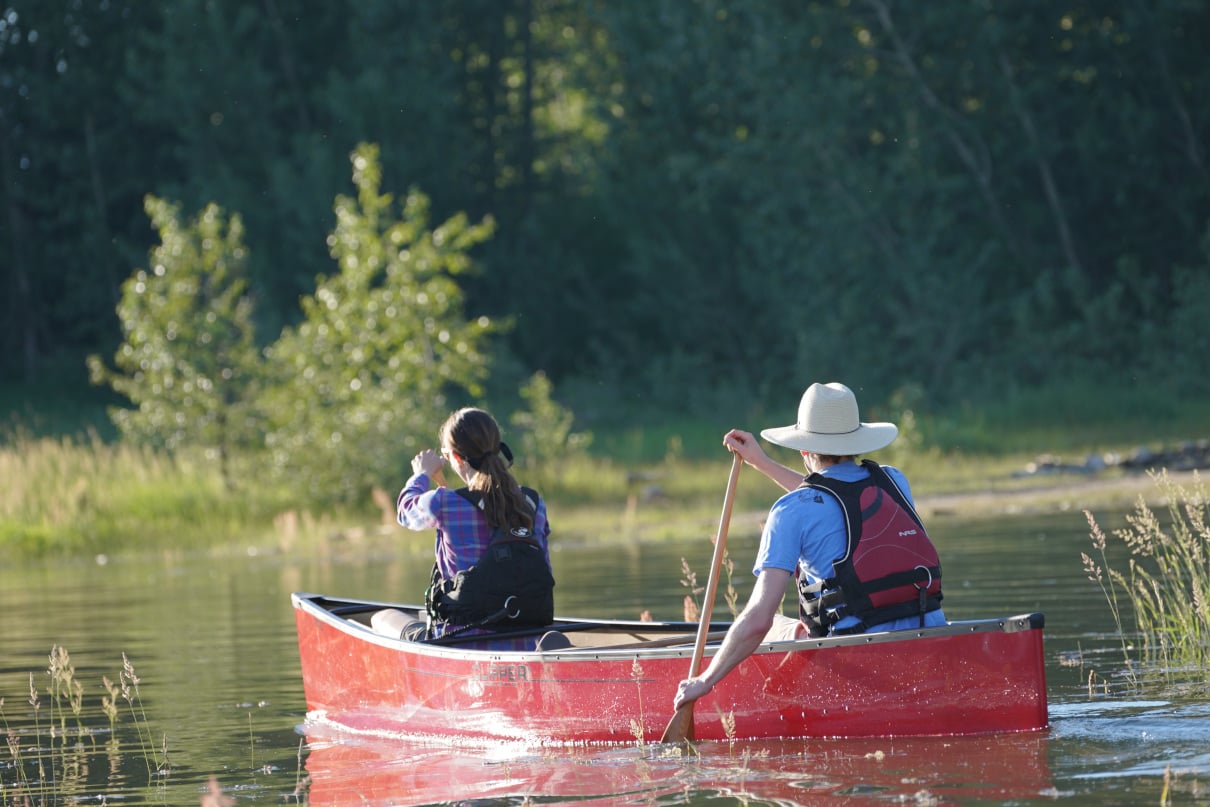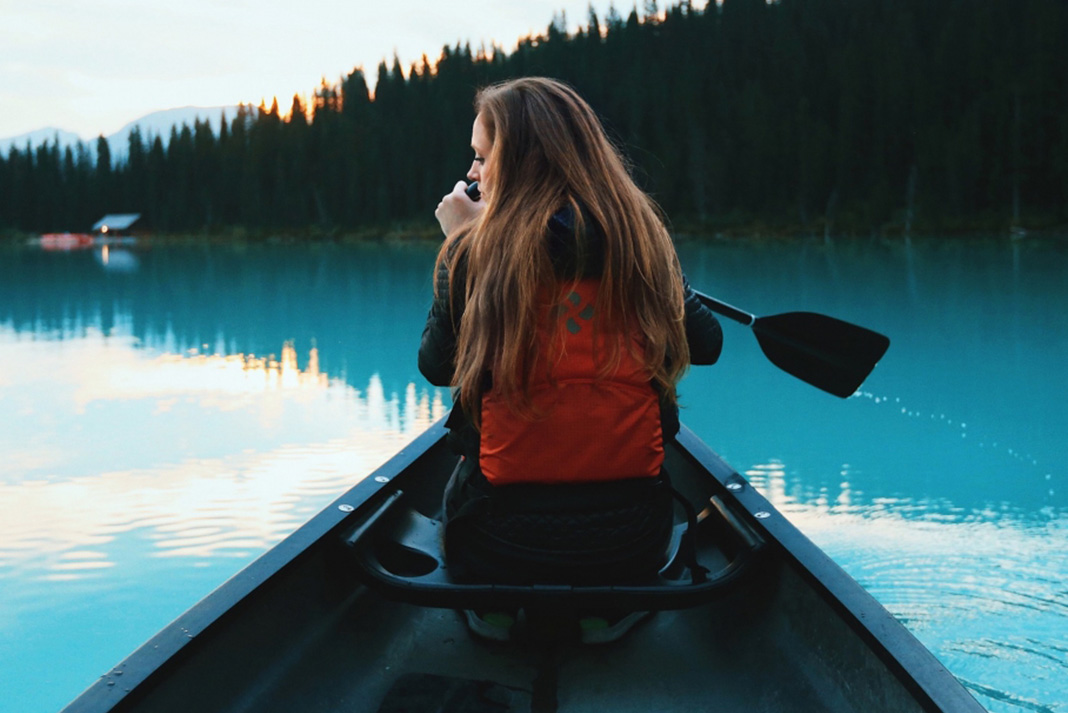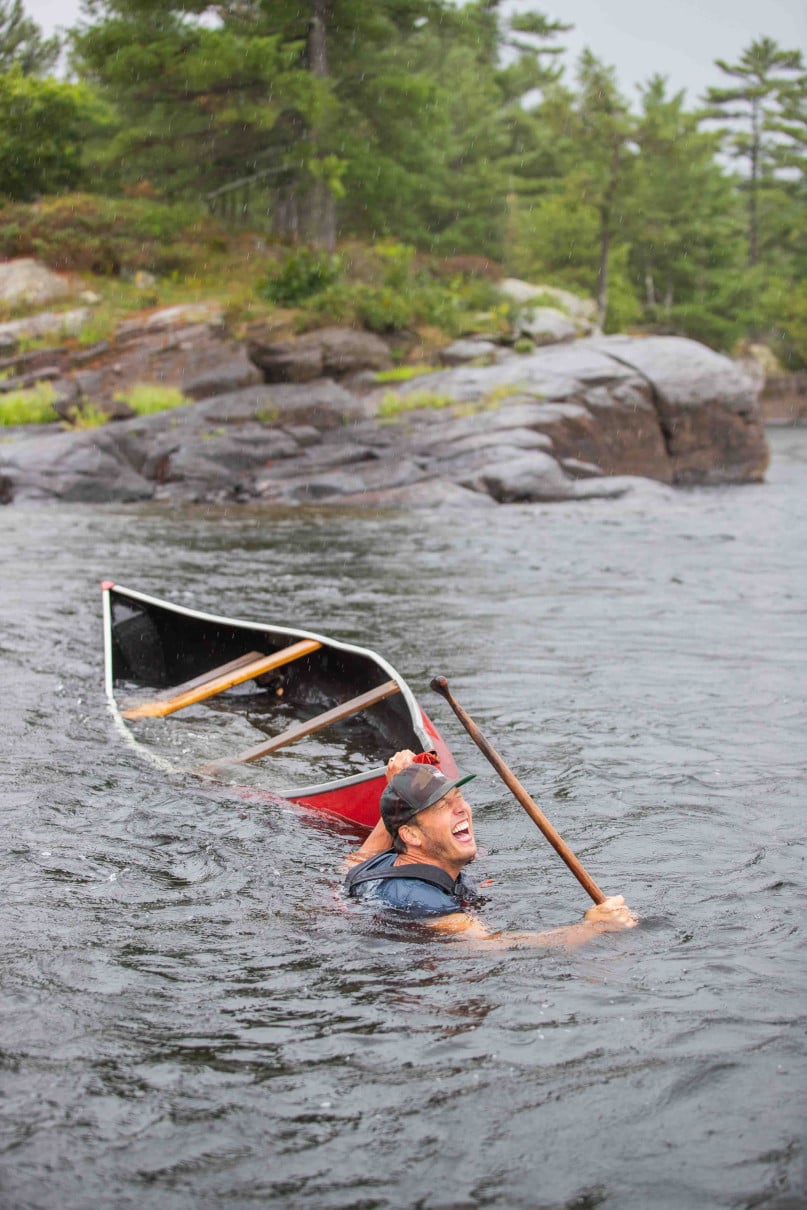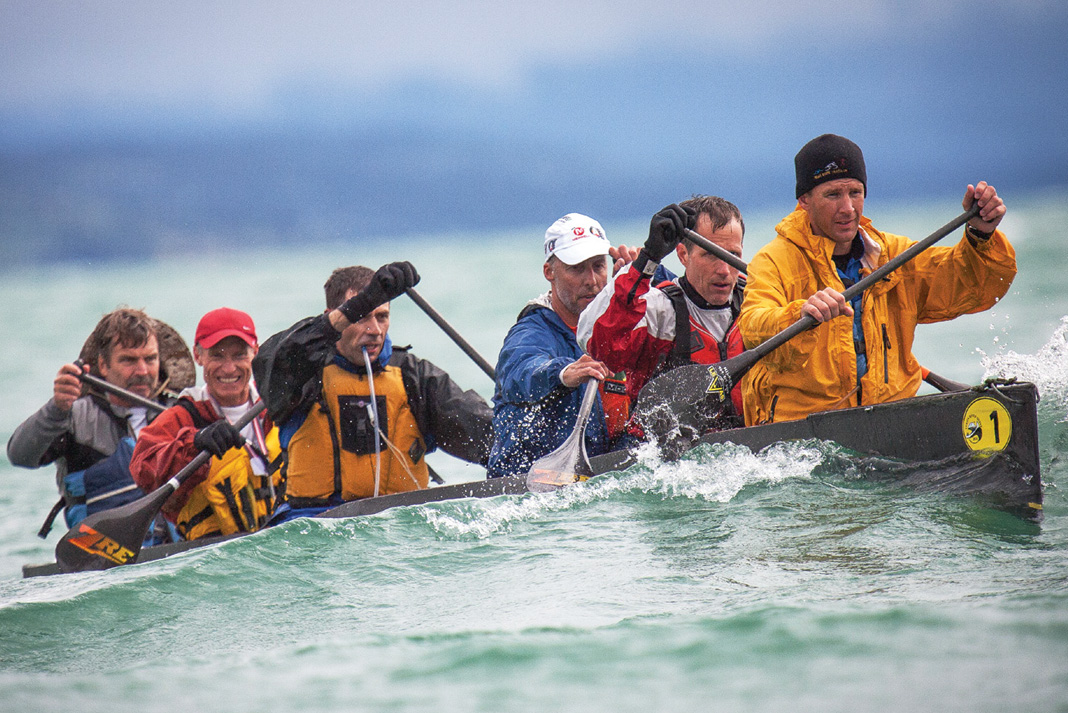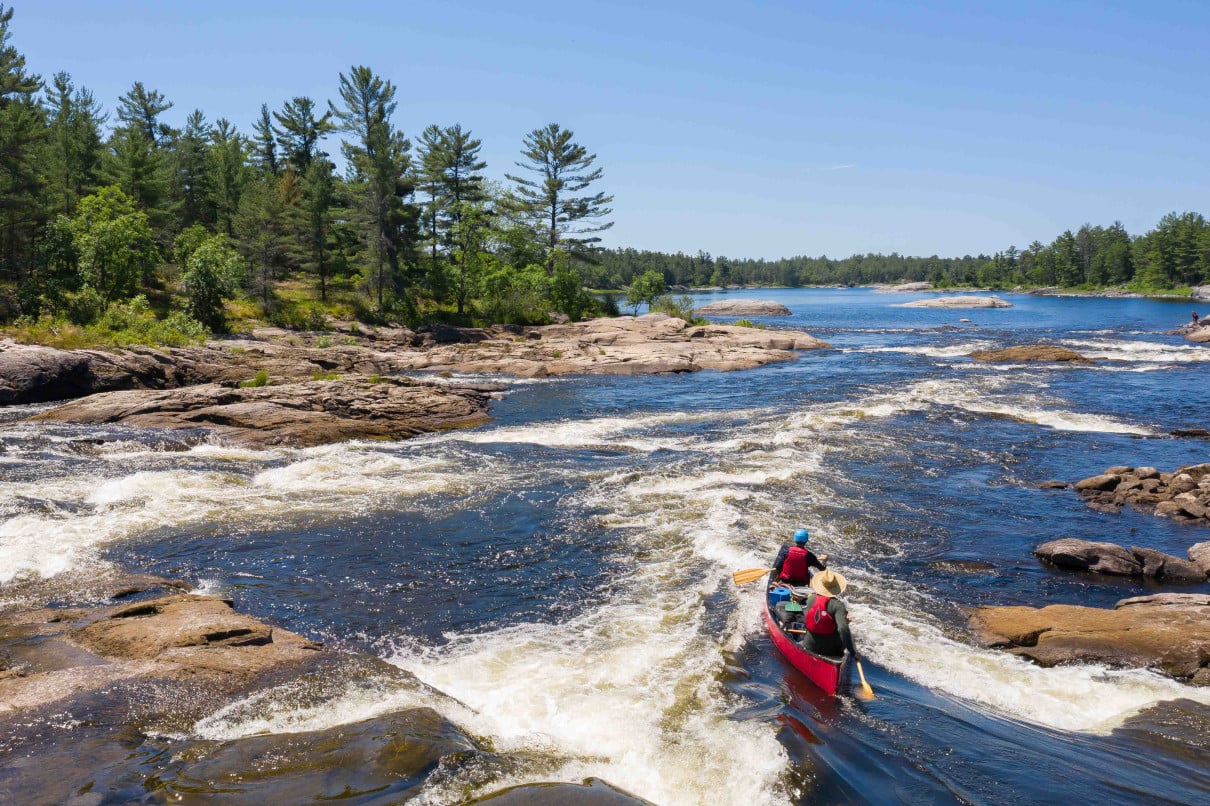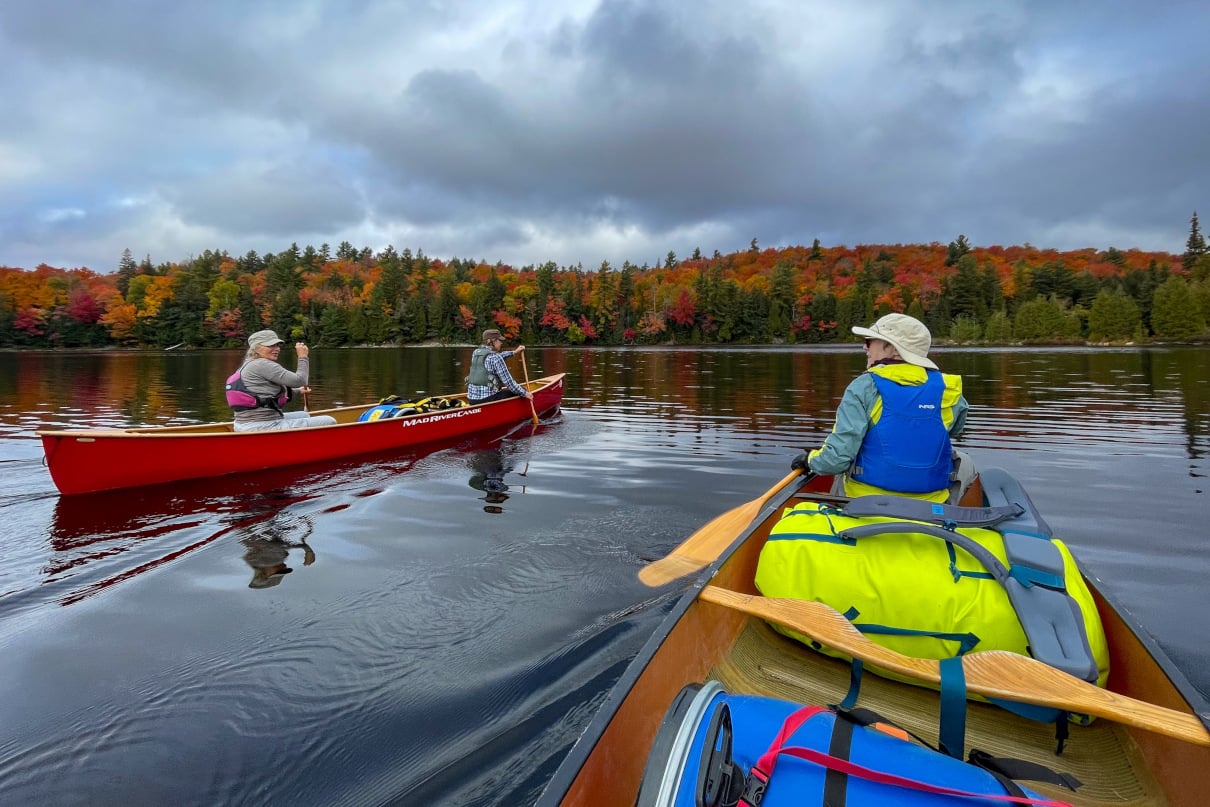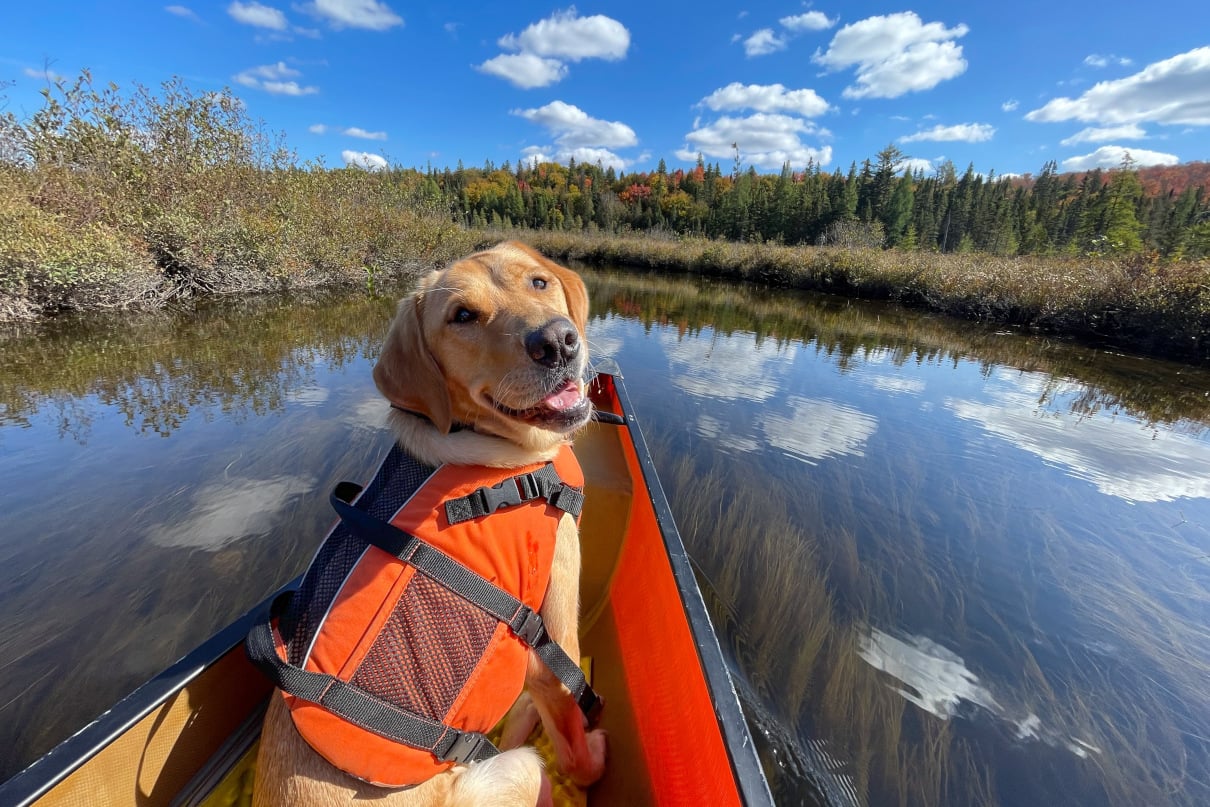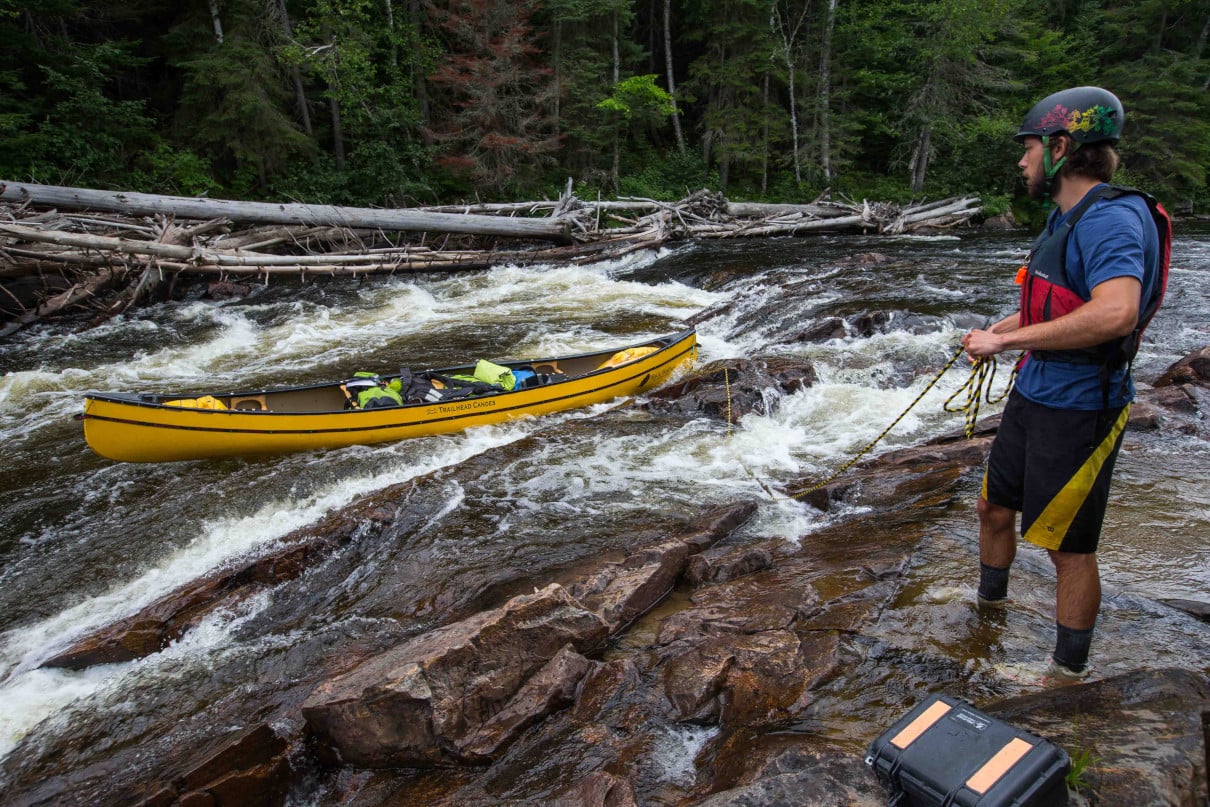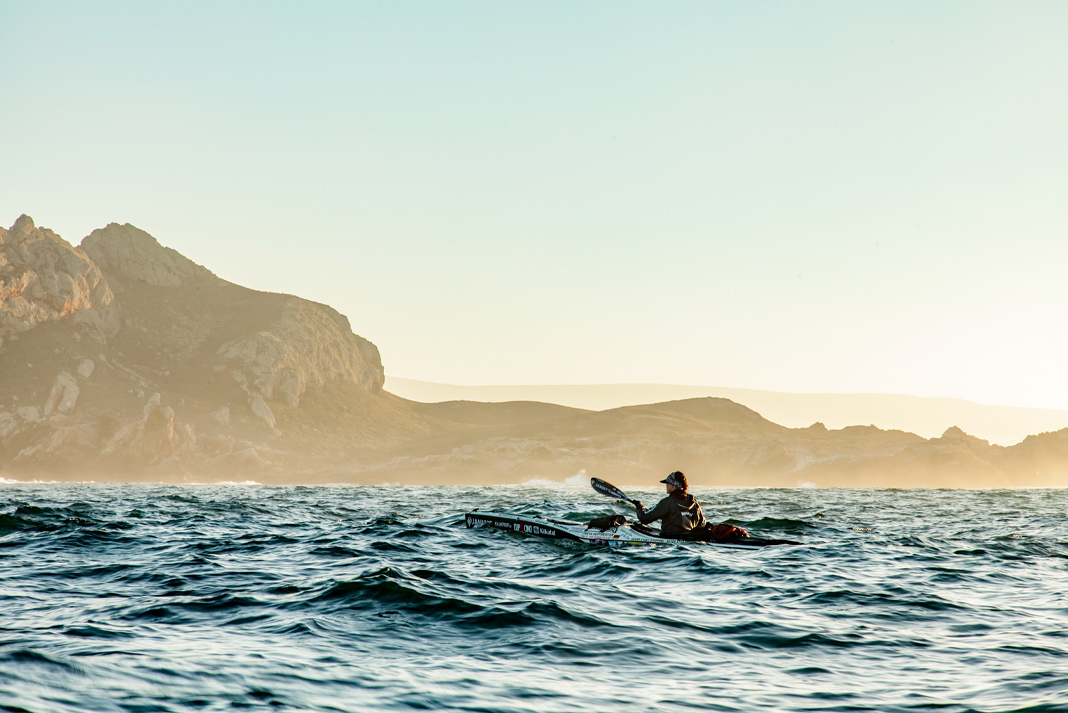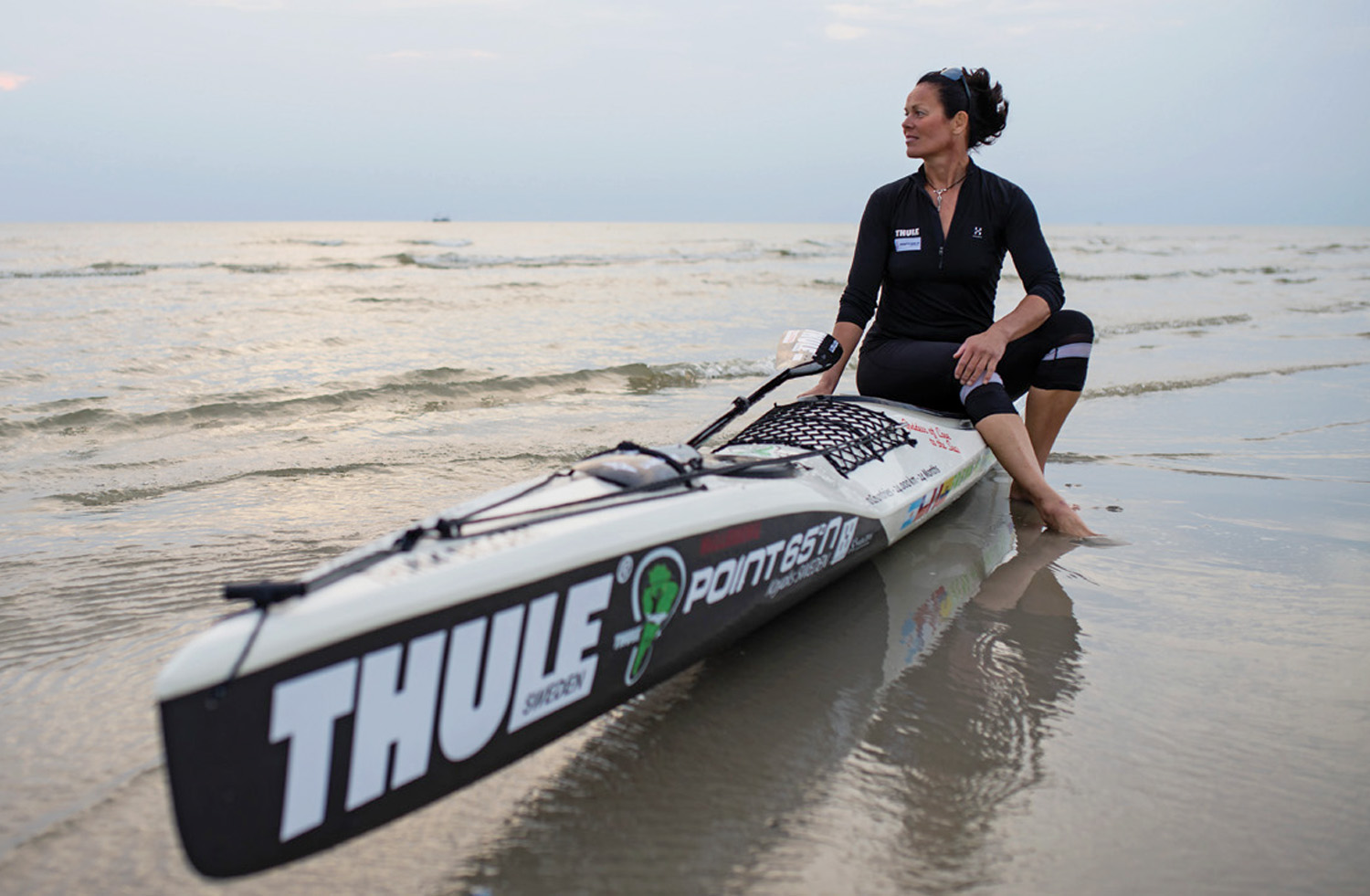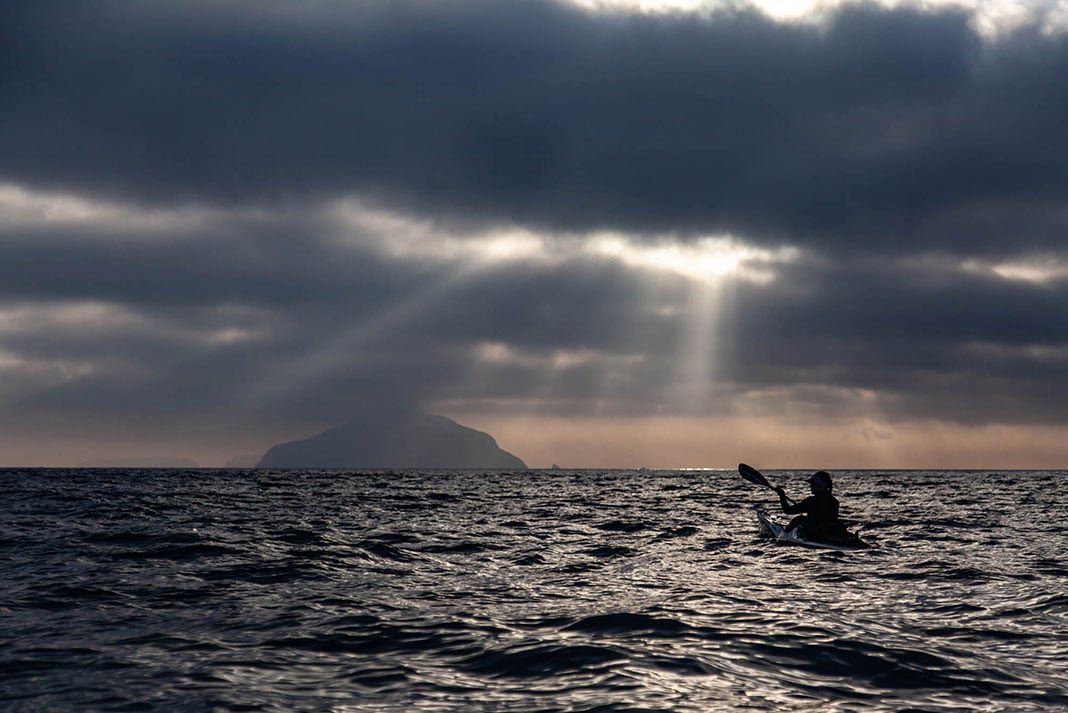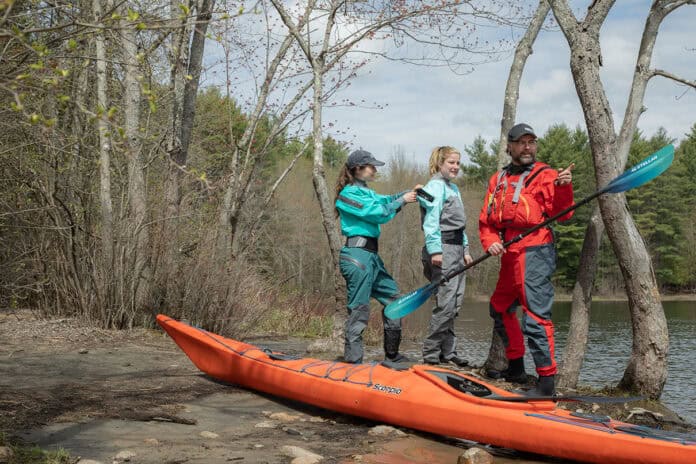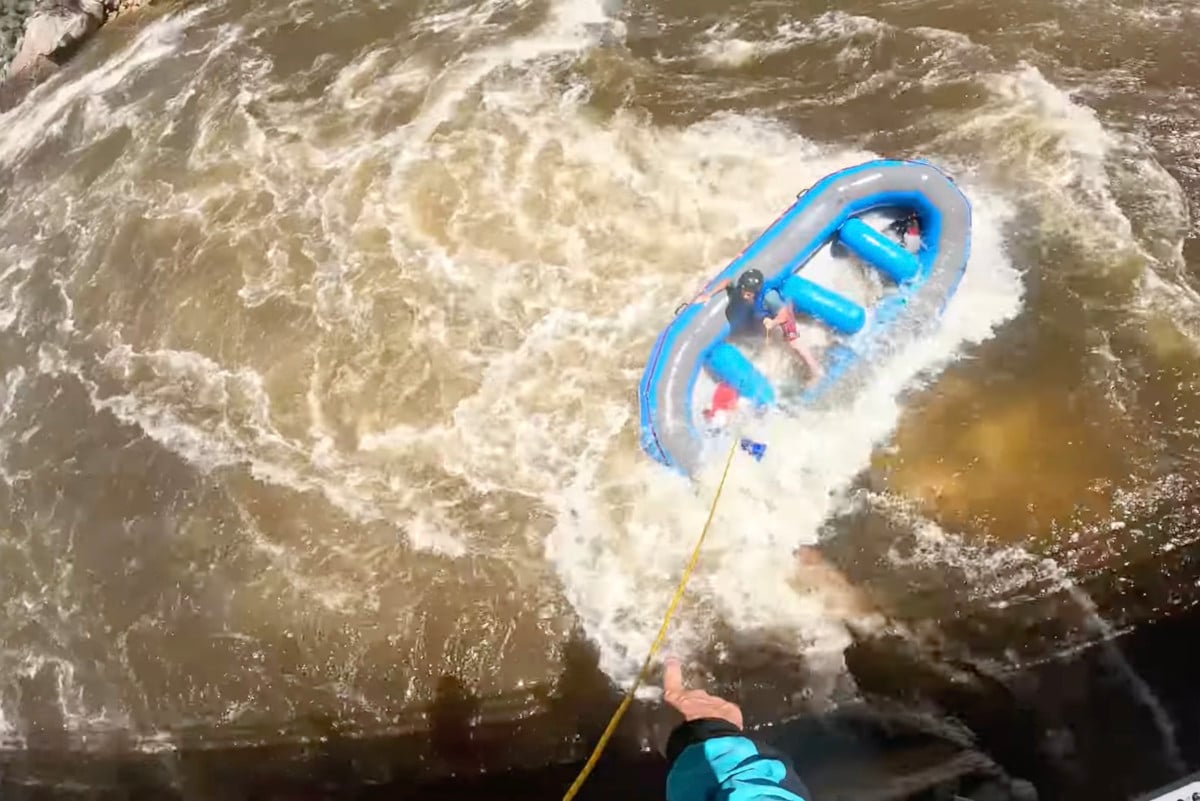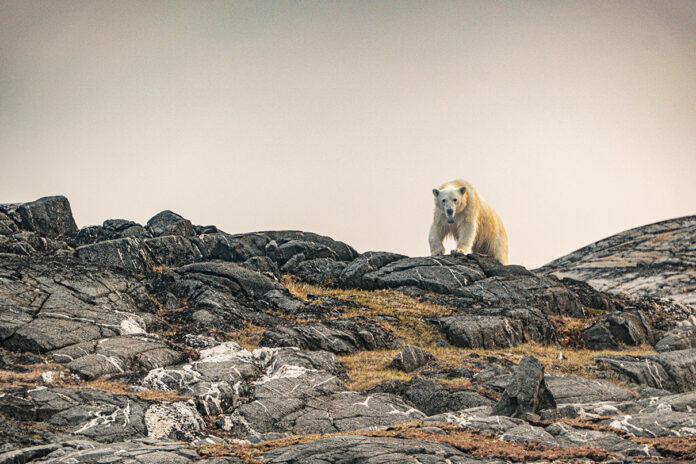
Enjoying the mystical cloud of joy nostalgia brings. | Feature photo: David Jackson
“Have I ever written about our ability as humans to forget pain and suffering, remembering only the good times?” I asked editor Kaydi while planning my summer canoe trips and writing this piece to appear in the Paddling Trip Guide. “You know, like, why would anyone ever do another paddling trip?”
Friedrich Nietzsche was a 19th-century German philosopher who famously wrote in his book Twilight of the Idols, “Was mich nicht umbringt, macht mich stärker.”
French voyageur Pierre-Esprit Radisson of the Hudson’s Bay Company predated Nietzsche by 200 years. Still, he likely shared a version of the famous aphorism, “Ce qui ne te tue pas te rend plus fort,” as he loaded a 90-pound pack on a newly recruited voyageur heading up Grand Portage, the grueling eight-and-a-half mile slog out of the west end of Lake Superior.
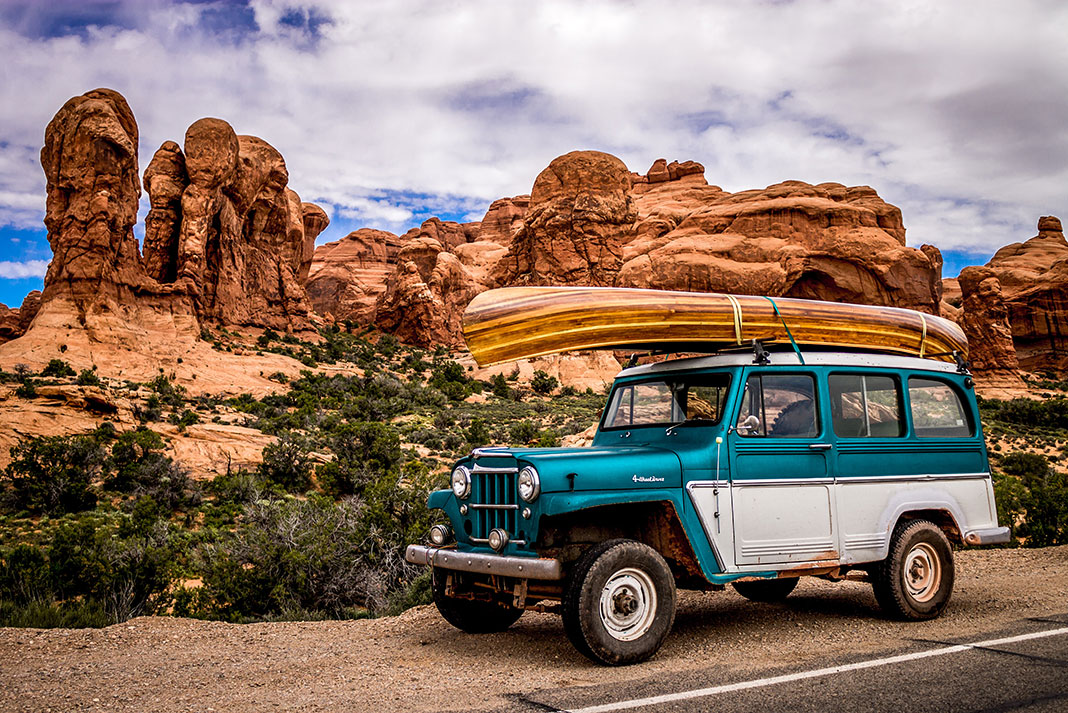
And, at this very moment, 136 years after Nietzsche, a counsellor is watching a camper hysterically swatting blackflies, saying the same thing, “What doesn’t kill us makes us stronger.”
Enjoying the mystical cloud of joy nostalgia brings. | Feature photo: David Jackson
If we made a list of possible dangers, risks and discomforts on any given paddling trip found in our 2024 Paddling Trip Guide, it would read like any liability waiver of things that could kill us or make us stronger, including but not limited to: Overturning or upsetting of canoes or kayaks; entrapment by trees, rocks or equipment; encounters with wild animals; equipment malfunction; storms, lightning, hail and snow; becoming lost or separated; lack of shelter; limited access to and/or delay of medical attention; physical exertion, hypothermia, exhaustion, dehydration or frostbite; and/or mental distress from exposure to any of the above.
And yet we go. Over and over again.
Motivated forgetting theory goes something like this: We forget feelings because we either do not want to remember them or the feelings are too painful and disturbing to recall. So, we push them deep into our unconscious, making them very difficult to retrieve.
Whether days of relentless driving wind, cold and rain are intentionally or unconsciously buried probably doesn’t matter. What matters is when my buddy Paul calls with a window of opportunity to paddle the Spanish River in the bloodsucking heart of bug season, I’m dumb enough to agree. I rationally know June is a bad idea, but I’ve buried the horrific feeling of thousands of blackflies biting my neck.
So, of course, I agree to go.
Looking back through rose-coloured glasses
The phenomenon of remembering the good times more vividly than the bad times can be attributed to a few human psychological phenomena. Positive memories are often associated with strong positive emotions such as love, joy and connection. These feelings make the good times more salient and memorable than negative experiences, which may be associated with feelings of pain, conflict and sadness. I’ll leave you to draw your own links to previous paddling trips.
And with the passage of time, we know the negative aspects fade in intensity while the positive memories become more enduring and cherished—sometimes as quickly as a cheeseburger and beer after the trip. As more time passes, the more nostalgic we become.
When we look back on past adventures, we often focus on the positive memories because they evoke feelings of warmth, comfort and happiness. This is called emotional nostalgia bias. It makes the good times stand out more prominently in our memories. This is why we fondly remember the dining hall despite the food being God-awful.
Krystine Batcho is a psychologist and professor at New York’s Le Moyne College. She regularly contributes to Psychology Today and is a leading expert on the study of nostalgia.
“Nostalgia helps to unite our sense of who we are, our self and our identity over time,” writes Batcho, who believes we are changing constantly in incredible ways. We’re not the same today as we were three years ago, she says. We may not even be who we were at the beginning of our last paddling trip.
“Nostalgia motivates us to remember the best feelings in our lives,” says Batcho. “It helps to unite us to our authentic selves and remind us of who we have been and then compare that to who we feel we are today.”
Basically, this positive, nostalgia-inspired version of ourselves gives us a sense of who we want to be in the future. And this is why we keep doing paddling trips.
What doesn’t kill us makes us stronger.
Scott MacGregor is the founder of Paddling Magazine.
This article was first published in Issue 72 of Paddling Magazine. Subscribe to Paddling Magazine’s print and digital editions, or browse the archives.
Enjoying the mystical cloud of joy nostalgia brings. | Feature photo: David Jackson
Two fishermen were on a boat preparing their rods for walleye during the morning of September 11, on Lake Erie, when they heard a noise and recognized it was someone yelling for help.
Kayaker Survives By Clinging To Broken Bucket
According to 19 News in Cleveland, the anglers Larry Smith and Charles Steven were in the area of the city’s drinking water intake, known as Five-Mile Crib, when they heard the distress cry. At first, they couldn’t see anything, then they drove the boat out further and saw an arm wave in the air.
“This time when we see it, we see an arm come up out of the water, and then the arm goes back into the water,” Smith told 19 News.
The anglers had stumbled upon kayaker James Manning, who had been reported missing around 6:30 p.m. the evening before. Wearing no lifejacket or layers besides his shorts, the most shocking revelation the two fishermen witnessed was that the kayaker had survived by grasping to a bucket he found floating in the lake.
“The bucket is what was keeping him afloat,” Steven, who was driving the boat, told 19 News. “I guess he was probably tired. It was like he had a death grip on that bucket. I shut the boat down. Smith grabbed him first by the arm, and then I went around and grabbed his other arm. Then we pulled him in the boat. I had a jacket and put it around him. I said you alright, you want me to call 911?”
The kayaker asked if, instead, he could first call his girlfriend of eight years to let her know he was alive.
A news story published by Cleveland.com shared that Manning had left home around 5 p.m. Tuesday to go kayaking — launching from Merwin’s Wharf on the Cuyahoga River. Manning intended to paddle the mile-and-a-half down the Cuyahoga to Lake Erie and back. Then he decided to change his plan and try to reach the Five-Mile Crib about three miles offshore.
Around 6:30 p.m., Manning’s girlfriend, Lindsay Longforth, texted to see how his kayak trip was going. She didn’t receive a response, and she followed up. This time, the messages were not delivered. Fortunately, she knew where he had embarked from and checked on the status of his vehicle, as well as notified the authorities something was wrong.
The police were able to track his phone’s last position five miles from the Great Lake-side community of Lakewood and searched the area using helicopters and drones until 3 a.m. With helicopters circling above, Manning was in the water and in a fight for his life.
Cleveland, Ohio skyline and Lake Erie. Image: DJ Johnson | Unsplash
A fight to survive
According to Manning’s interview with Cleveland.com, the ordeal began when his kayak started taking on water near Five-Mile Crib. Waves started to splash over the boat, and Manning suspects a crack or defect may have been the culprit for his sinking ship. Depending on the type of boat, a kayak can also sink from water entering through the drain plug on the stern if it has not been closed or a hatch is left open. Or if it is a sit-inside kayak and no skirt is worn to keep water out.
“I didn’t realize how much water had come in the kayak until it was too late,” Manning said. “It sunk on me immediately.”
According to the article, Manning tried to bring the kayak back to the surface, but the account makes it appear Manning was unsure of the source of sinking. Without a bilge pump or something else, it would be difficult to empty the water fast enough to self-rescue.
From the account, it also appears Manning did not have his phone in a floating case or dry bag he could hang on to. Whether through water damage or sinking, it went down with the ship.
Once his kayak sank, Manning started swimming the miles toward shore. He made multiple attempts, coming within what he believed was a half-mile and, at one point, even 20 yards from shore before currents carried him back out.
At one point, he shared with the interviewer a moment he recalled his relatives who fought in World War II, including one who had survived a torpedoed ship and told himself, “If Uncle John could spend 10 days in a lifeboat in the North Atlantic, I can do a night on Lake Erie.”
Without a life jacket and failing to reach land, Manning was left treading in the massive freshwater lake. All told the kayaker believes he spent seven hours trying to stay afloat. At times, his head began to slip under the surface, and he even took in some water.
Then, a miracle floated along. A cracked bucket Manning clung to for what little buoyancy it had.
After a few more hours holding onto the bucket, Manning floated into his second small miracle—a couple of guys out for some walleye.
The only tripping companion you really need. | Image: Geoff Whitlock
New for 2024, the Prospector 14 (P14) from Nova Craft Canoe is the first solo offering in the brand’s bestselling Prospector series. And this tough little tripper seems destined to become a classic.
The P14 was created to respond to the increasing popularity of solo tripping. “There’s a lot more activity in the last three or four years in solo,” says Nova Craft owner Chris Rath. “Not all go tripping, but if you want to go into the backcountry and want to carry some gear and the lake is quasi-large, you want capacity and stability.”
Whether solo trippers simply prefer to paddle their own canoes, go solo because they don’t know anyone else interested in wilderness tripping, or are just looking for some true solitude, the P14 is built to handle the backcountry easily. And it’ll make a compelling argument it’s the only tripping companion you really need while you’re out there.
The P14 isn’t Nova Craft’s only solo design, but the brand’s three other solo models have specialized purposes. The 12-foot Trapper is designed for fishing small waterways, the 14-foot Fox is a flatwater cruiser, and the longer and rocker-heavy Supernova excels as a solo river tripper.
“We were missing a solo design to meet the needs of a backcountry tripper who could encounter various paddling conditions in a wilderness park. It had to be something compact, easy to portage and manage solo,” says Sara Mills, marketing manager at Nova Craft. “With the Fox on one side of the solo spectrum and the Supernova on the opposite, we needed a compromise—something with whitewater capabilities but not a pig to paddle on flatwater.”
The only tripping companion you really need. | Feature photo: Geoff Whitlock
Enter the versatile P14. Intended to handle trips with mixed conditions, it lives up to the Prospector’s reputation of being a Swiss Army knife.
Just about every contemporary canoe builder makes a Prospector. Each manufacturer’s version of the design differs, but the category can best be defined as a general wilderness tripper with above-average depth, width and rocker. When paddling a Prospector, canoeists expect a versatile and rugged workhorse, able to perform in wind, waves and rapids, all while carrying an expedition load. It’s one of the most popular canoe designs of all time, and its 100-year acclaim is partly attributed to Bill Mason’s praise of the Chestnut Prospector and lamentation of its demise when the Chestnut Canoe Company went bankrupt in 1979.
Nova Craft Canoe was among the first modern canoe manufacturers to develop a composite replica, which was released in 1984. Today, its Prospectors are known for their “classic lines, greater capacity, and greater initial and secondary stability,” according to Rath. The new P14 is the fifth Prospector in Nova Craft’s series. Nova Craft’s tandem Prospectors come in 15-, 16-, 17- and 18-foot lengths, each with a 36-inch width, 14-inch center depth, and 2.5 inches of rocker.
Design & performance
Up until now, plenty of canoeists have solo tripped with Nova Craft’s Prospectors, particularly the 15- and 16-foot models. The canoes’ symmetrical designs allow them to be paddled backwards from the bow seat. So, how does the P14 differ?
While the P14 retains the moderate rocker of its tandem counterparts and just a half-inch less of depth, it’s four inches slimmer. So, if you’re used to paddling one of Nova Craft’s larger Prospectors, you may feel a difference in the P14’s initial stability. How much you notice the difference is totally subjective. Paddler size, experience, what you’re used to paddling, and trim all impact how stable a canoe feels to you.
At 32 inches wide, most paddlers will find the P14 plenty stable. Like its lengthier siblings, its shallow-arch hull is confidence-inspiring. Whether weaving through marsh flats, bouncing down small rapids or bobbing through mild chop on a big lake, the P14 is reliable. Reminiscent of a steadfast tripping companion, it was never fussy, did what needed doing, and was dang good company.
There are more benefits to paddling a purpose-built solo tripping canoe instead of a larger tandem paddled backwards, too. First of all, the P14 has less heft. It has a more comfortable paddling station. Most importantly, the P14’s compact shape and easier reach will translate into improved boat control for many soloists.
Our P14 tester is made of TuffStuff, Nova Craft’s proprietary composite made of basalt and Innegra. Woven together and infused with vinylester resin, it creates a reasonably light canoe with the strength to handle backcountry travels. | Photo: Kaydi Pyette
At 13.5 inches deep and with a capacity of 550 pounds, the P14 maintains a solidly high capacity for its size. Just what you would expect from a Prospector. There is ample room for all your tripping gear. And if you travel light, there’s even room for a dog.
Nova Craft offers the P14 in its full range of composite materials, from a 35-pound aramid layup to a 50-pound fiberglass version. Our tester model is made in TuffStuff, Nova Craft’s bestselling hull material, which debuted a decade ago to respond to the loss of Royalex from the canoe market. It’s a durable layup for backcountry tripping, allowing a paddler to bang the canoe around a bit without worry and providing peace of mind when tackling unexpected shallows.
And it’s reasonably light, too. At 45 pounds, our P14 tester is manageable for most solo paddlers, both on the shoulders when portaging and at the take-out when loading solo.
The P14’s ash and laced traditional canoe seat is comfortable and has a classic look. Seats can be ordered hung flat to suit paddlers who prefer to sit upright or hung angled downwards to suit paddlers who like to kneel. | Photo: Kaydi Pyette
Use the yoke when needed, then remove it while paddling. Nova Craft’s newly redesigned removeable yoke is a $150 upgrade on the Prospector 14. | Photo: Kaydi Pyette
Prospector 14 outfitting
With the Prospector 14, there’s no shortage of outfitting options. You can add skid plates, kneepads, cages for whitewater tripping, or an expedition deck if you’re traveling big water. Our tester features Nova Craft’s standard aluminum gunwales, but I’d be tempted to opt for ash gunwales for an instantly warm and classic look.
Because the seat is close to the P14’s center, paddling with a permanent yoke won’t be possible for many paddlers. That’s why Nova Craft offers a removable yoke. It consists of steel brackets and a cotter pin on each side. The removable yoke system installs and de-installs in seconds. Super simple. In testing, I found smaller paddlers can easily slip in behind the removable yoke and comfortably paddle with it installed—perhaps ideal for route sections with many small lakes and portages. Larger paddlers will have to remove the yoke to be comfortable, which is how Nova Craft recommends you paddle the P14 on your next solo wilderness adventure.
This article was first published in Issue 72 of Paddling Magazine. Subscribe to Paddling Magazine’s print and digital editions, or browse the archives.
The only tripping companion you really need. | Feature photo: Geoff Whitlock
Renowned canoe builder Jim Henry talks shop with his son, Dana. The Henrys are partnering with Adirondack Canoe Company to unveil never-before-seen designs under the brand Henry Designed. | Feature photo: Courtesy Adirondack Canoe Company
“Jim was always forward thinking,” said John Gereau, director of the Adirondack Canoe Co. in Mineville, New York. “What he did in the ‘70s with composites was incredibly cutting edge.”
Legendary canoe designer Jim Henry and his son Dana recently teamed up with ACC to release the Trapper, the first model in a new line of canoes labeled Henry Designed.
Legendary canoe designer Jim Henry and son team up with Adirondack Canoe Co.
Made with cutting-edge composite technology, this 14-foot tandem weighs just 38 pounds. Yet it’s designed as a rugged recreational canoe for everything from day trips to backcountry fishing to multiday adventures. The Trapper is based upon an unreleased design from Henry’s extensive archive of roughly 75 canoe schematics, the vast majority of which were never sold to the public.
“What’s particularly exciting is the opportunity to introduce these designs to today’s market,” Dana Henry told Paddling Magazine. “Jim’s unfulfilled innovations were ahead of their time but constrained by the market conditions in the past. We are all very excited to share [Jim’s designs] with a new generation of paddlers.”
Renowned canoe builder Jim Henry talks shop with his son, Dana. The Henrys are partnering with Adirondack Canoe Company to unveil never-before-seen designs under the brand Henry Designed. | Feature photo: Courtesy Adirondack Canoe Company
Dead River to Mad River
In the early 1970s, Jim Henry checked out a library book about Native American bark-and-skin canoes. This inspired him to design a plaster mold for a fiberglass canoe that he named the Malecite.
In August 1971, Henry raced his new boat in the second annual National Whitewater Open Canoe Championships. Held on the Dead River in Maine, the 22-mile downriver course combined flatwater, a portage and 16 miles of class II and II rapids. Henry won the competitive C-1 division with a time of 3:35:21, eight seconds ahead of the runner up. Word quickly spread about the winning boat, and Henry was soon building custom-ordered Malecites in his garage.
This led Jim and his then-wife Kay to co-found Mad River Canoes in Waitsfield, Vermont. At its height, Mad River had over 80 employees building more than 20 canoe models sold by a network of 200 distributors. One of Jim Henry’s major innovations came in the mid-1970s when he introduced DuPont’s newly invented Kevlar into canoe construction. Mad River’s most popular model became the Explorer, and further Henry designs incorporated rotomolded construction, Royalex hulls, pre-preg and carbon fiber.
Henry continued working with Mad River after it was sold to Confluence Outdoors in the early 2000s. In 2019 Pelican International acquired Confluence, but the company hasn’t produced canoes under the Mad River brand since 2022. As a result, for the first time in more than four decades, paddlers couldn’t purchase new models created by one of canoeing’s most famous designers.
Enter Adirondack Canoe Co.
“There’s almost a cult following,” said Gereau. “People are begging for [Henry’s] designs.”
In recent years, the ACC director began to notice a revealing trend. Numerous paddlers were posting comments in online forums lamenting that they could not replace their aging Mad River canoes with new models designed by Jim Henry.
By now, Gereau believed that new canoes on the market mostly fell into two categories. He saw carbon-fiber racing canoes that were fast but unstable, sacrificing primary stability for secondary. Or he saw wide canoes made from plastic or aluminum that had plenty of primary stability but were slow and heavy. What Gereau wanted for the ACC lineup was what he calls “the best of both worlds.” A modern composite boat that bridged the gap between extremes: fast and light but stable and durable.
“There’s almost a cult following. People are begging for [Henry’s] designs.”
“I do an awful lot of backwoods fishing,” said Gereau. “When you’re fighting a brook trout, you certainly don’t want to take a dip in 30-degree water in May.”
Meanwhile, during the COVID-19 pandemic, Jim Henry moved to a retirement community in Pennsylvania. Before relocating, he passed down his collection of tools and canoe schematics to his son. The hope was Dana might find a way to release some of the prototype designs using modern manufacturing techniques. This led the Henrys to Adirondack Canoe Co.
Founded in 2013, ACC is a boutique boat manufacturer affiliated with the nonprofit Essex Industries, also located in Mineville, New York. For 50 years, the latter company has built canoe accessories, employing an integrated workforce of abled and developmentally disabled employees.
The crew at Adirondack Canoe Company is eager to begin manufacturing canoe designs from Jim Henry’s extensive archive. | Photo: Courtesy Adirondack Canoe Company
Gereau explained that ACC is committed to building cutting-edge boats through research and development of composite technologies. One of their primary manufacturing techniques is vacuum infusion, which Gereau describes as an environmentally friendly process that provides two key benefits.
First, the process allows greater control over resin saturation when laying up composite fibers. In the past, resin amounts were often estimated, and over-saturation led to excess weight while undersaturation could cause weak spots in the finished canoe. The second benefit of vacuum infusion is that the toxic resins are contained within a vacuum-sealed barrier. This reduces the hazards associated with composite manufacturing and allows the ACC to involve more of the Essex workforce in constructing canoes like the Trapper.
The Trapper by Henry Designed
Fourteen feet long and with a waterline width of 37 inches, the new Henry Designed Trapper is intended as a tandem canoe for a wide range of paddlers. Its symmetrical, shallow V-hull offers a relatively flat bottom that aims for the sweet spot between primary and secondary stability. This allows paddlers to enter and exit the boat more easily or stand up while fishing.
The standard layup for the Trapper is a carbon fiber exterior with a Kevlar interior. An underside gelcoat serves as a wear guard for withstanding rocky shorelines like those found in the Adirondacks. ACC is currently taking pre-orders for the Trapper, which retails for $2,500 USD.
Renowned canoe builder Jim Henry talks shop with his son, Dana. The Henrys are partnering with Adirondack Canoe Company to unveil never-before-seen designs under the brand Henry Designed. | Feature photo: Courtesy Adirondack Canoe Company
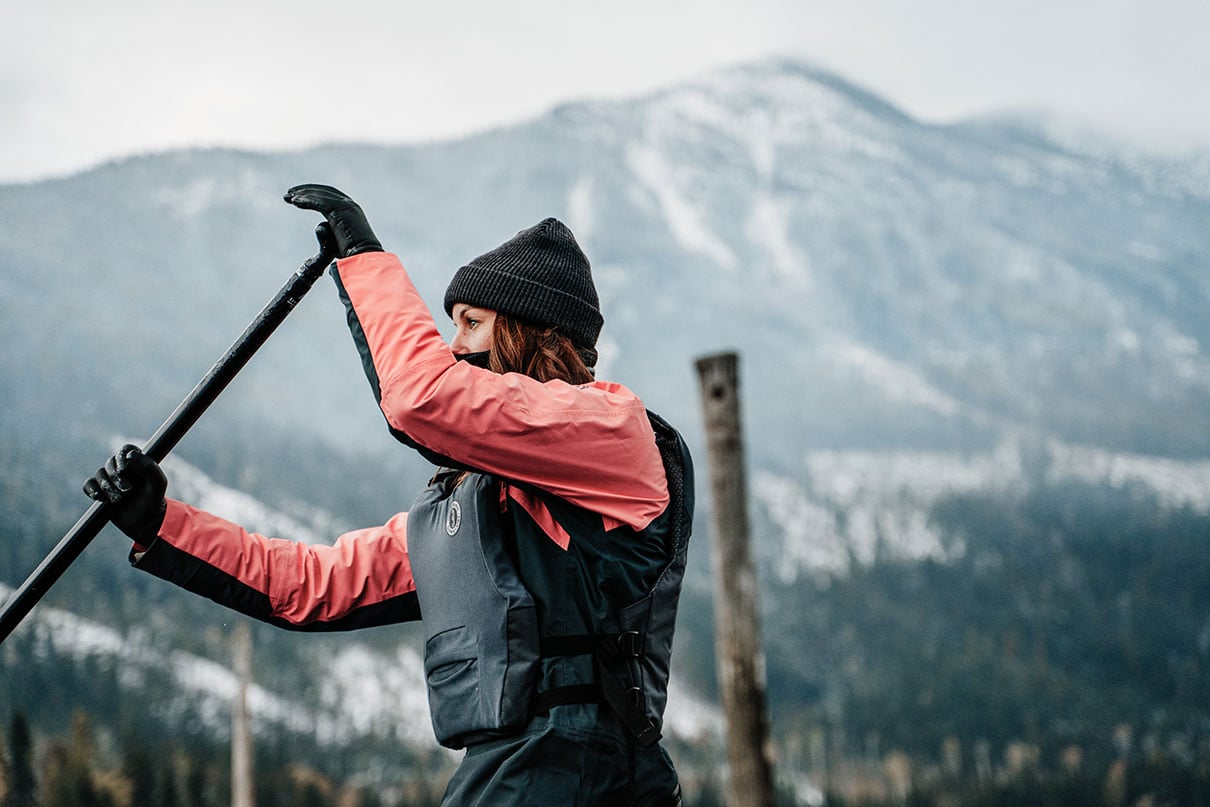
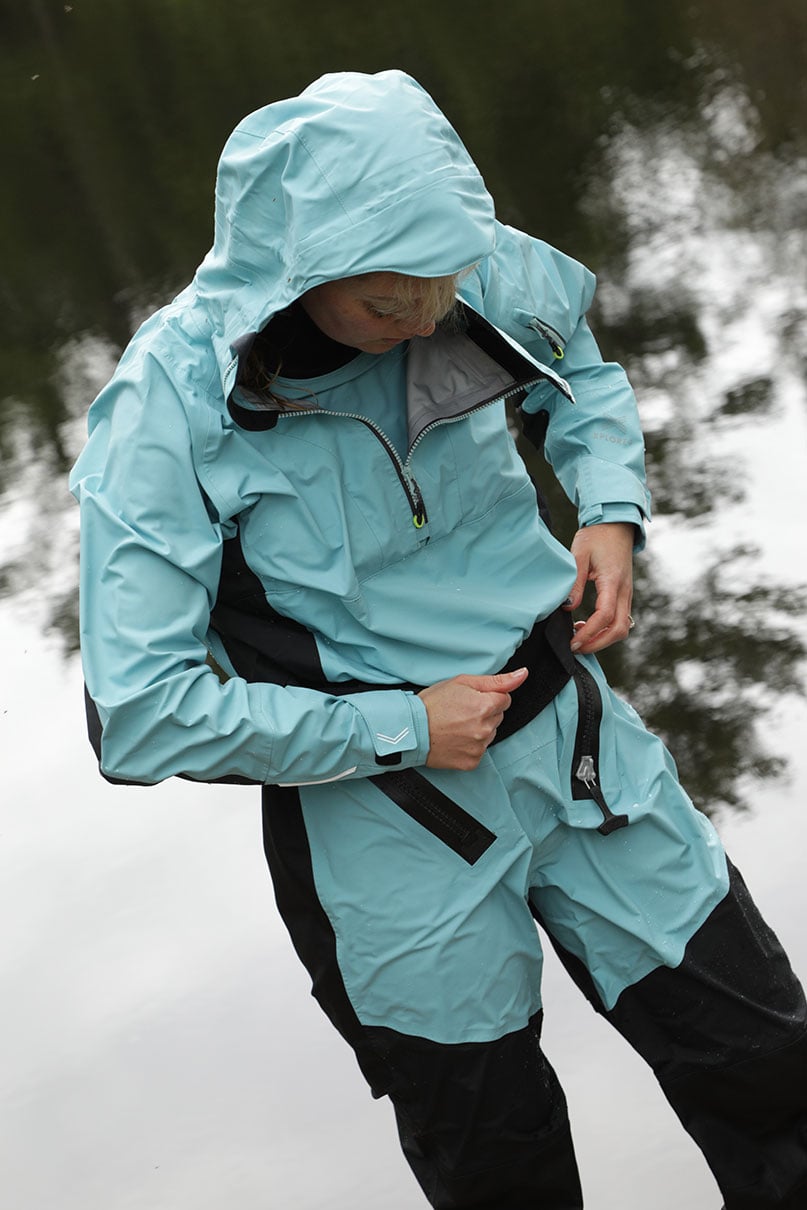
A waterproof-breathable paddling jacket or drytop with hood keeps paddlers comfortable even on foul weather days. | Feature photo: Virginia Marshall
The world of kayaking is as wild as you choose to make it. My kayak adventures have taken me from Lake Superior to the Aleutian islands. From the coast of Wales to the Golden Isles of Georgia. Hot weather, cold weather, even a little snow from time to time. The key to staying safe and comfortable on the water is choosing clothes that protect against the elements—sun, wind, rain, heat and cold.
The good news is that you may already have some of the right clothes in your closet. Kayaking clothing shares similarities with other outdoor gear. You’ll need insulating layers for cold, sun protection in heat and waterproof shells for rain. Throw in a little specialized clothing for cold water protection, and you’ll be well on your way to kayaking comfortably.
What to wear kayaking
We’ll go into more detail later in this article, but for starters, here are the key points to remember when choosing what to wear to go kayaking:
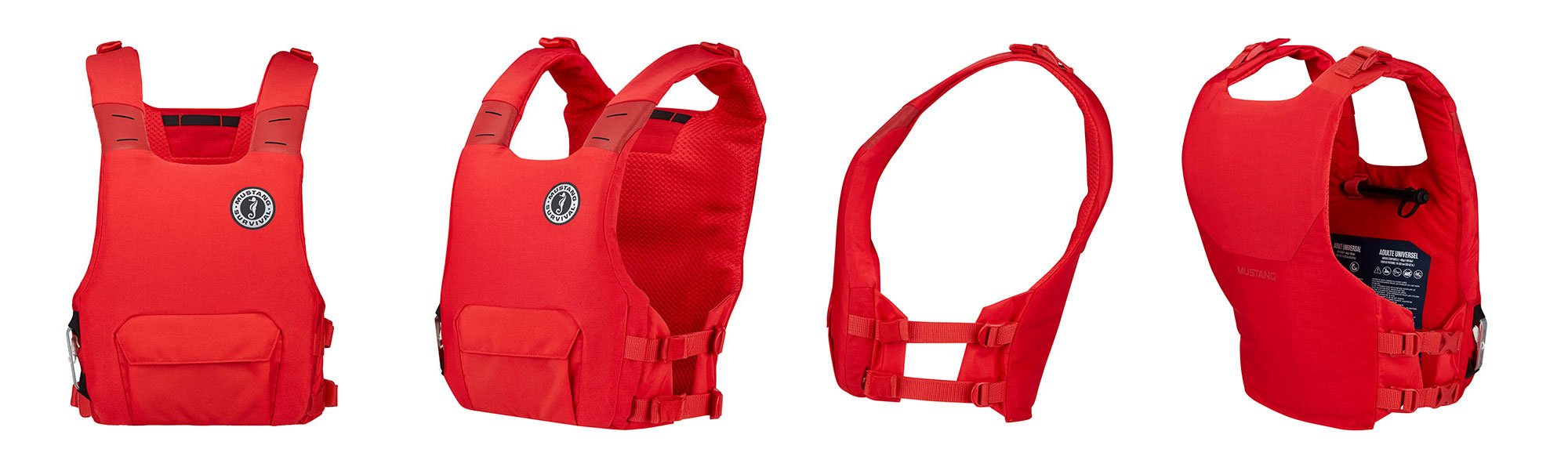
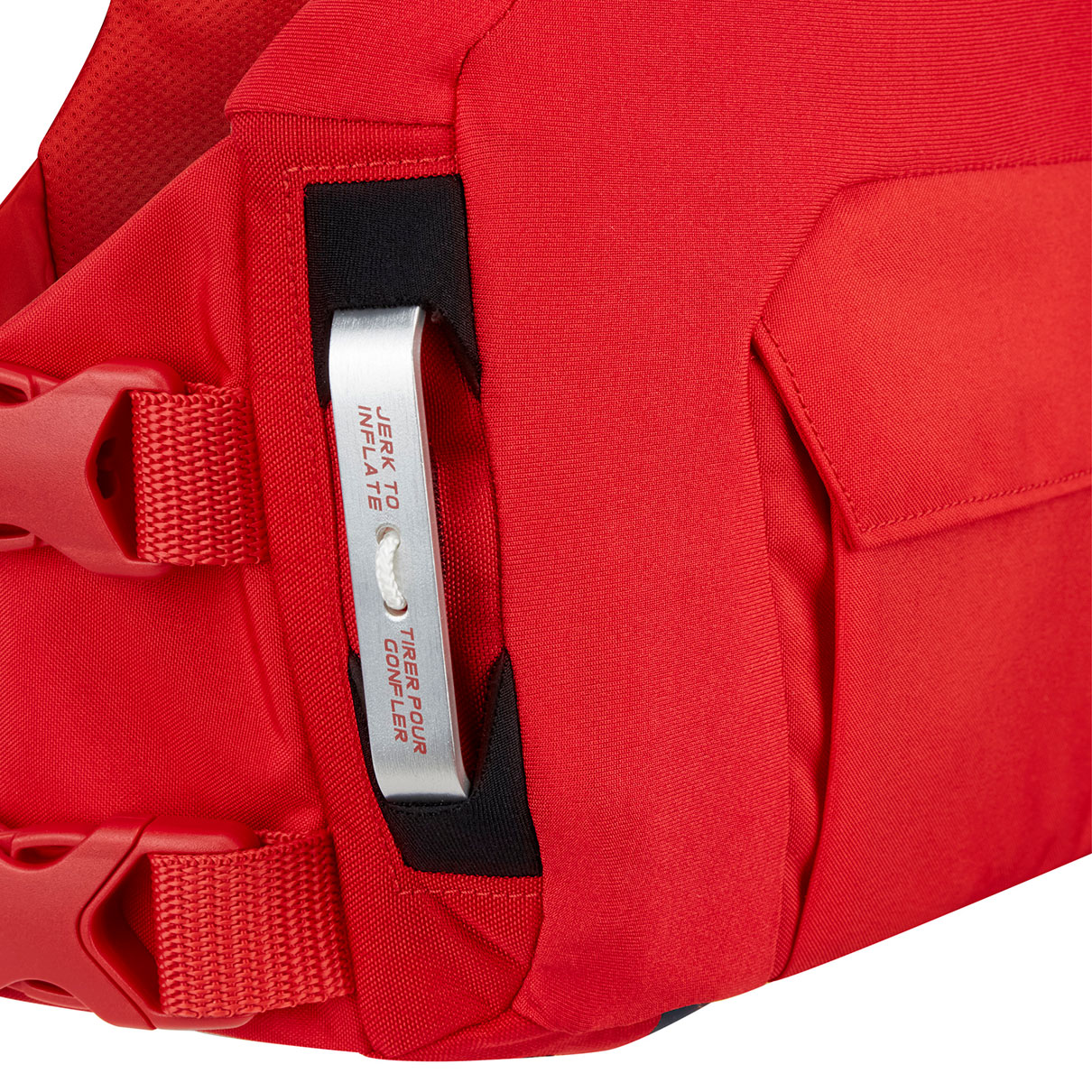
Always wear your life jacket. Technically, we call these vests personal flotation devices or PFDs. Even if you’re a strong swimmer, it’s a good idea to wear your PFD anytime you’re on the water kayaking. PFDs make it easier to swim, easier to get back into your kayak in a rescue and even provide some insulation. Get Paddling Mag’s recommendations for the best life jacket for the type of paddling you do.
Dress for immersion. Cold water is a killer. Water conducts heat away from the body 25 times faster than air, so even cool water can chill you quickly. That’s why it’s important to dress for a swim even if you don’t plan to tip. Specialized kayaking clothing like wetsuits and drysuits are key for cold water safety. More on this below.
Layer up. Dressing in layers is the best way to stay comfortable in the outdoors and kayaking is no exception. Savvy paddlers wear a good set of base layers next to their skin to manage moisture, insulating layers over that for warmth, and a shell layer on top to block wind when needed. It’s always a good idea to pack an extra layer in a dry bag, just in case you get chilled.
Don’t get burned. Sunlight reflecting off the water is intense and it doesn’t take long to get scorched, even with cloud cover. A base layer with long sleeves provides good coverage and sun protection. Wear sunglasses and a wide-brimmed hat, and apply sunscreen as needed.
Avoid cotton. Cotton absorbs moisture and stays damp. Wicking, fast-drying materials, like nylon and polyester, are better options to keep from getting chilled on the water. While wool takes longer to dry, it still provides insulation when wet, making it a good alternative.
When to wear a wetsuit or drysuit
The U.S. Coast Guard considers any water below 59°F (15°C) dangerous. Water this cold is painful against bare skin, can cause cold water shock and will rapidly chill your body into hypothermia. Over time, hypothermia can cause you to lose muscle control and may lead to drowning.
What if the water is warmer than 59°F? The fact is even 70°F water will give you a chill. Remember that water conducts your body heat away 25 times faster than air. Seventy-degree air is a pleasant temperature for a summer hike, but it will make your teeth rattle after an hour of swimming. When kayaking, dress for immersion any time water temperatures are 70°F or below.
What about air temperatures? For years, kayakers were advised to dress for immersion whenever the air and water temperature added up to less than 120°F. The problem is that sometimes the water can be dangerously cold even on a scorching hot day. This is common on Lake Superior, where summertime water temperatures might be in the 50’s while air temps soar into the 80’s. Nowadays, the National Center for Cold Water Safety recommends using water temperature alone as a guideline.
An important guideline for staying safe while kayaking is dressing for immersion. | Photo: Courtesy Eddyline Kayaks
Wetsuit vs. drysuit: Which should you wear?
Now that we know when to dress for immersion, we can talk about what to wear to stay warm in the water. There are two ways to go: wet and dry.
Wetsuits have been around for more than 70 years and are the most common approach. These specialized insulating layers hold water close to the skin where it’s warmed by body heat. Wetsuits keep you much warmer in the water than conventional outdoor clothing. They are also an affordable choice.
Unfortunately, wetsuits don’t perform well at the extremes. When temperatures are very cold, wet systems leave paddlers chilled. When air temperatures are very hot, it’s hard to stay cool in a wetsuit unless you jump in the water. Drysuits are better in these situations.
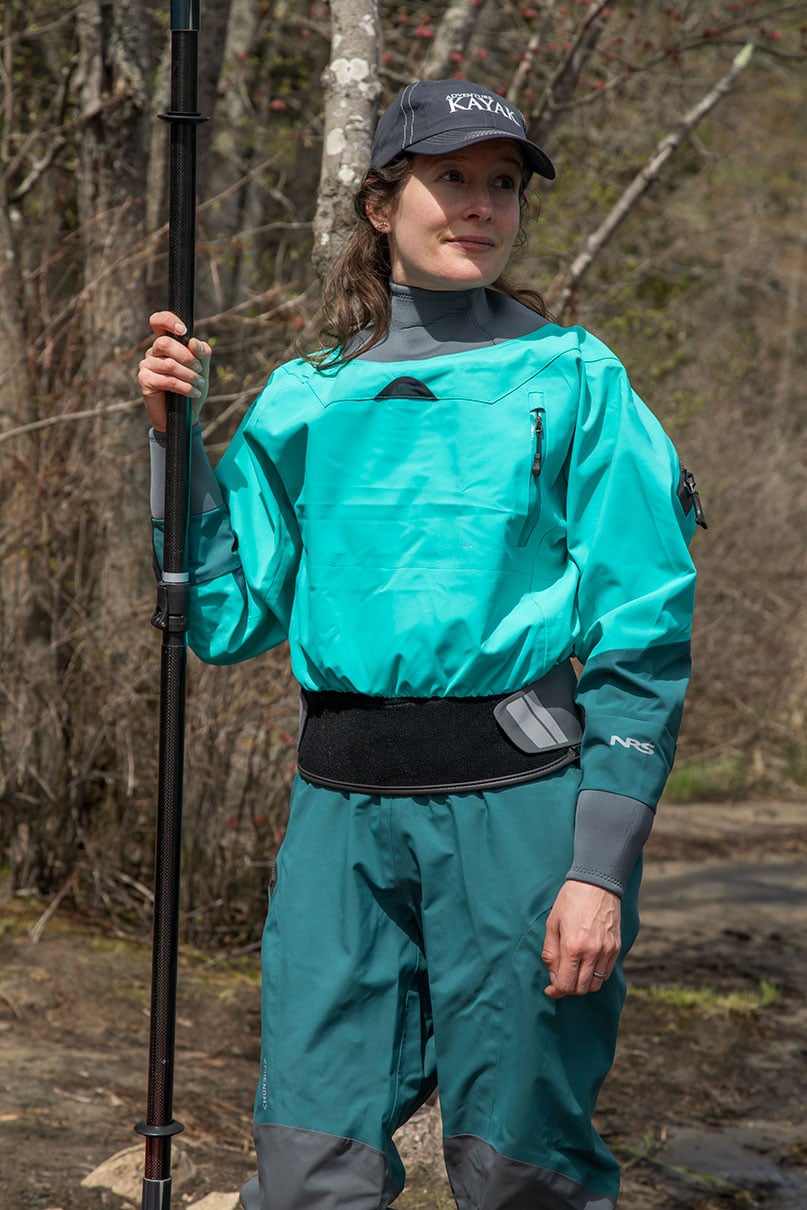
Drysuits keep you warmer because the suit is sealed to keep water away from your body. Insulation worn under a drysuit stays (mostly) dry, so water can’t conduct heat away from your body as fast. Insulating layers under a drysuit can be varied to adjust for different water and air temperatures, so you’re less likely to overheat in the summer or get chilled on a cold spring day. Unfortunately, drysuits are more expensive, particularly those with breathable fabrics that offer the broadest comfort range. Drysuits come in men’s, women’s and unisex models.
Layering basics: How to stay warm and dry
Here’s a quick primer on layering for comfort on the water.
Base layers are essential for managing moisture during kayaking. They wick perspiration by moving it from the inside to the outside of the fabric. Polyester is the most common material due to its quick-drying properties, while merino wool offers warmth, effective wicking and odor resistance. Nylon, though slow to dry, is sometimes used for sun protection. Kayak-specific base layers are designed with features like chafe-reducing seams, higher waistbands and longer hems for comfort while paddling, and we’ve put together a complete guide to our favorite choices for base layers.
Insulating layers for kayaking comes in two types: wet and dry. Wetsuits keep you warm when wet. Dry insulation is what most of us are familiar with already—usually polyester fleece. Fleece can be worn under a drysuit or even layered with a wetsuit in cooler weather. Dry insulation is more versatile and can be used for various outdoor activities. Wetsuit layers are typically used only for paddling and cold water protection.
A drysuit is a good idea for whitewater kayaking.
Shell layers are usually waterproof and have seams that are sealed at the factory to prevent leaks. The most versatile shell layers are made from breathable materials. These materials allow some perspiration to escape from the inside of the fabric. This helps keep you drier and more comfortable while paddling. Kayaking paddling jackets have specialized neck and wrist closures to help keep water out. Neoprene or similar cuffs seal sleeves and ankles more tightly than conventional closures. Even drier are the latex gaskets found in drysuits and drytops.
Sun protection for kayakers
The best way to avoid sunburn is to cover as much of your body as possible with sun blocking layers. The same base layers you wear under insulation in cool weather will effectively keep the sun at bay. Specialized sun blocking layers do an even better job and often come in cooling fabrics that will keep you comfortable in the heat. Add a wide-brimmed hat, sunglasses and a liberal application of sunscreen you’ll be ready for action. There are even sun gloves that offer protection for those who prefer not to lotion up.
Which shoes to wear for kayaking
Most kayakers favor wearing neoprene footwear and water shoes. Neoprene wetsuit booties keep your feet warm when wet. Waterproof neoprene boots keep water out and are even warmer. Both are low-profile to give you lots of wiggle room in your kayak.
Water shoes come in all varieties, from thin slip-ons to lace-up water boots. Shoes typically have more structure and support than neoprene booties and are a good choice if you know you’ll have to spend some time on your feet and want to take a shoreside ramble.
Wondering what to wear when you kayak? Stay comfortable and safe with this advice. | Photo Virginia Marshall
Sandals can be a good choice for many paddlers, however some people find them bulky and uncomfortable in an enclosed sit-inside kayak. But going barefoot is a bad idea. You never know what you might step on when you hop out of your kayak. It’s best to wear some kind of footwear for protection. A thin water shoe is better than nothing.
What to wear kayaking in summer
Dressing for kayaking in the summer can be either a breeze or a challenge, depending on the water temperature. Hot weather and warm water call for a focus on sun protection, but if the water is cold, you need to balance comfort in the cockpit with safety in the event of a swim.
In hot conditions with warm water, paddlers should focus on clothing that helps keep them cool and protected from the sun. Wicking base layers with long sleeves provide good coverage and sun protection. Specialized base layers are available with hoods and long sleeves for maximum coverage up top. Lightweight nylon shirts or hooded tops are another option for sun protection. Comfortable and quick-dry board shorts will do in many cases, but long, quick-dry nylon pants offer extra protection from sun and biting insects. A broad-brimmed hat is a good choice to keep the sun off your face and neck. Specialized paddling gloves are available to protect hands from sunburn.
If the water is below 70°F, dressing for summer is more challenging. If you go for a swim in shorts and a t-shirt in Lake Superior or coastal Maine, you’ll get hypothermic even if the air temperature is warm. Wetsuits provide enough insulation for a dip in these conditions, but wetsuits are hot to wear when air temperatures climb.
There are a couple of ways to work around these challenges.
What to wear under a drysuit and wetsuit in summer
If you’re wearing a wetsuit for insulation in summer you’ll want to maximize cooling while you’re in your kayak. Skip the shell layers so that any breeze will help cool your body. Wet yourself down from time to time to keep cool. Some kayakers will roll or dip their head into the water while holding onto a friend’s boat, or even go for a deliberate swim.
If you’re wearing a drysuit in summer, layer thin base layers underneath. You won’t have as much insulation, but you’ll have enough to protect you from all but the coldest water. If you start to overheat, use the techniques suggested above.
What shoes to wear kayaking in the summer
Water shoes are comfortable to wear in the summer, whether you’re paddling in shorts or a drysuit. They provide protection from sharp objects in the water and comfort in your kayak. Neoprene footwear is comfortable in the kayak but hot on summer days.
The key to kayaking comfortably and safely in the winter is layering up and dressing for immersion. | Photo: Kaydi Pyette
What to wear kayaking in colder temperatures
Anytime the water is cold, kayakers need to dress for cold water immersion. This means a wetsuit or drysuit and appropriate layers to account for conditions.
The colder the weather and water are, the more insulation you’ll need to stay warm. You can add fleece layers to your wetsuit, or use a thicker wetsuit, but eventually it becomes more practical to switch to a drysuit. Fleece layered under a drysuit will keep you much warmer than a wetsuit. When temperatures really dip, a drysuit is the way to go.
Cooler weather calls for different headgear and handwear. Warm, waterproof headwear is key to maintaining body heat. A hooded paddling jacket offers protection from wind and seals in more heat. Thick neoprene gloves are an option for protecting your hands but many paddlers find pogies to be warmer and more useful. Pogies are neoprene mittens that attach to your paddle. You can often keep your hands bare under pogies so you have a good feel for the paddle. Some paddlers wear thin gloves under pogies so they have a little protection when their hands are outside the mitts.
Cooler water and cooler air call for warmer footwear. Neoprene booties are a good choice and can be worn over wool socks for extra warmth and comfort. Waterproof neoprene boots will keep your feet dry and are a better choice as temperatures fall. Water shoes can be made warmer by wearing them over neoprene socks.
Extra layers for kayaking in cold weather
If you’re relying on fleece for insulation in early fall, it’s a good idea to pack an extra set of clothes to change into in the event of a swim. Paddlers using wetsuits might pack an extra fleece top for insulation or an oversized hooded jacket to be worn over other layers. Multi-day trips call for clothing that can be dried on the body or extra layers that can be swapped out in camp. In cold weather, it isn’t a bad idea to take a simple beach shelter like a tarp for protection during breaks, and a thermos with a hot drink to help warm you up.
A waterproof-breathable paddling jacket or drytop with hood keeps paddlers comfortable even on foul weather days. | Feature photo: Virginia Marshall
What to wear kayaking in the rain
Kayaking in the rain can be pleasant or downright miserable. The right clothing makes all the difference.
Closed-cockpit kayaks fitted with sprayskirts stay remarkably dry in the rain. Open sit-on-top designs are much more exposed to the elements. The right clothing for each will help you stay comfortable if it starts to pour when you are on the water.
In a closed-cockpit kayak, the most comfortable piece of clothing you can wear is a hooded paddling jacket that fits tightly over your sprayskirt. The skirt seals your lower body from the rain so you’ll stay dry and warm from the waist down. The paddling jacket keeps your upper body dry and comfortable.
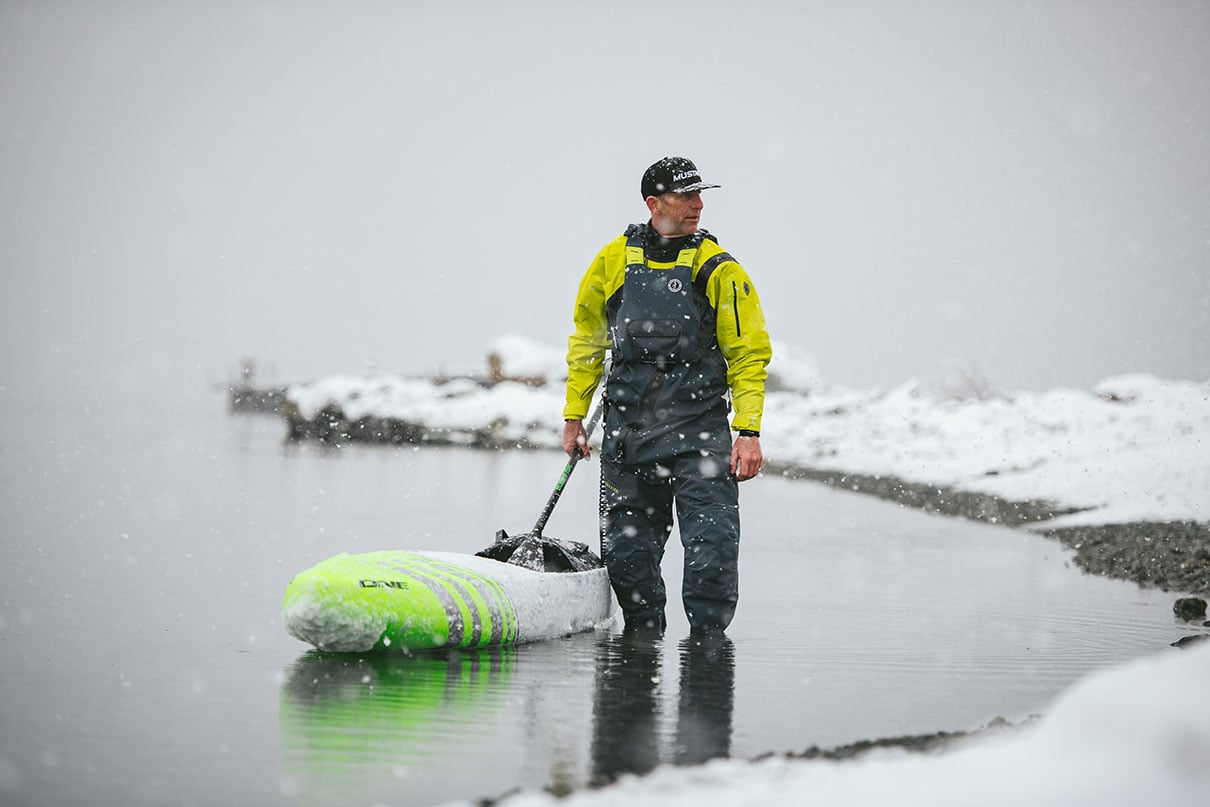
If you’re paddling a sit-on-top design, you’ll need waterproof paddling pants as well as a jacket. In this case, it’s better to choose a jacket that is a little longer at the waist so your top overlaps your pants and prevents any gaps where water could trickle through. Paddling bib pants or waders are another good way to get extra protection from rain and spray, and they’ll keep your feet dry if you step into the water. Waterproof neoprene boots are a great choice for keeping your feet warm and dry in rainy weather.
Sea kayakers wearing drysuits have a couple options for rainy weather. A broad-brimmed waterproof hat will keep the water out of your eyes on a warm day. In colder weather, rain might call for adding a hooded waterproof jacket over the top of your drysuit and PFD.
A waterproof-breathable paddling jacket or drytop with hood keeps paddlers comfortable even on foul weather days. | Feature Photo: Virginia Marshall
Ample bow volume and rocker helps the Rewind resurface and maintain speed after drops, while its slicey, low-volume stern turns every eddyline into a play opportunity. | Photo: Scott MacGregor
Kayaks weren’t intended for rivers. They began as a mode of travel and hunting for the Inuit on the tidal waters of the North. Then as they gained wider use, some foolhardy souls decided these long, enclosed boats, with profiles as straight as an arrow and made of destructible material, would make fine vessels to travel wild rocky rivers in search of recreation and exploration. We are forever grateful for their misjudgment.
We’ve come a long way in kayak design, and because of it, whitewater has never been more exciting or as accessible to learn as it is today. This also means we’ve never had more options to choose from. There are fine models available from a collection of brands in North America. The hope for these top picks, however, is to not only share what I believe are the best whitewater kayaks out there but also provide you with some key elements worth considering when making your choice.
For someone starting out in this sport, the most important aspect of a whitewater kayak design is that it inspires confidence. This is exactly why I became enamored with the Jackson Flow the moment I sat in it.
The Flow is slightly shorter with less volume than most current river runner/creek boat designs. This gives the kayak a more manageable feel for beginning paddlers to learn how rivers work and evolve their abilities without sacrificing stability and forgiveness. The boat’s rocker and overall profile provide enough speed and the ability to carry you over and away from drops and holes. The combination of the hull design and edges means you can use features to move around on the river, carve up a wave or spin like a top. In fact, the Flow may be the easiest-to-surf kayak of its genre I’ve ever sat in.
The combination of design attributes within the Jackson Flow equates to a kayak that made me feel like I could do what I wanted, when I wanted, on the river. That feeling is of immense value as a kayak for beginners, and why, once you’ve mastered the fundamentals, you still will not have outgrown the capability of this whitewater kayak.
Reasons to buy
Enough size to inspire confidence without going overkill.
A loose hull, combined with carvy edges and a tapered stern profile that surfs and utilizes features well.
Easy to adjust outfitting that allows you to make adjustments on the go.
Consider another if
You are looking for a half slice kayak that can perform moves like stern squirts (tailies).
Steep, difficult, high-volume whitewater is your average day.
You are not a fan of the Jackson outfitting system.
Bottom line
Beginner or not, if you are seeking an all-around river runner you can’t go wrong choosing the Jackson Flow as your whitewater kayak. See the Flow again on Paddling Mag’s list of best kayaks.
In 1996, Dagger Kayaks released what is considered by many the most popular whitewater design of all time, the RPM. Over 20 years later, it’s no surprise that with the modern half-slice movement, Dagger has produced another masterpiece in the Rewind.
The intention of a half slice is to open every dimension of a river. The Rewind is not radical in any of these dimensions, but rather a sound and predictable design that allows it to be both playful when you want it to be and capable when you need it to be. Every year a brand releases a new half slice and still the Rewind maintains a place at the top as the best all-around choice.
There is perhaps no aspect of a half slice more sought after than the ability to sink the tail. The Rewind provides this through a gradual thinning of the stern from the cockpit to the end of the boat, finishing in the last few inches with a flat, squared-off stern that will allow you to pivot into some beautiful tailies (or stern squirts as previous generations of paddlers have called them). Sinking the stern vertical on the Rewind is not a gimme though, as it might be with other stern designs. I look at this as a good thing though for the kayak’s ability to run a difficult rapid with more predictability. It has volume in the bow and a progressive rocker to carry it over drops. The tucked-in edges slide over rocks and provide some forgiveness in turbulent current. It remains river-running minded and the closest thing out there to—excuse the cliche—a quiver killer of a kayak.
Reasons to buy
Join the half-slice revolution and sink the stern.
One of the most predictable boats available in this genre.
Remains river-running-minded.
Consider another if
Getting vertical on the stern outweighs forgiveness and predictability.
You are looking for a pivot speed machine in hopes of Olympic kayak cross glory.
A low-volume tail that will get stood up in strong currents is beyond your comfort zone.
Bottom line
There is a reason the Dagger Rewind remains a popular model five years after it first hit shop floors thanks to a beautiful balance of party and business.
No boat more embodies the spirit of what river runners of today want on steep, high-volume rivers than the Pyranha Scorch. Plane out, skip, lean, simply put, the Scorch is a styley rapid slayer.
The Scorch was well thought out in its bow-to-stern design, combining big bow rocker, a planing hull with sharp edges running through the stern, and a tapered stern in the back that allows you to pick up the bow with big, leaning boofs. Those elements also provide the ingredients for skipping over drops and planing out of runouts on the stern with control to maintain momentum for a flowy ride down burly reaches.
When I reviewed the Scorch, what stood out most as I entered rapids I had just scouted carefully, was the kayak design’s ability to have me saying, “That was it?” at the bottom. The Scorch has even gained an unofficial superlative claim as the most stable whitewater kayak out there. An attribute sought after both for running the biggest rapids in the world or learning the ropes.
Reasons to buy
A boat profile made to style the biggest whitewater your adrenal glands can handle.
Combo of bow rocker, tapered stern, hull and edges to master modern river running with leaning boofs and skips.
A stable platform to stay upright.
Consider another if
Big rocker and volume make you feel like you are up to your nose in a boat.
You’re looking for softer edges or a displacement hull.
You want to play the river.
Bottom line
If you daydream of skipping out of one waterfall and into the next in the steepest gorges on earth, the Pyranha Scorch is your steed.
I’ve paddled generations of Jackson freestyle kayaks, including the Rockstar series. Whenever I jump in one it has a way of making me feel like I can suddenly hit an easy button on aerial maneuvers I’ve spent years toiling away at.
A big reason why Jackson’s Rockstars make for more effortless freestyle is their constant focus, or at least my perception of it, on the ability to initiate tricks. The Jackson Rockstar V continues the trend. For the Rockstar V Jackson went back to a slicey bow that cartwheels and plugs into moves in a fashion reminiscent of their 2016 model. It has a narrowed stern that lets you release from features.
The Rockstar V also has perhaps the loosest hull Jackson has ever designed to slide around and spin on waves and holes. The looseness of a hull is a key element both for setting up on a feature, whether for a flat spin or rotating into a McNasty, and for recovering after tricks to restabilize your surf on the the wave or hole. With the Rockstar V, Jackson has accomplished this with a double rail stepping down from the sidewall to the hull—something they’ve never included on a freestyle kayak before.
Reasons to buy
Easy to initiate the bow.
Loose Hull spins like a top.
Bees Knees Thigh Hooks are quick and easy to adjust, and Jackson has included a foam foot-block standard.
Consider another if
You are not a fan of Jackson’s rope and cleat backband or other outfitting components.
Your local rivers don’t hold quality playspots and a half slice would better serve your appetite for verticality.
Bottom line
The Rockstar provides the tools to up your game, whether freeriding or trying to win a pro rodeo.
Best inflatable whitewater kayak
AIRE Tributary Tater
Paddling Magazine’s Brenna Kelly (right) hashing out plans with the AIRE Spud and Tater on British Columbia’s Shuswap River. | Photo: Ursula Kilbridge
Every time I’m talking with someone about the AIRE Tater we come to the same conclusion: the thing is a blast. Traditional inflatable kayak designs are known for having more stability than any other individual whitewater kayak, but they are also known for steamrolling rapids like a barge. The Tater, and its youth-sized accomplice, the Spud, remain stable yet sporty. Their smaller size feels playful in whitewater by allowing some of the exciting elements of running a river (see plugging holes and getting thrown around by waves) to take place without the learning curve of an enclosed whitewater kayak.
Being an open deck inflatable it also means you can climb back in when you flip. Speaking of open-deck kayaks, there is an odd inverse between whitewater and flatwater when it comes to inflatable kayaks versus sit-on-top kayaks. I’d recommend a plastic sit-on-top most of the time on other waterways, but on whitewater runs, they run up against their limitations quick. An inflatable like the Tater is going to be more versatile and fun in the long run.
The Tater and Spud feel inspired by the growth of packrafts and their compact designs. While it is by no means as light or rolls up as small as a packraft, it is built with a base material of PVC closer to the denier of a raft, providing a burly construction that stands up to abuse. Its low retail cost also makes it a great budget-friendly choice.
Reasons to buy
Inflatable kayak in a smaller package that is the perfect blend of stability and excitement.
An open cockpit means you can climb back on after you flip.
Burly PVC construction holds up to heavy use.
Consider another if
You are planning to carry extensive gear, such as on a multi-day trip.
You are seeking the traditional “barge” feel of an inflatable kayak.
You want technical performance only available with a sit-inside hardshell whitewater kayak.
Bottom line
I’ll say it again, whether you are a whitewater veteran, beginner or looking for a boat for your kid, the Tater and smaller Spud are a blast.
If a brand is still selling a whitewater kayak over 15 years later, it’s a design you can trust your kids with. The Remix has been beloved for years for its speed and rounded, forgiving hull. Personally, I paddled both the Remix 69 and 79 for years as my creek boats. The Remix series is also loved by kayak schools, and the smallest size, the Remix 47, is a great choice for your kid’s first whitewater kayak.
For years, river running designs were getting shorter—the Remix changed the narrative. Instructors knew this boat would be a benefit to building fundamentals in the sport. Back in 2008, when the Remix was first released, Paddling Magazine founder Scott MacGregor reviewed the boat and asked instructors what they found so exciting about it.
“This group of top instructors,” MacGregor wrote, “strongly believe kayaks need a minimum amount of speed, stability and tracking for beginners to understand the basic concepts of paddling whitewater.”
The Remix succeeded and is still building the foundation of our sport today with its youth size.
Reasons to buy
Trusted design around for nearly two decades.
Length-to-width ratio provides speed needed to properly learn fundamentals like eddy turns and peel-outs.
Rounded hull is forgiving while learning to understand the dynamics of currents.
Consider another if
The Remix 47 doesn’t fit your child properly
You are looking for a flat planing hull
They would feel more comfortable with an open-deck boat like an inflatable whitewater kayak.
Bottom line
The Remix series has been a successful design in production for nearly two decades—the record speaks for itself.
There are plenty of niches within whitewater, but if you can only own one kayak, buy the boat that you are going to enjoy paddling on the majority of the stretches you run. You also want your kayak to be a design that simultaneously allows you to progress your skill level, but doesn’t lead to consistent frustration.
If your river is class II–III but lacks features capable of freestyle rides, look toward a half slice that makes your whole run playful and allows you to challenge yourself. If you are new to the sport and staying upright and feeling stable are your priorities while you get the basics down, consider a full-volume river runner/creek boat. And if you just want to float down stretches of mild to moderate whitewater without being in an enclosed boat, or learning skills like rolling, an inflatable is going to be an incredible way to experience rivers.
As you spend time whitewater kayaking you are going to gain a better appreciation of where you want to go with the sport and what types of waterways you want to run, and your sense of the type of boat you want to paddle may evolve as well.
The kayaks in this article were chosen through recent years of accumulated experience with numerous whitewater models, as well as the input of our contributors through our extensive boat reviews.
Paddling Magazine digital editor Joe Potoczak.
Why trust us
Our digital editor Joe Potoczak has paddled whitewater for more than 20 years. He has run rivers on four continents, led instruction programs, competed in freestyle competitions and whitewater races, and is a former member of the U.S. Wildwater team.
ALABAMA, September 2024 — The 6th edition of the Alabama Scenic River Trail’s Great Alabama 650, the longest annual solo paddle race in the world, will see its largest field of competitors yet. This year, 20 boats are set to begin the grueling 650-mile race across Alabama on September 21. Paddlers from 11 states and two countries (the U.S. and Germany) will face whitewater rapids, tidewater currents, flatwater stretches, and nine dam portages, with 35% of participants hailing from Alabama.
Participants will compete in one of three divisions: male solo, female solo, or tandem teams. Racers have 10 days to reach the finish at Fort Morgan, with only 4 hours and 45 minutes of mandatory rest throughout the race. Each Racer is required to have a crews to assist them as they traverse the state’s waterways. Crew can often make or break the race as the support team that racers choose will be who they rely on for food, rest, supplies, and support across the 10-day period. The race is an intense test of racers speed, endurance, and skill, where kayaks, canoes, and stand-up paddleboards are used interchangeably due to the variety of water conditions found on the Alabama Scenic River Trail.
“There’s no other race like this anywhere in the world,” said Race Director Greg Wingo. “Racers will encounter a variety of water challenges, and the wildlife is just as unique, with sightings of bears, eagles, alligators, and even sharks. It’s guaranteed to be an exciting 10 days!”
Notable participants include returning champions Trey Reaves (2023) and Bobby Johnson (2019, 2022), along with Ryan Gillikin, who aims to become the third-ever five-time finisher. Lindsey Tilton of Florida and Veronica Sosa of Texas are attempting to become the first women to complete the race primarily on paddleboards.
The race kicks off at 10 a.m. on September 21 at Weiss Lake. Spectators can follow the action via a live map on AL650.com and through real-time updates on ASRT’s social media (@GreatAlabama650) using the hashtag #AL650. If spectators see a racer out on the water, they are encouraged to post a photo with the hashtag (#AL650) or tag the @greatalabama650 race account to share the racer’s progress.
Event Details
Who: 20 racers
What: The 6th edition of the Great Alabama 650, a 650-mile paddle race
When: September 21, 2024 – October 1, 2024
Where: Starting at Weiss Lake and ending at Fort Morgan, Alabama
Social Media: Follow ASRT’s race specific accounts @GreatAlabama650 on Instagram and Facebook as well as #AL650 across platforms for live updates
The Alabama Scenic River Trail (ASRT) maintains and promotes the National Water Recreation Trail, which stretches 630 miles, along with a network of 6,300+ miles of river trails throughout the state. ASRT works to ensure fun, safe, and welcoming opportunities for people to explore Alabama’s diverse waterways. Through collaborations with local partners, members, organizations, and outfitters, ASRT serves as the state’s premier paddling resource for all skill levels. The organization’s trail network spans from North Alabama mountain streams and whitewater rapids to South Alabama’s river deltas, making it one of the most varied water trail networks in the nation. The Great Alabama 650, ASRT’s signature race, highlights the full scope of these waterways, promoting appreciation and recognition of the state’s great water recreation opportunities. To learn more, visit alabamascenicrivertrail.com.
Lili Colby of Mustang Survival paddles the new Esquif Ocoee at the Paddlesports Trade Coalition Colab in Oklahoma City. | Photo: Kaydi Pyette
The legendary Ocoee, one of the most renowned solo whitewater canoes of all time, is making a return—this time, crafted by Esquif in T-Formex. Launched at the Paddlesports Trade Coalition Colab industry gathering in Oklahoma City, Esquif’s Ocoee builds upon the legacy of the original design, which has earned a cult following in the open boat community since its inception in the 1990s.
“We’re proud to reintroduce the Ocoee in T-Formex and continue its legacy,” said Esquif president Jacques Chasse, who was accompanied at the September 4-6 event by two Ocoees fresh from their molds.
Designed by the late Frankie Hubbard and originally produced by Dagger, the Ocoee revolutionized whitewater open canoes with its hard chines and flat-bottom hull. In a market that was at the time dominated by softer, rounder designs and shallow-arch hulls, the Ocoee quickly became known for its performance on the slalom circuit. The Ocoee set the standard for front surfing and technical paddling, and was also the first production boat that allowed paddlers to offside tilt and engage outside edge to pivot turn an open canoe. Advanced paddlers cherished its agility, while beginners often found it challenging to master—which is exactly what made the Ocoee a legend.
Since Dagger stopped production of the Ocoee, the design has been picked up by several brands for multiyear stints, mostly notably by Bell Canoe Works for four years and then Nova Craft Canoe. Currently North Star and Echo, among others, offer versions of the Ocoee. However, Esquif saw an opportunity to craft the boat in T-Formex, the brand’s replacement for Royalex, which was the material used in the original Dagger design.
Lili Colby of Mustang Survival paddles the new Esquif Ocoee at the Paddlesports Trade Coalition Colab in Oklahoma City. | Photo: Kaydi Pyette
Photo: Kaydi Pyette
Photo: Kaydi Pyette
A Legacy Reborn
“The Ocoee was a game changer. And you know, many in the whitewater paddling community and canoeing community are not necessarily 18 years old anymore—they’re nostalgic. It’s a mystical thing with the Ocoee that I believe is worth bringing back to the market,” says Chasse.
Esquif’s Ocoee’s mold is pulled from a never-paddled OG Ocoee. “We took an original boat—we were lucky enough to get our hands on a brand new one, never used or touched the water—so our canoe is an authentic Ocoee,” adds Chasse.
At 40 pounds, the Esquif Ocoee in T-Formex shaves at least seven pounds off the original Dagger design in Royalex, which tipped the scales between 47 to 52 pounds. The Ocoee is now available with wood or vinyl gunwales.
Photo: Kaydi Pyette
Esquif Ocoee Specs:
Length: 11’2″
Width: 29″
Depth at bow: 16”
Rocker: 5.5″
Weight: 40 lbs
Material: T-Formex
Capacity: 500 lbs
MSRP: $2,329 USD
The original Ocoee listing in Dagger’s 1994 catalog. | Photo: David Hadden / Facebook
Out with the convention center and in with the rootsy demo. | Feature photo: Riversport OKC
The Paddlesports Trade Coalition Colab is billed as a new type of industry gathering. Paddling Business spoke to key players about the philosophy and business realities behind the September 4–6 event in Oklahoma City.
The preparation has been going on for months, synthesizing the best features of previous gatherings, putting some old favorites front-and-center, adding some new elements and throwing others overboard.
First over the gunwale was the trade show billing. “Colab is the opposite of a trade show. It’s a collaboration of the paddlesports community,” says PTC board member and Level Six CEO Stig Larsson.
Adds PTC Executive Director Jeff Turner, “Colab is an annual event for the entire paddlesports industry that includes engagement, education and an opportunity to buy and sell. I don’t know if that’s so different than a trade show, but as an industry we are going to see if we can do it in a more casual atmosphere and a more engaged atmosphere.”
Out with the convention center and in with the rootsy demo. | Feature photo: Riversport OKC
The event is taking place in Oklahoma City, a favorite venue of past paddling shows. Suppose a kid threw the best birthday party in the neighborhood for three years running and then moved across town. That party was Paddlesports Retailer, the first national paddling-only show, held in Oklahoma City from 2017 through 2019. Paddlesports Retailer had the trappings of a traditional trade show with a convention hall full of exhibitor booths, plus a demo day at Riversport OKC, with boats and gear arrayed around the whitewater park in the heart of downtown Oklahoma City.
“We’ve heard from so many people in the business how engaging that event was, not just the convention center, but more importantly, what happened at Riversport,” Turner says. That feedback shaped Colab’s product showcase: Out with the convention center and expensive booths and in with the rootsy demo at a whitewater park.
“It’s not designed to be a spectacle. Nobody is going to show up with a double-decker trade show booth,” says Mark Deming, Chief Marketing Officer at NRS. “Paddlesports at its heart has always been a very grassroots community. It’s humble. It’s not flashy, and we’re just leaning into that.”
Putting paddlesports front and center
Another lesson PTC organizers took from Paddlesports Retailer is aligning the event with the organization’s goals. In 2017, Paddlesports Retailer replaced Outdoor Retailer as the premier paddling show in North America, but when it later morphed into The Big Gear Show the industry was again left without a national event focused exclusively on paddlesports.
The PTC entertained proposals from trade show companies, including a strong pitch from Big Gear Show owner Lost Paddle Events, but ultimately went its own way. “We as a board decided that what we were looking to do for the PTC Colab wasn’t really a trade show company’s expertise,” Larsson says.
Elements of Colab that break the traditional trade show mold include the PTC annual meeting and a series of panel discussions and educational seminars. These sessions are designed to spark the sort of conversations and—dare we say it—collaboration that leave folks energized after 12 hours on their feet.
“The most important thing about Colab is coming together and collaborating in that purest sense, to be inspired and generate ideas,” says Lili Colby, Product to Market Coordinator at Mustang Survival and a key player in forming PTC.
Photo: Michael Hewis
Organizers surveyed the industry to see what topics were front and center on their minds, and then curated speakers and focus groups around those subjects. Colab will feature talks on industry cooperation, understanding today’s paddlesports consumer, and paddling as a vehicle for community engagement. An icons panel will share lessons from decades in the business.
Colab will also feature deep dives on shipping and distribution strategies, a proposed PTC professional credential for retailers, and next-level digital marketing. “Imagine you could go to a PTC event and talk to like-minded peers who are struggling the same way you are trying to figure things out,” Larsson says. “You share ideas, you connect, and you know you’re no longer alone in this wild world of business.”
The where and when of Colab were simple. Oklahoma City’s facilities fit the event’s unique needs, and local leaders were eager to roll out the red carpet for Colab, just as they had for Paddlesports Retailer. As for timing, it was always going to be September. “Retailers just want to focus on selling in June, July and August,” Turner says, adding that as a paddlesports-only event, Colab didn’t have to change its schedule to suit other constituencies.
“My eyes are wide open to what we’re trying to accomplish here,” Turner says. “We are trying to change significantly the way an industry thinks, and hopefully for the better.”
This article was first published in the 2024 issue of Paddling Business. Subscribe to Paddling Magazine’s print and digital editions, or browse the archives.
Out with the convention center and in with the rootsy demo. | Feature photo: Riversport OKC
Hashing out plans with the AIRE Spud and Tater on British Columbia’s Shuswap River. | Feature photo: Ursula Kilbridge
We don’t typically review seven-year-old boats. These last few years have been extraordinary times, and the Tributary Spud by AIRE, first released way back in 2017, is an extraordinary little inflatable whitewater kayak. Okay, fine. Let’s also make this boat review about the Tater, equally extraordinary, only three years old, and until now—because of popularity and the pandemic supply chain issues—almost impossible to get.
AIRE’s Tributary Spud & Tater, not just for small fries
Let’s travel back in time to when Ed Sheeran’s “Shape of You” was number one on the Billboard Hot 100 singles chart. The Cleveland Guardians were struggling to keep the team together. And whitewater was flat, if not decreasing in popularity.
There have been lots of great ideas to increase whitewater participation. Diversity initiatives. Crossover kayaks as gateway river drugs, so to speak. More urban whitewater park developments. Let’s make class II cool again slogan T-shirts. And, of course, getting kids paddling. But how?
“The Spud is perfect for introducing kids to the joys of whitewater kayaking. It is light, short and stable so kids can get a good feel for running waves, punching holes and eddylines in a kayak designed just for them,” wrote AIRE in their printed catalog three years before the world locked down, when they first launched the Spud.
At the time, I remember thinking AIRE had taken their cute little BAKraft packraft and cloned it in a more durable and less expensive raft-grade material. Made sense to me. I’d paddled the BAKraft and loved it.
By creating the smallest and lightest whitewater kayak for the purposes of hiking or biking in and paddling out, AIRE inadvertently pushed the limits of how small we thought a legit kayak could be. The BAKraft wasn’t only easy to carry, it was silly fun to paddle.
It doesn’t take a sales and marketing genius standing at too many on-water events watching kids drawn to the brightly colored lime green BAKraft before a packraft morphs into a production kids’ boat with the coolest name. Keep it reasonably priced, and it’s a sure win.
The history of the Spud’s popularity goes like this, I’m sure: Parents buy Spuds for kids. Parents, of course, also paddle them; who wouldn’t? Parents loan the Spuds to other adults who don’t paddle, “Put Jimmy in the Spud, he’ll be fine.” Jimmy paddles a river for the first time. Jimmy does fine. Jimmy loves it and now loves whitewater. Jimmy buys a Spud for himself.
Seven years later, the AIRE catalog now reads, “The Tributary Spud is designed for ages Youth+… The Spud doesn’t stop at kids, though. It’s a wild, playful boat for adults as well.”
Hashing out plans with the AIRE Spud and Tater on British Columbia’s Shuswap River. | Feature photo: Ursula Kilbridge
Design & performance
The Spud is seven feet, two inches long and 35.5 inches wide with 7.5 inches of bow and stern rise. It has two air chambers; one is the 11.5-inch collar or tubes, and the other is in the floor. Because the floor is inflated and floats above the water, it’s self-draining with no need for a skirt. You sit directly on the floor with the seat—backrest, really—lashed in where it makes sense to get it trimmed level. That’s it. Oh, and AIRE makes its inflatables using an exterior shell with a vinyl AIRECELL bladder zipped inside.
The Spud’s load capacity is 200 pounds, so it can accommodate a range of little to big kids. The Tater, my second favorite name for a whitewater boat, is 14 inches longer and two inches wider, has one more inch of rise at both ends and can hold a max load of 275 pounds.
“The Tater is designed to deliver the same playful performance you’ve come to love from the Spud, with enough capacity to carry adult-sized paddlers comfortably,” says AIRE’s art and marketing director, Alex Aldecoa. She says their sales team spends a lot of time talking customers up into the Tater. “The Tater does all the same things, but with more room in the cockpit and more float, so it performs the same as the Spud for smaller paddlers.” Remember, the Spud was originally designed for kids.
Rolled and bundled with a single four-foot NRS cam strap, the Spud is no bigger than a microwave oven. Side-by-side, the Tater and Spud are hard to tell apart, depending on who did the rolling. The Tater is just 24.5 pounds, so only three pounds more. It’s more difficult to discern the difference than you’d think.
The Tater is three pounds heavier with 55 pounds more capacity. What are your tots on the matter? | Photo: Scott MacGregor
From dropping my tailgate to fully inflated using an NRS barrel pump, the Tater took me under four minutes to fully inflate to the recommended approximate pressure of about 2.5 psi. Out of breath but determined to beat my time, the slightly smaller Spud took me about the same. Well within the attention span of even the most eager toddler.
Spud & Tater on the water
On the Internet, you’ll find videos of advanced boaters running Spuds and Taters down class IV creeks and drops. Spend more time Googling and you’ll also find the British Lawn Mower Racing Association proving that, given the chance, almost anything is taken far beyond its intended purpose.
Jamie Cruickshank was a raft guide. Now, she’s a busy wildfire fighter based out of Revelstoke, British Columbia. Because she’s deployed most of the summer, she doesn’t get to hardboat as often as she used to. Invited to join three locals for a low water, early spring run on the nearby class II to III section of the Shuswap River, we loaned her our Spud.
An a-peeling duo. | Photo: Ursula Kilbridge
Inflation in four minutes flat. | Photo: Ursula Kilbridge
“I’m not afraid to swim whitewater, but I’m not as confident with my roll these days,” Jamie said. “I loved the Spud. Forgiving. Sporty. Fun. If I swam, I could self-rescue.” Jamie didn’t swim. And she wouldn’t have gone if not for the stability and comfort she felt in the Spud. The way I see it, AIRE grew whitewater by 33 percent that day.
How else are the Tater and Spud growing whitewater? Paddling’s media sales manager, Brenna Kelly, loads three-year-old Hudson and six-year-old Piper in the larger Tater and loans the Spud to Christie and her daughter, Josie. Christie wasn’t a whitewater paddler, until now. Well within the load capacity of each boat, even with snacks, they all float the class I runout of the Jordan River exploring every gravel bar along the way.
With such wide appeal, it’s no surprise the Spud and Tater are AIRE’s top-selling consumer boats. And they probably will be for another seven years. Get them while they’re hot.
This article was first published in Issue 72 of Paddling Magazine. Subscribe to Paddling Magazine’s print and digital editions, or browse the archives.
Hashing out plans with the AIRE Spud and Tater on British Columbia’s Shuswap River. | Feature photo: Ursula Kilbridge