Home Blog Page 23

This Mapmaker Exposes The Secret Histories Of Rivers

an artistic LIDAR map of the Porcupine River by Daniel Coe
“The fact that many river forms are whimsical and visually intriguing makes them perfect subjects for this kind of creative mapping,” says cartographer Dan Coe. Pictured here are the Porcupine and Draanjik rivers in Alaska. | Feature photo: Dan Coe

Cartographers like Dan Coe battle the notion that everything on the planet has already been mapped. “The world is always changing and is full of new data and phenomena that can be visualized most effectively with maps,” insists Coe, a paddler and geographer based in Olympia, Washington. “Maps offer a sense of discovery and exploration. If you know how to interpret them well, the effect is akin to reading a great adventure novel.”

This mapmaker exposes the secret histories of rivers

Coe was inspired to take up mapmaking after working as a sea kayak guide in Alaska and Oregon. He studied geography at Portland State University, where he says his “interests in the outdoors, geography, and art coalesced into a mapmaking career.” As a profession, he develops technical maps for the Oregon and Washington state geological services. But Coe is also drawn to the art of mapping rivers—in part from his own experiences paddling waterways like the Willamette and Columbia in the Pacific Northwest.

Eight years ago, Coe started experimenting with light detecting and ranging (LiDAR) imagery to make river maps. This super precise data is collected by low-flying aircraft, which collect terrain information using radar, ultimately to create detailed three-dimensional models of the Earth’s surface. The technology is widely used to manage natural resources and agriculture. But Coe proves it has an artistic upshot as well.

an artistic LIDAR map of the Porcupine River by Daniel Coe
“The fact that many river forms are whimsical and visually intriguing makes them perfect subjects for this kind of creative mapping,” says cartographer Dan Coe. Pictured here are the Porcupine and Draanjik rivers in Alaska. | Feature photo: Dan Coe

“You can digitally remove all of the vegetation and buildings on the surface of the model and only view the bare ground,” he explains. “With that bare-earth surface, you can see where rivers have meandered in the past by adjusting colors and shading to visualize subtle changes in elevations. These often show up as ghost channels in a floodplain’s topography, which indicate where a river used to flow.”

Coe applies color gradients in rendering his digital maps, typically with the lightest color marking the river’s surface and progressively darker shades representing higher elevations. “I tend to use bright, saturated colors since I’m only representing one visual variable (elevation),” he says. “I love art that is visually bold and intriguing.”

The results are flashy and distinctive fusions of art and science, which have been compared to networks of veins and arteries, lightning bolts, plumes of smoke and tree roots by viewers. Coe’s maps also help explain how rivers continuously shape the earth’s surface.

“These images are great snapshots of how rivers erode and deposit sediments over time and how these processes create various landforms along a river’s course,” he notes.
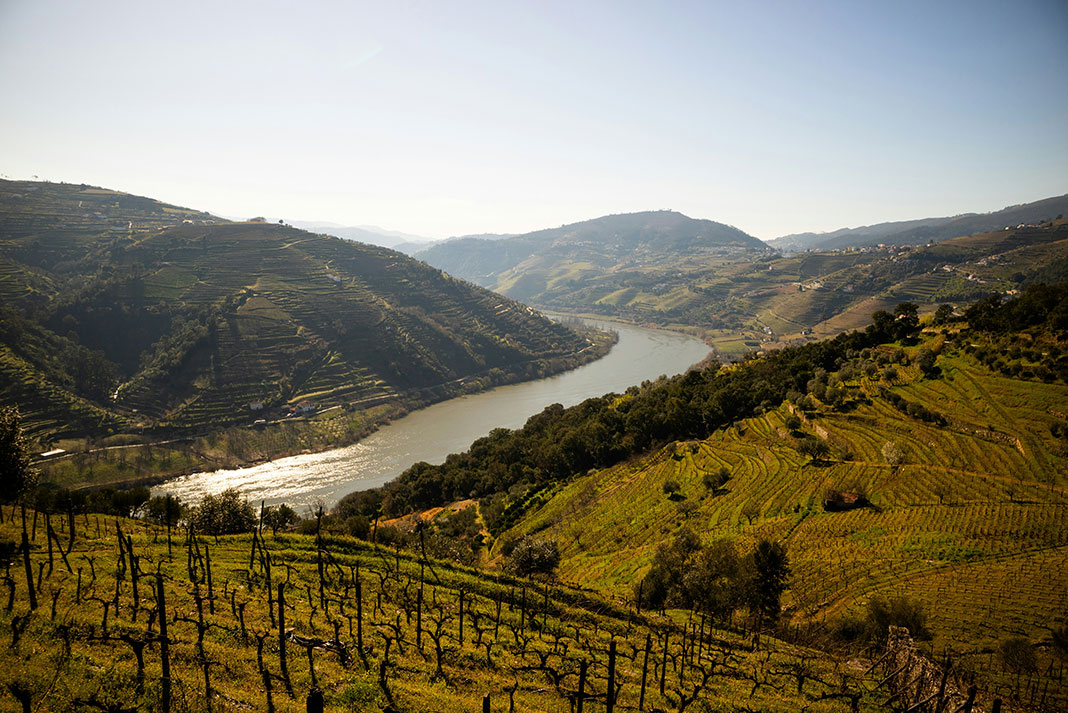
Of the more than 200 rivers Coe has mapped so far, his favorite is the Dee River estuary on the border of England and Wales. Many sea kayakers have experienced the constant flux of land and water in the deltas and estuaries of coastal areas, as tides and freshwater currents interact to form ever-changing environments. Where the Dee meets Liverpool Bay on the Irish Sea, “the elevation range is all within a few meters,” Coe explains. “But the visual effect of those subtle changes is exquisite.”

Coe isn’t worried about running out of rivers to map. This year, he’s launching a new business called Meander and Flow Design, focusing on river cartography. “My hope is to continue to make these kinds of images for many different purposes, including film, print, digital, museum, and gallery projects,” he says. “New technologies like LiDAR allow us to map living rivers in ways that not only show their current state but also show clues and evidence about how they have moved and changed over time. This appeals to me as a cartographer, as a boater, and as a curious human.”

Find more of Daniel Coe’s work at dancoecarto.com.

Cover of Issue 73 of Paddling MagazineThis article was first published in Issue 73 of Paddling Magazine. Subscribe to Paddling Magazine’s print and digital editions, or browse the archives.

“The fact that many river forms are whimsical and visually intriguing makes them perfect subjects for this kind of creative mapping,” says cartographer Dan Coe. Pictured here are the Porcupine and Draanjik rivers in Alaska. | Feature photo: Dan Coe
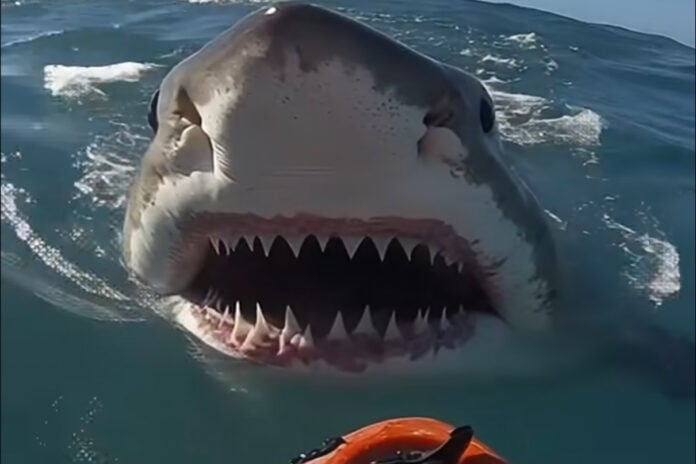
 

3 Ridiculous AI Shark Attack On Kayaker Videos

An AI-Shark approaches a kayak
An AI-generated shark comes in for a nibble. Featured Image: APEXOCEANSIM | YouTube

There are plenty of very real and very frightening shark and kayaker encounters caught on film, but these recent viral videos aren’t among them. From improbable encounters to paddles that go straight through the rotomolded deck of a kayak, here are the most ridiculous artificial intelligence (AI) generated shark attack on kayaker videos on the internet:

https://www.youtube.com/shorts/5qjpypEYYoc

Shark heavy breaths on kayak

In this viral YouTube short, a massive shark emerges from the ocean to heavy breathe on the bow of a recreational kayak – never mind, of course, that sharks do not breathe air. While the video is distinguishable as AI-generated from the unnatural shine on the shark’s back and the grid-like noise in the image that appears in the ripples and splashes, the video is perhaps most obviously a fake based on the behavior of the shark itself.

While many commenters observed that the video is obviously AI-generated, with one commenter noting that the 1975 film JAWS had more realistic shark footage than the viral video, other viewers were not convinced that the footage was fake.


Shark lands on handless kayaker

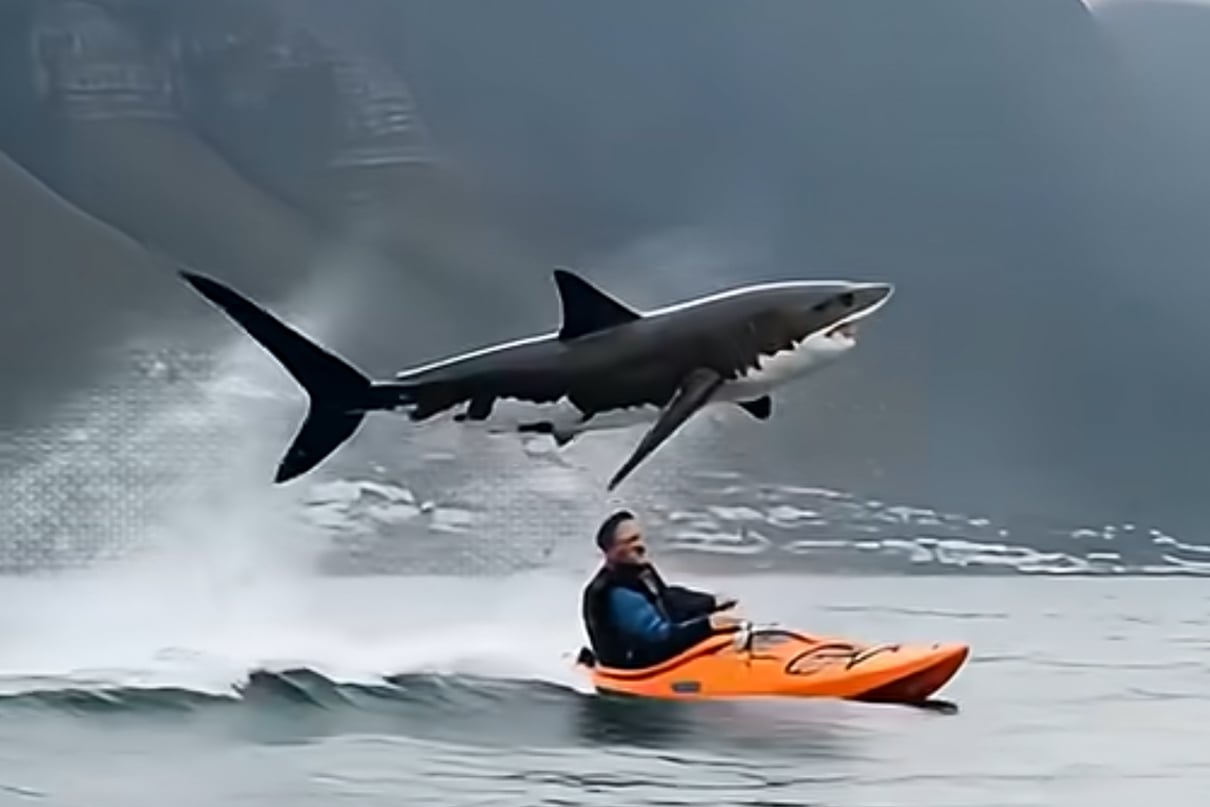
While this YouTube short is slightly more difficult to discern as AI-generated initially, the warping tangle of shark landing on a kayaker makes it pretty clear something with reality is amiss. The kayaker appears to be surfing a small wave without a paddle when a shark breaches and soars through the air behind him. The shark appears to land on the kayak – that’s when things get a little fuzzy.

The kayaker appears to be at least partially ejected from the kayak and tumbled at least twice before appearing upright in his kayak at the end of the video, making for the most impressive renter and hand roll of all time – that is, if the paddler had hands of course, which he does not. To the video’s credit, the handless kayaker does appear to be wearing a PFD.

AI-image of a shark jumping over a kayaker
A realistic image? Not so much. A shark leaps over a kayaker without a paddle, and noise can be seen in the spray on the left hand side of the image and beneath the shark, all signs that the video is AI-generated. Image: Aloys-Mythical-q6f | YouTube

Beyond the improbability of the shark encounter and extremely unlikely behavior of the kayaker, the video also shows the grid-like noise in the water most apparent when the video is paused, a telltale sign of AI-generated video.

While by the end of the YouTube short the AI qualities of the video may seem obvious, several commenters weren’t so sure, sharing that it took several watches to discern whether or not the video was fake.

Great white shark gently nibbles on kayak

In this utterly ridiculous YouTube short, we see an improbably buoyant shark gnaw on the bow of a sit-on-top kayak before flinging some water at the screen. The video is accompanied by the grunts and gasps of what viewers can only assume is meant to be the AI-generated kayaker, and not the shark.

The movements of the video are far from the fluid movements of footage shot on a camera, and the kayaker’s paddle appears to go clean through the deck of the plastic kayak as the video moves.

While sharks do rarely attack kayaks, this video isn’t a real recording of such an encounter.

How to tell if a video is AI-generated:

The biggest tell for AI-generated footage is often the content itself – all of the videos above depict extremely unlikely shark behavior or, in some cases, unlikely kayaker behavior such as the absence of an actual paddle in the second video. Beyond situation and surface-level visual cues, there are other ways to determine if a video is genuine footage or generated by AI.

If you suspect a video may be AI-generated but aren’t sure, visit the profile of the page that posted the video. Are all of the images and videos on the page incredible kayak encounters with sharks or equally unlikely scenarios? Repeated fantastical videos could be a sign that the page posts AI-generated content.

Another way to pick out AI-generated content is to pause the video and look closely at the details and edges of elements within the image. For example, you might notice a warped kayak deck in a video where shark teeth meet a kayak, or you might notice that a kayaker has no hands in certain frames. Additionally, the grid-like noise in moving water is a telltale sign of AI-generated video.

Overall, trust your instinct. Whether the contrast of the colors is a little too pronounced, or the motion is just not quite true to reality, your gut feeling about a potentially AI-generated video could be telling you something. Not unlike the uncanny valley phenomenon, which refers to the increasing discomfort humans report when viewing faces that are not quite human, the unease you may feel while viewing a video you believe to be AI-generated may be a sign that it isn’t real.

Currently with a little practice it’s fairly easy to distinguish between AI-generated videos and videos shot in the real world on a camera, but as AI technology improves we can expect telling the real from the artificial to become more difficult.

An AI-generated shark comes in for a nibble. Featured Image: APEXOCEANSIM | YouTube

Best Walmart Kayaks For 2026

Outside of a Walmart

You can buy almost anything at Walmart—household items, groceries, pharmaceuticals, sporting goods…and even kayaks! Walmart kayaks are meant for casual paddlers looking for a budget-friendly way to enjoy the occasional outing on calm, sheltered water. Consider a Walmart kayak if you want to dabble in paddling but have no specific aspirations to develop your skills and progress beyond quiet water and beginner conditions.

Walmart kayaks are a good option for families, cottagers and those looking for a fun boat to take to the beach. You will find a variety of options for Walmart recreational kayaks, including inflatable kayaks and fishing kayaks—of both the sit-inside and sit-on-top varieties. Many are available for well under $500.

Be aware that Walmart kayaks aren’t high performance watercraft and have serious safety limitations for use in open water. These entry-level kayaks are also less refined in terms of paddling speed, maneuverability, handling and comfort. It’s also important to recognize that Walmart sales associates likely do not have the same breadth of kayaking knowledge as a dedicated paddling store. Simply put, you get what you pay for.

With all this in mind, a Walmart kayak might be all you need. Our review of Walmart kayaks will provide you with the essential knowledge to find the best kayak for your paddling needs.

Top picks: Best Walmart kayaks

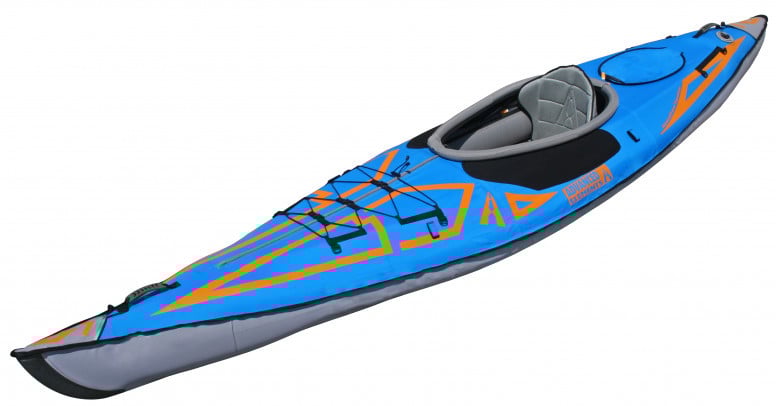
Advanced Elements AdvancedFrame Expedition Elite

Advanced Elements AdvancedFrame Expedition Elite Specs
Length: 13′ 1″
Width: 32″
Weight: 42 lb
Capacity: 450 lb
MSRP: $1049.99 USD

Advanced Elements AdvancedFrame Expedition Elite Kayak.

Buy from:

ADVANCED ELEMENTS

A truly hybrid inflatable kayak, the AdvancedFrame Expedition Elite incorporates our proven aluminum rib-frame technology in the bow and stern, along with a Drop-stitch floor, to provide optimal paddling performance and rigidity. At 13′ long, with plenty of storage space, the Expedition Elite is the perfect kayak for any adventure.


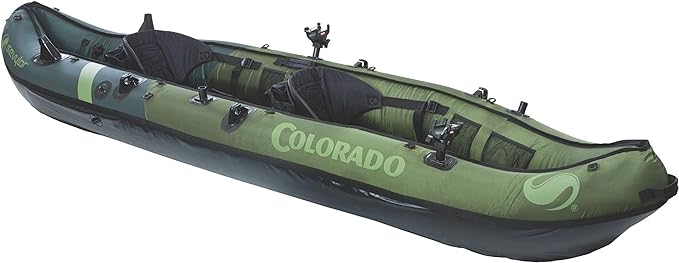
Sevylor Colorado

Sevylor Colorado Specs
Length: 10′ 8″
Width: 36.5″
Weight: 32.9 lb
Capacity: 200 lb
MSRP: $611.49 USD

Sevylor Colorado

Take home your catch limit with a buddy after a day in the Sevylor Colorado 2-Person inflatable kayak. With 18-Gauge PVC, a thick tarpaulin bottom and a tough nylon cover, this kayak is durable enough to get you to your favorite out-Of-The-Way fishing hole. Just in case, though, the multiple air chambers will help you get back to shore. The adjustable seats will keep you paddling comfortably the whole trip. But if you want to move more easily, you can always add the Sevylor trolling motor and store your paddles in the convenient holders. The Berkley quick set rod holders let you adjust your pole angle for the ultimate hands-Free fishing experience. With your hands free, it’s easier to take care of your gear, which stores nicely in the Sevylor Colorado 2-Person inflatable kayak mesh pockets or attached to D-Rings.


Sevylor QuikPak K1

Sevylor QuikPak K1 Specs
Length: 8′ 7″
Width: 30″
Weight: 19 lb
Capacity: 400 lb
MSRP: $259.99 USD

Sevylor_QuikPak K1

Buy from:

WALMART AMAZON

This compact one-person boat inflates in minutes with the included hand pump and packs down into the included backpack for travel. As you paddle along the shore, the cargo net on top of the kayak keeps your gear close at hand and a drink holder can hold a water bottle to keep you hydrated. A durable, tarpaulin bottom is built for durability, while a clever design with multiple air chambers means that the boat will not fully deflate if it gets a single puncture. A backrest and multiposition footrest makes for comfortable paddling or floating.


Ozark Trail Angler 10

Ozark Trail Angler 10 Specs
Length: 10′ 0″
Width: 30″
Weight: 41 lb
Capacity: 250 lb
MSRP: $389.43 USD

Ozark Trail Angler 10.

Great for lakes and rivers and to get to those excluded fishing spots The Ozark Trail Angler 10 fishing kayak is perfect for your next adventure. Weighing only 41 pounds, it is lightweight enough for most adults to carry with ease. The Ozark Trail Angler 10 sit-on kayak features a large, comfortable seating area with protective thigh pads and adjustable foot braces. You have plenty of room for your gear with the covered storage compartment with bungee cords in the front and back. It is constructed from rugged UV-stabilized high density polyethylene. The Ozark Trail Angler 10 sit-on kayak tracks and paddles with ease providing you with maximum stability while in the water.


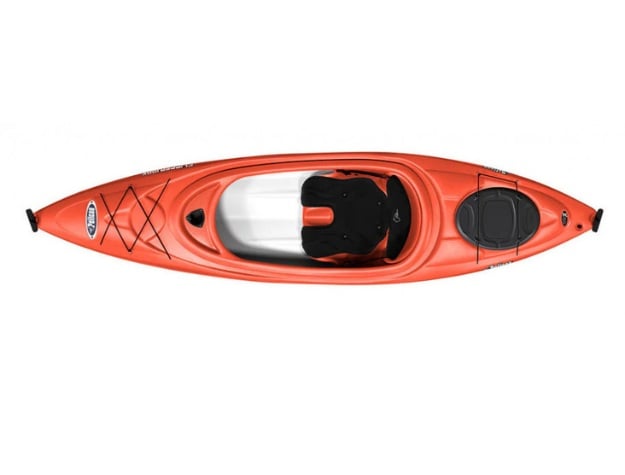
Pelican Clipper 100X

Pelican Clipper 100X Specs
Length: 10′ 0″
Width: 28″
Weight: 38 lb
Capacity: 275 lb
MSRP: $248 USD

Pelican Clipper 100X

The Clipper 100X recreational kayak is built on a twin-arched multi-chine hull that perfectly combines stability and good course steering. Featuring an Ergoform adjustable padded backrest with a cushioned seat for optimal comfort, this sit-in kayak also provides a stern storage compartment with bungee cords to store all your gear easily. Made with durable Ram-X material, this recreational kayak is made to withstand impacts and will quickly become your most trusted companion on the water.


Shop for Walmart kayaks

There is a wide range of kayaks available at Walmart. All are meant for recreational paddlers, especially families looking for a cheap kayak to use occasionally in sheltered water locations, such as smaller lakes, ponds and quiet rivers. Walmart kayaks include hard-shell models (constructed of durable plastic) and inflatables, which can be deflated and stored in smaller spaces but often lag behind hard-shells in terms of paddling performance.

You can shop for Walmart sit-on-top kayaks, which are easy to enter and exit for paddlers of all sizes and skill levels and ideal for sunny days and warm water. By comparison, Walmart sit-inside kayaks are decked (or partially decked), providing shelter from the environment—though are sometimes more challenging to enter and exit due to the enclosed cockpit seating area. Walmart kayaks also include fishing models with features like rod holders and space for a fishing crate.

The selection of Walmart kayaks varies considerably between locations in Canada and the U.S.

Shopping for a used Walmart kayak?

Walmart kayaks are abundant on buy-and-sell websites like Craigslist, Kijiji and Facebook Marketplace. Walmart kayaks offer great value in beginner kayaks for family fun—and many options are available in different styles and from a variety of manufacturers. Your first step in making a good investment is to research the specific attributes of the make and model Walmart kayak you’re considering. Once you’ve found a contender, consider the following advice to make a good purchase:

Overall condition

Examine the overall condition of the Walmart kayak. Sun damage and soft spots on the hull are good ways to determine a kayak’s condition. Apply firm pressure to all parts of the kayak to test for stiffness—it shouldn’t feel spongy.

After that, examine the deck (top) and hull (bottom) for damage including:

  • Deep gouges that are more than 3 mm or 1/8th of an inch deep
  • Obvious abrasion, especially if the worn areas are a different color from the rest of the kayak
  • Deformities, which will make the kayak paddle less efficiently

Walmart kayaks are made of durable plastic that’s meant to withstand plenty of abuse; some damage is fine, so long as the shape of the kayak remains intact.

Inflatable kayaks

Inflatable kayaks are also common on the used market. Leaks are the main concern with buying a used inflatable; ensure the kayak holds air—both in the air chambers that make up the hull as well as the valves. Though durable, inflatable kayaks are often cheaper and have a shorter lifespan due to punctures and defective valves.

Outfitting

Walmart kayaks often feature bare bones outfitting. Take a close look at comfort features like the seat (is it padded and supportive for your body type?). Foot rests are critical to give you purchase on the kayak to paddle efficiently and are often absent in cheaper Walmart kayaks; if they’re present, make sure they’re functional and not damaged by grit or sand. Some sit-inside Walmart kayaks are equipped with a bulkhead, a critical feature for safety and seaworthiness that will keep a swamped kayak afloat: make sure it’s solid and intact.

Outfitting is the critical interface between the paddler and kayak, including the seat, back support, thigh rests and foot rests. Often these features lack refinement in budget-priced Walmart kayaks. Examine these parts individually and consider how well they work together as a whole—the easiest way to achieve this is by sitting in the boat (and ideally paddling it) to make sure it feels comfortable. Think about how long you’ll be sitting in the kayak. If it’s uncomfortable in a quick test, how will it feel after an hour?

Outfitting often comes down to personal preference; there’s no one-size-fits-all. One of the drawbacks of a cheaper, general-purpose Walmart kayak is substandard outfitting. Take a close look and consider investing in a more expensive kayak if you plan on more serious paddling. If you’re handy, outfitting is easily modified with some glue, foam and DIY time; consider any upgrades you could make to save a few bucks and get a custom fit.

On the water

The only way to fully appreciate the comfort and performance of a kayak is to try it before committing to a purchase. Arrange a meeting place with the seller that allows you to take a few moments on the water. Bring your usual paddle and dress in what you plan to wear while paddling. With a sit-inside kayak, be sure to assess how easy the boat is to enter and exit.

Make a deal

In general (that is, before Covid-19 put a premium on outdoor equipment) the typical starting point for a used Walmart kayak in moderate condition was about half its retail price. All that’s changed in the wake of boat shortages brought on by the pandemic, but you can use it as a starting point in haggling a fair price.

Add some accessories

Accessories are key elements of fishing kayaks; if you want to do some kayak angling make sure you examine features like rod holders and live wells.

If you’re offered a PFD as part of a used kayak sale make sure it’s in good shape, fits properly and is Coast Guard-approved for the location you’ll be paddling.

Wear A Life Jacket
  • Everyone, even strong swimmers, needs to wear a life jacket at all times when on the water. It is extremely difficult to put a life jacket on once you fall into the water. Even a light wind can blow any paddlecraft away from you, faster than you can swim.
  • Always wear a USCG-approved Level 70 or Type III life jacket designed for paddling.

For more tips on what to look for when selecting a used kayak, read our article on How To Buy A Used Kayak.

Walmart kayak buying guide

Experienced paddlers live by the motto, “Try before you buy.” But it’s hard to find water within miles of most Walmart stores, so buying a Walmart kayak is best described as a leap of faith. That being said, think outside the box (store) for test paddling opportunities. Maybe you can find friends or family who would be willing to share their Walmart kayak with you for an outing or two. This sort of experience provides a sense of what’s available in Walmart kayaks; paddling also allows you to appreciate how different kayak design elements fit your body and perform.

Box stores like Walmart will never offer the same expertise as a specialized paddlesports retailer—or even that of larger outdoor chains like Dick’s or Bass Pro. Remember you’re not going to find high-end, performance kayaks at Walmart. If you’re serious about paddling and want to develop your skills and invest in a dedicated hobby, you may be better off shopping elsewhere.

As mentioned earlier, Walmart kayaks are economical choices for those who plan on paddling sporadically—and only in benign conditions. This reality may fall exactly in line with your recreational paddling needs.

Still have questions? Here are expert answers to some of the most common questions about Walmart kayaks.

  • Does Walmart sell kayaks in store?

    Walmart sells a range of kayaks in store, but selection varies from location to location and inventory changes based on time of year. Canadian and American Walmart stores have a different selection of kayaks; in general, you’ll find more options at U.S. outlets.

    Browsing Walmart’s website is a good way to narrow your choices and find out what’s available in your area; you may also place an order online and pick up your Walmart kayak at the nearest store.

  • Are the kayaks at Walmart any good?

    When it comes to kayaks, “good” is a subjective term that differs from paddler to paddler. The range of kayaks sold at Walmart are best for casual users who are most interested in finding a cheap kayak. That being said, Walmart kayaks are good at falling within the budget of an occasional paddler; on the other hand, Walmart kayaks are not as good for paddlers who want to invest in a single kayak to develop their skills.

    As with most consumer purchases, you get what you pay for. Walmart does offer a wide variety of inflatable kayaks (convenient for those with limited storage space), kids kayaks and fishing kayaks.

  • Should I buy a kayak from Walmart?

    Consider buying a kayak from Walmart if you’re a casual paddler looking for a cheap, beginner-friendly kayak and willing to trade off comfort and performance for a lower price. Walmart sells a wide range of recreational kayaks, including inflatable kayaks and fishing kayaks, that fit this description. On the other hand, don’t buy a kayak at Walmart if you’re looking for expert advice from a sales associate.

  • Why not to buy a Walmart kayak

    Lack of performance, safety features and comfort—as well as lack of expertise from sales associates—are the biggest reasons not to buy a Walmart kayak. All of these points are most relevant to those looking to invest in kayaking and take their paddling adventures farther than the local lake or quiet river. A Walmart kayak is a great choice for families, cottagers and other infrequent paddlers who wish to take short outings on calm, sheltered water.

Paddle Sober And Smart
  • Never mix alcohol and paddling. Coast Guard and state BUI (boating under the influence) laws apply to all vessels. This includes canoes, kayaks, SUPs and rafts.
  • Kayak prices Walmart

    Walmart is an outstanding choice if price is your primary concern in buying a new kayak. How much are kayaks at Walmart? Prices vary from $200 kids kayaks to full-featured fishing kayaks approaching $1,000 in price. The majority of Walmart kayaks are sold for less than $500, making this a great place to find a budget-friendly kayak for occasional use in calm and sheltered water conditions.

  • Walmart kayak return policy

    Can you return a kayak to Walmart? Good question. Walmart has a 90-day in-store return policy on kayaks, subject to inspection from a sales associate.

  • Does Walmart register kayaks?

    Registering your kayak is essential if you ever need to file a warranty claim with the manufacturer. Walmart does not register the kayaks it sells; to do so, you must follow the instructions provided by the kayak manufacturer (often including a sales receipt).

  • When do kayaks go on sale at Walmart?

    Walmart kayaks are available at budget-friendly prices throughout the year. Wait until later in the summer to benefit from the best sales, though be aware you’ll find less selection at this time of year. Walmart kayaks may go on sale at any time of year depending on inventory. Check out your local store for Walmart kayak sales throughout the year.

Walmart kayak reviews

Since you won’t be able to take a Walmart kayak for a test paddle before you buy, consider reading our reviews of these boats to give you a better sense of which to choose and what to expect once you do get out on the water.

Education: Get Some!
  • Take a paddling safety course from the American Canoe Association (ACA), your local paddling shop or outfitter, or other reputable source.
  • Take a boating safety course from the U.S. Coast Guard Auxiliary, U.S. Power Squadrons® or your own state’s boating agency.
  • Take on-the-water skills training.


Pelican Bought After Boom And Bust

man paddles Pelican kayak constructed of Ram-X material
Feature photo: Courtesy Pelican

Pelican Intl Inc, now a newly formed entity has acquired assets excluding GSI Outdoors, of Pelican International Inc and Confluence Outdoor Inc according to a press release.

Pelican Intl Inc. has acquired the assets of Pelican International Inc. and Confluence Outdoor Inc. excluding GSI Outdoors according to a press release from Pelican Intl Inc., now a newly formed entity. The transaction was spearheaded by Danick Lavoie former Pelican President and CEO, and involved a court-approved Sale and Investment Solicitation Process (SISP) under the Companies’ Creditors Arrangement Act (CCAA) in Canada and Chapter 15 in the United States. Also involved in the sale were former executives Frederic Guay and Guy Prenevost. Additionally, private investors have partnered with management to “set Pelican Intl’s path for growth, resilience, and success”. Confluence Outdoor Inc. will now operate as Pelican Intl USA inc. to unify North American operation.

“With a robust portfolio including Pelican, Wilderness Systems, Dagger, Perception Kayak, Advanced Elements, and Boardworks, we will continue to expand the accessibility of our products,” shared Pelican International Inc in the press release.
Updated May 22, 2025.


Pelican International Inc, one of the world’s largest kayak manufacturers, is in the process of being bought out by former executives in partnership with real estate developer Groupe Mach, according to reporting by Quebec-based La Presse. The deal follows a two-step insolvency process: first Pelican sought insolvency protection under the Bankruptcy and Insolvency Act (BIA) in Canada in February 2025, before transitioning to court-supervised restructuring under the Companies’ Creditors Arrangement Act (CCAA) in March.

Pelican’s founding Élie family, which started the company in 1968, will not be involved in the restructured business. Pelican was majority-controlled by brothers Antoine and Christian Élie at the time of filing.

Kayak manufacturer Pelican to be bought by real estate developer and former executives

If the transaction closes, Pelican will be bought out by former executives who have partnered with Groupe Mach. Former President and CEO Danick Lavoie along with a group of former managers approached Groupe Mach. The transaction was submitted April 29 and approved April 30 by the Quebec Superior Court.

At the time the company sought insolvency protection, Pelican was controlled 80 percent by Élie brothers Antoine and Christian. In March 2025, La Presse reported that Pelican had taken out loans, some of which were used to acquire GSI Outdoors in 2022 and $60 million of which was distributed to shareholders as special dividends in 2021 and 2022. The Élie family received an estimated $50 million, according to the newspaper’s reporting. The decision to reward shareholders followed the outdoor industry-wide COVID boom.

Pelican saw profits of $35 million in 2021 and $10 million in 2022 followed by a slowdown in 2023. Pelican’s downturn reflects a broader post-pandemic reckoning across the outdoor industry. After sales surged in outdoor sales during COVID, many manufacturers were left with high inventory and shrinking demand as inflation and shipping costs rose.

Since 2023, La Presse reported that the company has lost $34 million and the special dividends paid out to shareholders were greater than the losses over the past four years. La Presse also reported that, including amounts owed to suppliers, Pelican was carrying roughly $181 million in liabilities, including $125 million owed to secured lenders led by National Bank.

Groupe Mach owns the Pelican manufacturing plant located in Laval and a logistics center in Varennes. Pelican completed three sale-leaseback transactions, selling its complexes to Groupe Mach but it was not enough to prevent the company from seeking creditor protection.

In recent years, Pelican expanded its paddlesports empire. It acquired major U.S. brand Confluence Outdoors in 2019—bringing Wilderness Systems, Dagger, Perception and Mad River Canoe into its fold—followed by inflatable kayak manufacturer Advanced Elements in 2021. No operating changes have yet been reported for the kayak brands within the Pelican portfolio.

In 2022, Pelican acquired GSI Outdoors, a United States-based company specializing in camping gear. The new ownership group plans to sell the GSI Outdoors division.

La Presse also reported that almost all of Pelican’s current 460 employees will keep their jobs.

Pelican did not reply to a request for comment.

All financial figures and restructuring details are based on reporting by the French-language newspaper La Presse. Read their original reporting here.

Kayakers Paddle From Dublin To Istanbul Despite Arrests And Winter Conditions

Joyne Coyne paddles from Dublin to Istanbul
The team arrives in Istanbul. Feature Image courtesy Johnny Coyne.

When most twenty-somethings set out to travel Europe, they do it with a backpack in hand, hopping from train to train while visiting museums and bars. John Coyne and Liam Cotter set out with a different kind of European odyssey in mind.

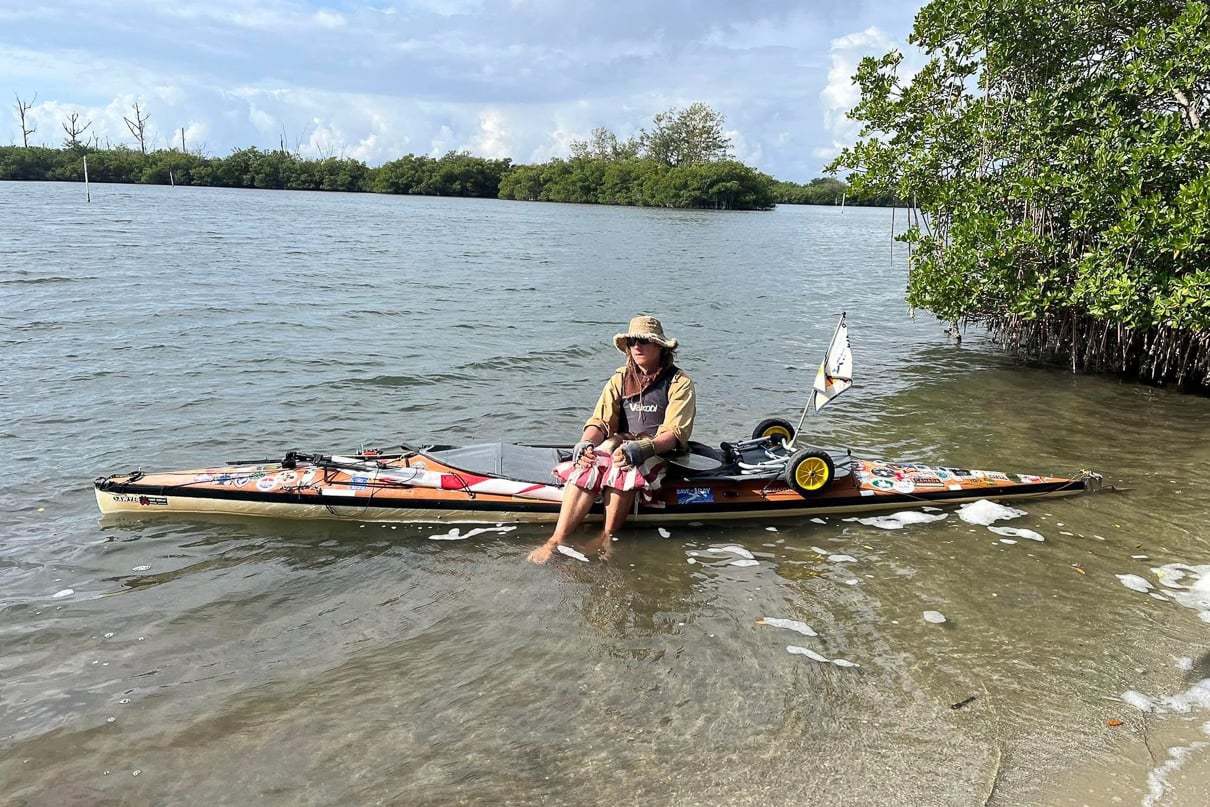
Departing from Dublin, Ireland on September 5, 2024 and finishing in Istanbul, Turkey on the Black Sea on April 25, 2025, the pair kayaked from Ireland to Asia, joined by Ryan Fallow in Germany. The trip was the first recorded sea kayak journey from Ireland to Asia, completed continuously by Coyne. Much of the route was also completed by Cotter, who took time off in the middle due to a shoulder injury but rejoined at the Black Sea, cycling out to meet them before rejoining the journey by kayak.

While Coyne was the only paddler to complete the route in its entirety, he’s quick to share that it was a team effort and shared success.


View this post on Instagram


A post shared by Johnny Coyne (@johnnycoyne_)

Epic kayak odyssey spells trouble with the law

The team faced winter conditions throughout the majority of their paddle, along with gear failures, logistical challenges, and were even arrested twice.

“It was incredibly hard. We faced minus 10 [celsius] in winter conditions sleeping outside the River Danube, the Irish Sea, the English Channel, the Black Sea. Injuries, exhaustion, burnout, hypothermia… and we got arrested a couple of times,” explained Coyne.

The expedition covered 5000 kilometers (over 3000 miles) and raised money for Daisy Lodge to support children with cancer and their families.

“We got arrested in Croatia, first of all,” said Coyne, explaining that while paddling the River Danube they had legally entered Serbia, then later had stopped for a break back in Croatia, on the other side of the river.

“We went to a restaurant and we looked up and three police officers were there ready to take us away. It turned out that we weren’t allowed to go back into Europe unless we notified Croatia. And so we got fined 130 euro each,” explained Coyne.

This wouldn’t be the group’s final encounter with the law.

“Then we got arrested in Romania,” shared Coyne. On the border of Serbia and Romania, the group found themselves in high winds in a remote area. Wet, cold and out of food, the group landed in Romania to seek safety and a hotel. “We pretty much got caught within the hour of being in Romania by the police. They actually all did understand our reasoning.”

The group found themselves spending the night in the police station, before the police helped them then enter the country legally.

Coyne shared that they had the police called on them several other times, usually for trespassing, but found that when people heard about their route and mission they were usually helpful and kind.

From Ireland to the Black Sea

From being kicked off the canals in France and forced to portage to sleeping underneath the Cliffs of Dover, the nearly seven-month adventure saw a different side of Europe than the average adventurer.


View this post on Instagram


A post shared by Johnny Coyne (@johnnycoyne_)

Crossing the English Channel, the 25-mile (45 kilometer) body of water between England and France, at neap tides wasn’t in the cards for Coyne and Cotter. After months of careful planning and long, full days of paddling, the pair arrived at the channel at the spring tide instead to face a large tidal range and strong currents. Then, their support boats fell through. The pair decided to tackle the crossing in less than ideal conditions.

The crossing took 12 hours, and the pair camped underneath the Cliffs of Dover the night before.

“We knew what we were doing. We knew we could do it. We knew it would be harder than any other time, but the weather … it got a bit worse than we expected,” said Coyne. “As Liam said when we got to France, we may not be the most efficient, but we get the job done.”

By the time Coyne and Cotter, now joined by Fallow, reached the Black Sea much of their gear had broken, including Coyne’s primary paddle. While the trio faced freezing temperatures, they were also greeted by dolphins.

“We didn’t even know there were dolphins in the Black Sea,” shared Coyne. “For about three to four hours, hundreds and thousands of dolphins were swimming with us, jumping with our boats, swimming with our boats.”

“I had no proper gear, and my paddle I was using was terrible, and it was just so remote, so cold, and really windy conditions for the last two weeks,” explained Coyne. “And then there were also earthquakes as we were arriving into Istanbul. Perfect.”


View this post on Instagram


A post shared by Johnny Coyne (@johnnycoyne_)

How to plan your dream expedition according to Johnny Coyne

Coyne is no stranger to big adventures. After starting his own kayaking and sailing business at 21, Coyne, now 24, spends summers working and making money to finance expeditions in the winter. According to Coyne, the biggest factor in planning an expedition is simply deciding to do it.

“It’s all about just going for it, I think, and just not being afraid,” said Coyne. “Even if you do run out of money and you do have to come home, at least you tried it. You are still going to have a story and you’re still going to have an experience for life.”

Coyne also recommends that people looking to have an adventure of their own start with putting some money aside.

“If you can put $2,000-$3,000 aside, that’d be enough for at least a month-long expedition, depending on where you are. And I would say if you’re a paddler, that’s the first step, isn’t it?” shared Coyne. “I think it’s all about just going for it. Literally, that’s all I can really say is just go for it.”

The team arrives in Istanbul. Feature Image courtesy Johnny Coyne.

The Best Places To Paddle Near You

A kayaker on a river with green vegetation on either side
There are more paddling opportunities in your backyard than you may think.

Whether you’re an expert or a beginner, there’s almost always somewhere to go kayaking, canoeing, rafting or paddleboarding near you. Finding that perfect location can vary greatly in difficulty, depending on the waterways and popularity of paddling in your area. That’s where we can help. Below you’ll find our favorite paddling destinations and all the resources and tips you need to find more stretches, as well as people to go for a paddle, whether you’re looking for a whitewater run, canoe trip route or afternoon of kayaking.

Armed with these handy tools, you’ll not only be able to find your next place to paddle, but also where to rent, who to go with, which tours to take, where to get lessons and more.

Know The Local Hazards
  • Check navigation charts before you launch.
  • Check with those who have local knowledge of man-made and natural hazards, e.g. low-head dams; sweepers, strainers and undercuts; tides and currents; and rocks and shoals.


The best kayak, canoe, raft and SUP trips near you

Our picks for paddling destinations across the U.S., Canada, and around the world:

U.S states

Alabama

Alaska

Arizona

California

Colorado

Florida

Georgia

Hawaii

Idaho

Illinois

Indiana

Kentucky

Maine

Massachusetts

Michigan

Minnesota

Missouri

New York

Nevada

North Carolina

Ohio

Oregon

Pennsylvania

Check The Weather
  • Plan for changing weather conditions. Prepare for the worst case.
  • Don’t forget to check tide, currents, or river levels.

Tennessee

Texas

Utah

Washington

West Virginia

Wisconsin

Wyoming

Canada

Alberta

British Columbia

Northwest Territories

Nova Scotia

Ontario

Quebec

How to finding more places to go kayaking and canoeing

The two best tools you can use to find places to paddle, tours, lessons, and rentals are the Paddling Trip Guide and Paddling Maps.

Explore the Paddling Trip Guide

Our Paddling Trip Guide provides information about kayaking, canoeing, paddleboarding and rafting trips. It allows you to sort and filter for adventures based on location, activity, operator, waterway, trip length, accommodation, guided or non-guided, adventure level and more.

Start using Paddling Maps

This free website will help you find the best paddling near you including launch sites, put-ins, take-outs, river classifications and more.


Kayak and canoe rentals

Are you planning an adventure but need to rent a kayak? Kayak rental shops exist near almost every major waterway in North America and the world. Maybe you want to rent a paddle or pedal kayak. Or perhaps you want a fishing kayak. On a budget? No problem, cheap rentals aren’t hard to find. Hourly, daily and weekly rentals are usually available. Find the right kayak rental near you or check our ready-made, destination-specific guides below:


Kayak and canoe launches

Enter the water easily at specified kayak launches. These places are usually free boat launches or ramps. Sometimes a permit is required. Find a place to launch your kayak near you by consulting your local tourism website or using the Paddling Maps app.


Kayak & canoe tours near you

Paddle with whales, watch the waves crash with bioluminescence or simply take the stress away with a guided kayak tour. See some of our tour round-ups below:

[ View all kayak tours in our Paddling Trip Guide ]

Top kayak and canoe spots

With thousands of places to paddle, it’s easiest to first choose what kind of kayaking you’d like to do. Then choose a lake, river, stream or coastline, pack your bags, and head to the water.

To help with your planning process, we’ve put together the following articles:

7 River Safety Essentials To Take On The River

Kayak Camping: Ultimate Accessories And Gear List

7 Essentials For Long Kayak Trips

5 Underrated Kayak Safety Skills

Kayak fishing

Our Paddling Trip Guide has the low down on kayak fishing adventures. Alternatively, the Kayak Angler website, our sister publication, has a kayak fishing hotspots section with hundreds of articles on where to fish and when.


Kayak and canoe clubs

Almost everywhere with a major waterway has a kayak club. Find yours by asking other paddlers around town, searching for “kayak club” on Facebook, or contacting the organizer of a local paddling event.

There are also larger social media kayak and paddling clubs. These online communities are the perfect place to share your paddling photos, meet fellow paddlers and post about your best days on the water.

Education: Get Some!
  • Take a paddling safety course from the American Canoe Association (ACA), your local paddling shop or outfitter, or other reputable source.
  • Take a boating safety course from the U.S. Coast Guard Auxiliary, U.S. Power Squadrons® or your own state’s boating agency.
  • Take on-the-water skills training.

Kayak and canoe lessons

Learning to kayak with a certified instructor will save you time, money and maybe your life. Sign up for an instruction or skills clinic, practice your skills on a regular basis, and surround yourself with safety-conscious paddlers.


Used kayaks for sale near you

Buying a used kayak is no easy task. Learn everything you need to know in our article: How To Buy A Used Kayak.


Kayak and canoe stores and shops near you

Whether you’re looking for a repair shop or want to buy a new kayak or canoe, there are likely many shops near you. You can also order from many brands direct online; however, we recommend test paddling a kayak before you buy.


Canada’s Largest Canoe Camping Reserve Is Hidden in Plain Sight—And It’s Not Algonquin

La Vérendrye Canoe Camping

Boasting more than 800 kilometers of maintained routes traversing rivers, reservoirs and some 4,000 scenic lakes, Réserve faunique La Vérendrye is one of North America’s most expansive—and least crowded—canoe camping destinations. Paddlers can choose from 500 backcountry campsites and 20 established canoe camping circuits, ranging from easy two- or three-day loops to challenging routes of 10 days or more.

For backcountry travellers weary of the crowded portage trails and booked-out campsites in popular destinations like Algonquin Park, canoe camping La Vérendrye offers a blissfully quiet alternative in the beautiful boreal forest landscape. At over 12,500 square kilometers, this Quebec reserve is nearly twice the size of Algonquin Park. Whether you enjoy portage-free paddling, intimate lake-to-lake journeys or navigating rapids on a thrilling wilderness river, La Vérendrye’s diverse canoe routes offer something for every paddler.

To get started planning your canoe camping La Vérendrye adventure—known locally as canot camping La Vérendrye, from the French “canot” for canoe—here is everything you need to know about paddling in this spectacular wildlife reserve.

Where Is Réserve faunique La Vérendrye?

Réserve faunique La Vérendrye is in western Quebec, near the border with Ontario, straddling the Outaouais and Abitibi-Témiscamingue regions. The wildlife reserve’s southern entrance is a two-hour drive from Ottawa and less than three hours from Montreal. From Toronto, the southern entrance is a seven-hour drive.

Quebec Route 117—which serves as the Trans-Canada Highway northern route in the province—bisects the reserve for nearly 200 kilometers from north to south, with the towns of Val d’Or and Mont Laurier serving as gateway communities. More than 30 canoe camping access points are accessible from Route 117 with registration centers at the northern (km 453) and southern (km 275) entrances, Le Domaine (km 329) and Lac Rapide (Rapid Lake, km 358).

La Verendrye Backcountry Canoeing
Enjoy the solitude of the La Verendrye backcountry. | Photo: Martin Poitras

Best La Vérendrye Canoe Camping Routes

La Vérendrye canoe routes include lake and river travel as well as portage-free touring on two massive reservoirs, with route distances varying from 23 km to 240 km. The wildlife reserve offers 20 designated routes, or circuits, overseen by Sépaq and identified by name and route number.

The first step to planning your La Vérendrye canoe camping experience is deciding how many days you want to spend paddling and camping. Then, review the route options for that length of trip on Sépaq’s canoe-camping La Vérendrye web portal. Or choose from the suggested routes below:

Réservoir Cabonga (#25

Duration: 2 to 15 days
Difficulty: Beginner
Portages: None

Why paddle it: Studded with countless islands and rimmed by beautiful sandy shores, sprawling Réservoir Cabonga offers endless no-portage canoeing and sea kayaking. Choose from nearly 50 campsites with options for linear or loop routes. Access to the central reservoir is from Lac-Rapide visitor centre or launch just a few kilometers from Le Domaine to explore the southern end of the lake. Be prepared for treacherous waves on windy days.

Portage-Larouche (#34)

Duration: 3 days/2 nights
Difficulty: Beginner
Portages: 6 (735 meters total)

Why paddle it: This charming 44-kilometer loop begins near the Lac-Rapide visitor centre and makes a scenic circuit of mid-sized lakes connected by peaceful streams and narrow meanders. Few motorboats along most of this route add to its tranquillity. Be sure to make camp at one of the stunning rock slab sites near the outlet of Lac Nizard.

Lac Gaotanaga (#70)

Duration: 3 days/2 nights
Difficulty: Intermediate
Portages: 3 (385 meters total)

Why paddle it: Suitable for more experienced canoe campers, this 47-kilometer route in the northwest corner of the wildlife reserve combines open-water paddling on scenic Grand Lac Victoria with swift-flowing sections of the Ottawa River. A highlight of the loop is spectacular Big Chute, where you can score a rocky campsite overlooking this hypnotic cascade. For a longer intermediate trip in the same area, try the Lac Granet – Ouatouais (#73) loop, which begins at lovely Lac Granet and explores the upper reaches of the Ottawa River (115 km, 7 days).

La Perche-Chartier (#78)

Duration: 4 days/3 nights
Difficulty: Advanced
Portages: 6 (1,680 meters total)

Why paddle it: Another fine option for more advanced canoe trippers, this 62-kilometer lollipop loop begins at Baie-Barker in the Wanaki biodiversity zone and encompasses three large lakes with beautiful scenery and clear water for exceptional swimming. Watch for the glacially formed esker on Lac Graham.

Rivière Chochocouane (#60)

Duration: 6 days/5 nights
Difficulty: Advanced/expert
Portages: 12 (1,465 meters total)

Why paddle it: The unspoiled Rivière Chochocouane is one of La Vérendrye’s premier whitewater paddling rivers. This 60-kilometer route offers numerous class I-III rapids for experienced paddlers to run, along with well-maintained portages and options to extend your trip by one or two days. A shuttle service is offered for downriver trips. Alternatively, allow 10 days for a 138-kilometer loop—the Grand Boucle Chochocouane (#63)—combining a descent of the river with upstream paddling on the Rivière Canimiti and a diverse mix of large and small lakes and streams. Expect 17 portages (3.5 km total) on this challenging circuit in the northeast reaches of the reserve.

La Vérendrye Canoe Camping
La Vérendrye promises a wilderness paradise for paddlers, without crowds at the put-ins or on portage trails. | Photo: Martin Poitras

How to Plan Canoe Camping in La Vérendrye

Whether you’re a beginner or expert canoe tripper, planning a backcountry adventure exploring La Vérendrye canoe routes is simple. Choose a river or lake circuit that suits your interests and aspirations, reserve the required number of campsites and arrange equipment rentals or shuttles if needed from Sepaq. Canoes and kayaks are available to rent on-site, and a shuttle service simplifies logistics for one-way journeys.

Permits and reservations

Canoe camping circuits in La Vérendrye must be reserved before your arrival at the park registration center. Backcountry canoe camping reservations cannot be booked online and must be made over the phone by calling Sépaq at 1-800-665-6527, or Canot-Camping La Vérendrye at 1-844-897-4980. Reservations open at the end of February for the upcoming paddling season. Registration centers are open daily from mid-May to the end of September.

Campsite reservations at Réserve faunique La Vérendrye work a bit differently than the site- or lake-specific reservations you may be familiar with from other canoe tripping destinations. Canoe campsites at La Vérendrye are reserved by circuit, or route, with limits on the number of parties on a circuit at any given time. This means you choose one of the 20 established canoe circuits based on how many nights you wish to camp, then within this route you have the freedom to sleep on any site you want.

Canoe camping sites can accommodate up to 10 people. Most sites have a pit toilet and firepit. La Vérendrye canoe camping fees are $16.25/adult/night (children under 17 are free of charge).

La Vérendrye canoe route maps

La Vérendrye canoe route maps are available to download from the Sépaq website in both printable PDF and GPX (GPS) file formats. You’ll find detailed map downloads for each of the reserve’s 20 canoe camping circuits. Each map set includes the paddling route, distances, campsites, portages and any rapids, as well as a QR code to download the map for offline use with your smartphone. Note these La Vérendrye canoe route maps are available in French only.

For general planning purposes, you can also view and download an overview map (1:225,000, French only) displaying all of the canoe camping circuits in Réserve faunique La Vérendrye here.

When to go

The best time to plan your La Vérendrye canoe camping experience is from mid-May to late September. Plan an early-season trip in May or June to witness spring wildflowers and vivid greens blooming across the lakeshores. Even better, this is prime time for viewing iconic wildlife like moose, beaver and black bear, and you’ll likely have much of the park to yourself (just be prepared for biting bugs).

If you prefer warm waters for swimming, the peak summer months of July and August are your best bet and the berry picking is superb. Late summer is also a great time if you’re looking to avoid blackfly and mosquito season. Alternatively, plan an autumn trip to catch the hardwood canopy ablaze with fall colors. The cooler days and crisp nights of September reward with bluebird skies and bug-free campsites.

Gear and canoe rentals

For visitors looking to rent equipment, lakewater and whitewater canoes and tripping barrels are available to rent from the La Vérendrye canoe camping registration centre at Le Domaine (Route 117, km 329). Canoe rental includes paddles, PFDs and safety gear; rates start at $40.50/day. Booking in advance is recommended and can be done at the same time as your camping reservation, by phone at 1-844-897-4980.

You can also book a shuttle service to drop off and pick up from the canoe camping registration center to the different routes. Shuttle bookings should be made at least four weeks before your visit, call 819-438-2017 for details or e-mail laverendryecanot@sepaq.com.

Fishing in La Vérendrye

In addition to holding a valid fishing license and following local fishing regulations, canoe campers who wish to fish during their trip must pay a daily right-of-access fee ($20/person/day). The main species in the reserve’s lakes are walleye and pike. There are also fishing and lodging packages available for folks who want to explore La Vérendrye but aren’t interested in backcountry camping.

La Vérendrye Canoe Fishing
Say hello to spectacular fishing in La Verendrye. | Photo: Martin Poitras

More Amazing Places to Paddle in Abitibi-Témiscamingue

Looking for even more incredible paddling opportunities? La Vérendrye may be one of the world’s largest canoe camping destinations, but two other parks in the Abitibi-Témiscamingue region of Quebec are equally enticing. Discover outstanding canoeing and kayaking routes at Parc national d’Opémican and Parc national d’Aiguebelle.

Parc national d’Opémican

Stretching from the pine-clad cliffs of Lac Témiscamingue (Lake Temiskaming) on the Ottawa River to the vast watery labyrinth of Lac Kipawa (Lake Kipawa), Parc national d’Opémican is a hidden treasure just five hours north of Toronto or a one-hour drive from North Bay. The Laurentian Mountains provide a beautiful backdrop to a plethora of paddling possibilities, all accessible from the small village of Laniel.

Don’t worry about the details with the park’s canoe camping package, which starts at $109 a day for campsite rental and paddling gear.

Discover the region’s rich cultural history while canoeing or kayaking to peaceful backcountry campsites. Explore the islands of Lac Kipawa, follow along the spectacular cliffs of Lac Témiscamingue, or admire the magnificent scenery of Baie d’Opémican on waterways travelled by the Anishinaabeg since time immemorial.

Ideal for novice canoe campers, the park’s White Lake sector provides access to several small, interior lakes for a tranquil paddle-and-portage journey ending at Russell Bay on Lac Kipawa. In the Île-aux-Fraises sector, the challenging waters of mighty Lac Kipawa entice more experienced canoe and kayak campers to explore its deep water bays and the islands of the Opémican Archipelago. Finally, whitewater paddlers enjoy the wild and thrilling waters of the Rivière-Kipawa (Kipawa River)—the day run from Lac Kipawa to Lac Témiscamingue covers 16 kilometers with 18 rapids and a 30-meter waterfall.

Canoe, kayak and paddleboard rentals available on-site; view a map of paddling routes (French only) in Parc national d’Opémican here.

Parc National D'Opemican
Enjoy world-class canoeing in nearby Parc National D’Opemican. | Photo: Louis Jalbert

Parc national d’Aiguebelle

Nestled among the dramatic granite outcrops and verdant boreal forest of the Canadian Shield, Parc national d’Aiguebelle offers spectacular scenery and sublime canoe camping just a day’s drive from Ottawa or Toronto. Whether you are discovering canoe camping for the first time or have lost count of your nights in the backcountry, this compact park rewards paddlers with diverse wildlife, 2.7-bilion-year-old rock walls and breathtaking fault lakes set among the rugged Abijévis hills.

Canoe camping packages, including campsite and paddling gear rental, start at $108 a day.

Explore fascinating geology and dramatic cliffs on the La Haie and Sault fault lakes, which straddle the divide between the St. Lawrence and James Bay watersheds. At just eight kilometers roundtrip, these twin lakes can be explored in a day or book La Guêpe rustic hut at the head of Lac La Haie for an overnight excursion. Combine paddling with hiking the spellbinding trails that climb to the clifftops and cross the lake on a 22-meter-high suspension bridge!

From Taschereau Visitors Centre in the park’s northern sector, navigate the many islands and bays of lovely Lac Loïs. Perfect for beginner canoe and kayak campers, nine comfortably appointed campsites just three to four kilometers from your departure point are ideal places to spend a peaceful night under the stars. Canoe, kayak and paddleboard rentals and camping packages available on-site.


Still dreaming of more exploring? Learn more about the best paddling routes in the Abitibi-Témiscamingue region.


Best Rivers To Kayak In Michigan

kayaking over the Grass River in Michigan
Keep your eyes open for river otter on the Grass River! Image: Maddy Marquardt

Michigan is home to crystal-clear blue waters, sandy beaches and wild rivers making it the perfect place to kayak for everything from a casual float to overnight wilderness trips. Whether you’re looking for a long-haul kayaking adventure on a river or a scenic day trip, here are some of the best rivers to kayak and canoe in Michigan.

Michigan rivers are on the traditional and ancestral homelands of the Potowatami, Ottawa, and Chippewa tribes of the Algonquin Nation.

Best rivers to kayak and canoe in Michigan

To access many put-ins on state land, you’ll need a Michigan Recreation Passport, which can be purchased when you renew your license plate in Michigan, in person at a state park, or at a self-registration pipe located at many put-ons.

Crystal River

The Crystal River near is one of the prettiest rivers you can find to kayak in Michigan, located near Glen Arbor in the northwestern Lower Peninsula. Here, expect to paddle teal blue waters on a sandy-bottomed route through a lush forest with seasonal wildflowers along the river banks. The Crystal River is a great paddle trip to see wildlife including herons and river otters, and a fun place to kayak with kids!

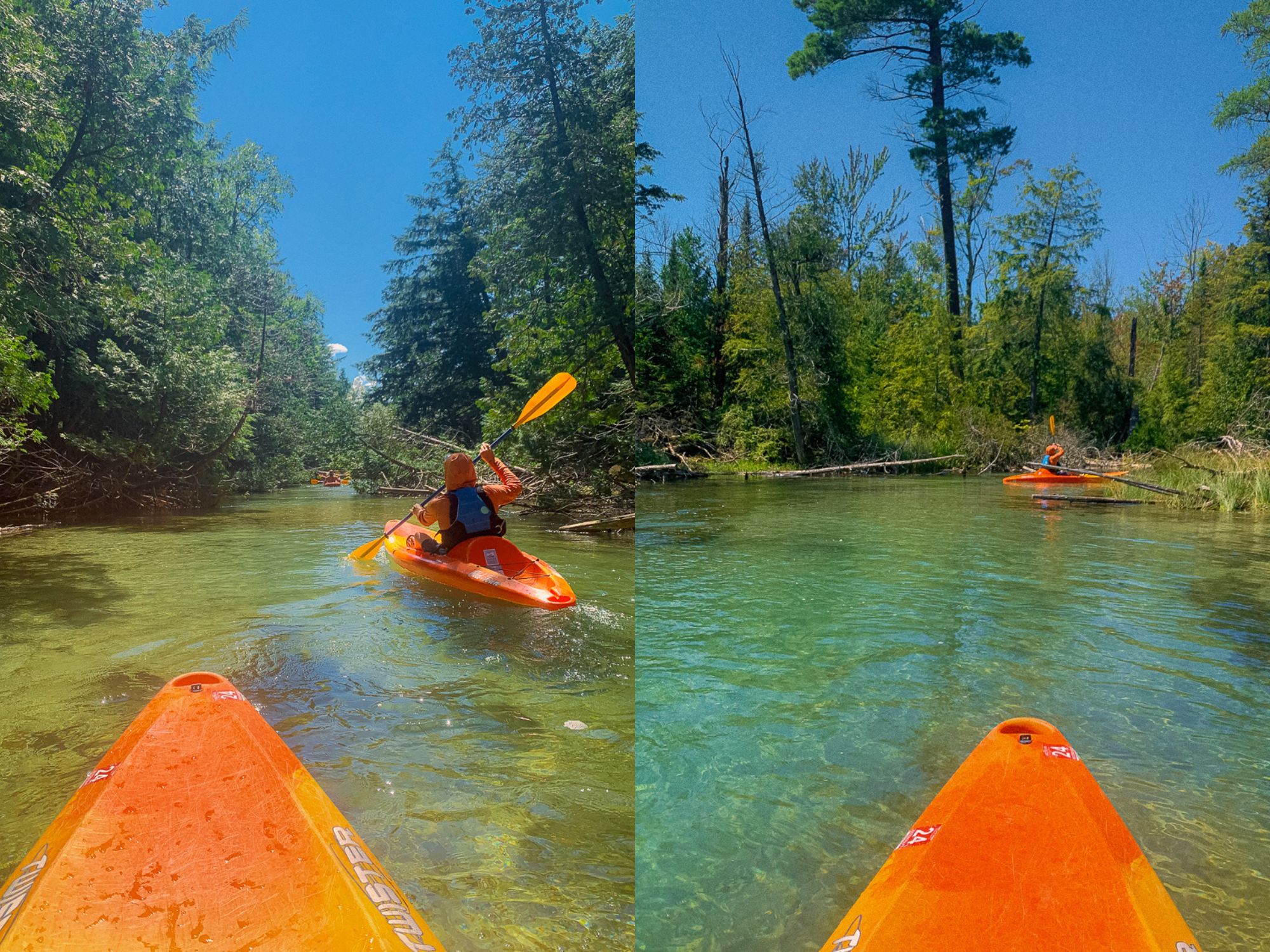
Image of an orange kayak on the blue water of the Crystal river in michigna
Kayaking the Crystal River it becomes quickly clear where it got its name! Image: Maddy Marquardt

In the early fall, the Crystal River is the ideal place to paddle over the Lake Michigan salmon run. Salmon were stocked in the Crystal River in the 1970s to combat the invasive alewife; today, salmon still return to the Crystal River every autumn to spawn by the hundreds.

While you can bring your own kayak or canoe to paddle the Crystal River, shuttles and rentals are available from Crystal River Outfitters. Expect to complete two to three short portages, or places where you will have to carry your kayak, along this route. Portages around dams and road underpasses are well-marked. The Crystal River is just six miles long in its entirety; most routes are a half-day trip.

The Crystal River is part of the Sleeping Bear Dunes National Lakeshore, and an America The Beautiful National Parks Pass or Sleeping Bear Dunes day pass is required.

Au Sable River

The Au Sable River begins its journey near Grayling, Michigan, winding nearly 140-miles to Lake Huron. This river is well-known as a wonderful river for canoeing, but it also makes for a great kayaking trip. In addition to being home to the 120-mile Au Sable Canoe Marathon – a popular nonstop canoe race – the Au Sable River is an excellent river for overnight kayak and canoe tripping.

The Au Sable is known for brown trout flyfishing in addition to being often regarded as the best river to canoe in Michigan. Find a guide to put-in and take-out options on the Au Sable river from Carlisle Canoe Livery, and rent canoes and/or kayaks from Carlisle Canoe Livery or Borcher Canoe & Kayak both based in Grayling, Michigan.

Jordan River

Designated Michigan’s first “wild and scenic” river in 1972 under the State of Michigan’s Natural Rivers Act, the Jordan River winds through the Mackinaw State Forest near East Jordan, Michigan. Spring fed, sandy-bottomed and crystal clear, the Jordan River is a beautiful river for kayaking and fishing. The Jordan River is nearly 25 miles long and flows into the South Arm of Lake Charlevoix.

A canoe floats down the sandy-bottomed Jordan River in Michigan
The Jordan River is cold, clear, and fast moving! Image: Maddy Marquardt

Personally, the Jordan River is my favorite river to kayak in Michigan, taking paddlers through green and dense forest and wildflower beds. The Graves Crossing put-in allows for a three-hour paddle on swift water, small rapids and riffles depending on the water levels and some technical sections in the narrow, faster moving sections of the river. A more beginner-friendly put-in option can be found at the Webster’s Bridge put-in.

Kayak rentals and shuttles can be found at Jordan Valley Outfitters.

Manistee River

The nearly 200-mile long Manistee River flows from its headwaters between Gaylord, Michigan out to Lake Michigan. The Manistee is a popular Michigan river for kayaking and canoeing, including overnight multi-day trips, with numerous developed and rustic campgrounds along its length.

Flowing through a valley shaped by glaciers, the Manistee River is one Michigan’s formally-designated Wild and Scenic Rivers. Like many of the Northern Michigan rivers, the Manistee is an excellent trout fishery. The section of the Manistee above the Tippy Dam tends to have a faster moving current and more obstacles, while the lower section of the Manistee is wider and slower in current.

Find float times, maps and canoe and kayak rentals for the Lower Manistee River at the Pine River Paddlesports Center. For the Upper Manistee River, find canoe and kayak rentals at Chippewa Landing.

Two-Hearted River

The Upper Peninsula of Michigan’s Two-Hearted River is not only a popular Michigan river for canoeing, but the setting of Ernest Hemingway’s Big Two-Hearted River, a two-part short story. The river is also the namesake of the Michigan Bell’s Two-Hearted IPA, a popular local beer.

The Two-Hearted River is a secluded wilderness paddle, including the especially scenic and sandy lower portion of the river as it approaches Lake Superior.

The Green and Reed Campground makes for a good put-in point or camping option, while the Mouth of Two Hearted River State Forest Campground offers another rustic place to camp with river access.

Boardman River

Michigan’s Boardman River runs through Kalkaska County to flow into the Grand Traverse Bay. On the Lower Boardman there are several spots with fast-moving water including riffles and small rapids, including rapids at Old Keystone and Beitner Park to the tune of class I and class II with one class III site.

Inexperienced paddlers will need to portage or avoid this section of the river, while whitewater kayakers may find it to be one of the best whitewater sites in the Lower Peninsula of Michigan.

The Boardman River before and after these rapids is flatwater, if a little swift moving with some obstacles. Canoe and kayak rentals can be found at The River Outfitters in Traverse City.

Torch River

The Torch River runs between Torch Lake and Lake Skegemog and is known for its remarkable Caribbean-like blue water color. This is a short kayaking day trip, best done in the mornings before motorized traffic in this popular section of river picks up. Paddle out to the popular and scenic Torch Lake Sandbar, down the Torch River past boathouses intermingled with wildlife, and eventually out to the wilder Lake Skegemog where you’re likely to spot beaver and mink.

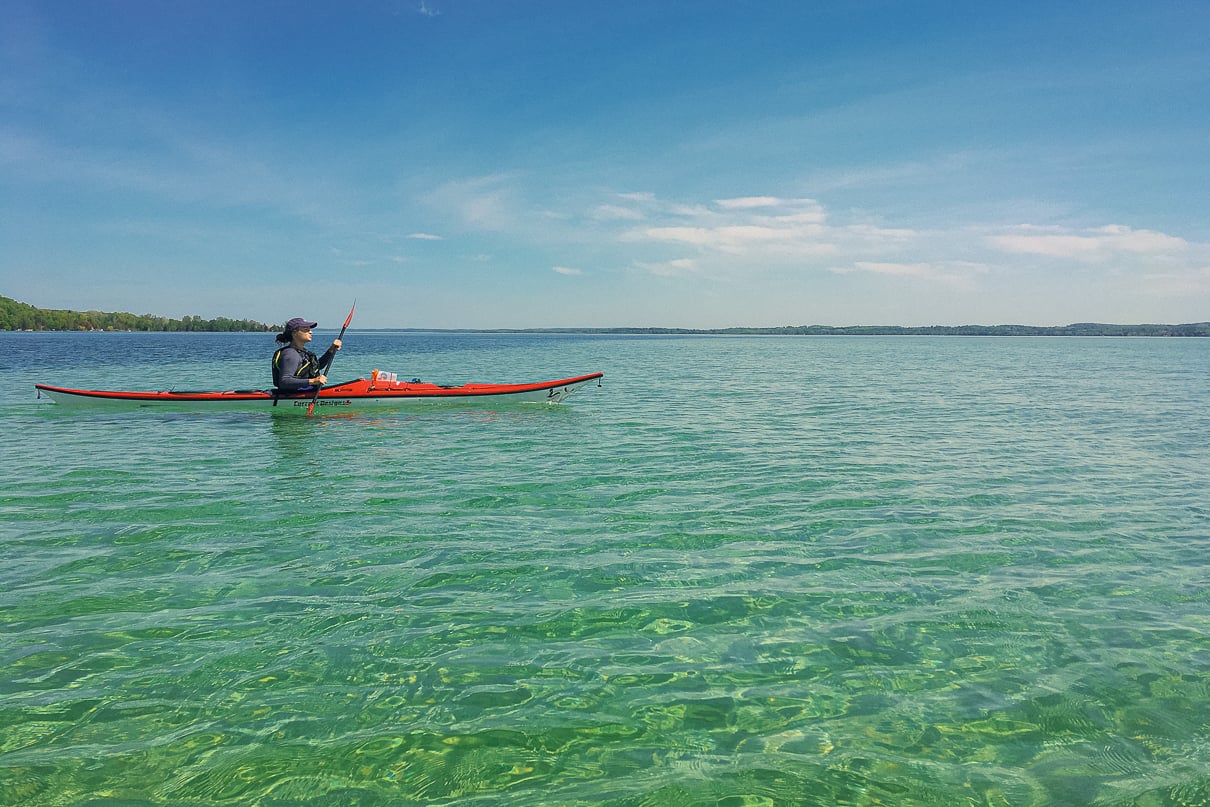
A kayaker floats on crystal clear torch lake at the mouth of the Torch River in Michigan
Tropical-like waters at the mouth of the Torch River. Image : Maddy Marquardt

Paddlers can put-in at the Torch River Bridge access site or the DNR Launch Ramp off Aarwood Trail NW.

The Torch River is part of the Chain of Lakes Water Trail, an over 100-mile water trail that includes 12 lakes and rivers, connecting Ellsworth, Michigan and to the Grand Traverse Bay and Lake Michigan.

Huron River

Michigan’s Huron River is home to the Huron River Water Trail which winds 104-miles from Proud Lake near Novi-Wixom to Lake Erie. Along the Huron River a paddler can find class II rapids at Delhi and Dexter or Mill Creek, and a series of small man-made drops at Argo Cascades; portage options are available around rapids.

While the Huron River makes for an especially great day trip, it is also possible to kayak the entire length of the river camping in a few spots along the way. Be advised that there are several dams to portage, and a few longer sections of the river without campsites.

Grass River

Michigan’s Grass River near Bellaire, Michigan is a unique opportunity to paddle a nature reserve with sedge meadows, northern fens and cedar wetlands. The Grass River is clear and sandy bottomed, flowing between Lake Bellaire and Clam Lake on the Chain Of Lakes Water Trail.

kayaking over the Grass River in Michigan
Keep your eyes open for river otter on the Grass River! Image: Maddy Marquardt

The area around the Grass River is home to over 500 species of plants, 147 species of birds, 35 species of fish, and 33 reptiles and amphibians according to the local Grass River Natural Area, making it one of the best places to kayak in Michigan for wildlife.

The Grass River is 2.5 miles long with a mild current and flat water, making it perfect for an out and back day trip. Put in at Willow Day Park on Lake Bellaire to begin your paddle with the current first and paddle back against it, or put in at Arrowhead Park on Clam Lake to paddle upriver first and float back down with the current on your return.

Rentals including pick up and delivery can be found at Paddles & Pedals in Bellaire, Michigan.

Delia’s Run and Big Island Lakes

Looking for the ultimate kayaking or canoeing wilderness experience and one of the best places to paddle in Michigan’s Upper Peninsula? Head up to Big Island Lakes Wilderness to paddle a chain of 23 interconnected lakes and rivers.

Kayaking the Big Island Lakes Wilderness in the Upper Peninsula at Sunset
Sunset in Big Island Lakes Wilderness. Image: Maddy Marquardt

Big Island Lakes Wilderness is lightly-trafficked and excellent for overnight camping. A few short portages may be necessary to access some of the interior campsites.

Overall, Big Island Lakes Wilderness is an excellent place to kayak or canoe immersed in wildlife and appreciate the dark skies of Michigan’s Upper Peninsula.

What We Know About The Canoeist Killed By Alligator In Florida (Video)

Florida woman Cynthia Diekema, 61, was killed by an alligator on a canoe trip on Lake Kissimmee on May 6, 2025. While out canoeing near Tiger Creek with her husband, the couple drifted over an alligator.

Paddling in about 2.5 feet of water the couple likely startled the large alligator who then capsized the canoe, sending both paddlers into the water. An eyewitness account states that Diemekma landed on top of the alligator; Diekema’s husband attempted, unsuccessfully, to fight it off.

Woman killed by alligator while canoeing on Lake Kissimmee

“This is a devastating loss and our hearts go out to everyone affected by this tragedy,” shared Roger Young, Executive Director of the Florida Fish and Wildlife Conservation Commission (FWC) in a press conference.

The FWC has launched an investigation into the incident, working with wildlife specialists and biologists as well as the sheriff’s office to understand what happened.

“While alligator attacks resulting in fatality are extremely rare, this tragedy serves as a somber reminder of the powerful wildlife that share our natural spaces,” said Young.

According to FWC public information officer Bradley Johnson the attack was not believed to be predatory in nature, adding that the FWC always encourages the public to keep their distance from wildlife.

“It’s premature to speculate exactly what happened,” shared Young, adding that they do have an eyewitness account of the incident, and that evidence is present to connect the individual alligator to the injuries.

Two alligators including an 11-foot four-inch alligator and an alligator between ten and eleven feet were recovered from Lake Kissimmee by the Statewide Nuisance Alligator Program (SNAP).

Alligator incidents in Florida

This is the second attack of an alligator on a paddler on Tiger Creek in Lake Kissimmee since March, when a woman was bitten by an alligator while kayaking. Generally alligator attacks on paddlers are extremely uncommon in all seasons, however according to Florida Today mating season for alligators in the area runs through June, and alligators are typically more aggressive April through September.

The FWC recommends the following to minimize chances of incidents with alligators:

  • People with concerns about an alligator should call FWCs toll-free nuisance alligator hotline at 866-392-4286.
  • Keep a safe distance if you seen an alligator
  • Keep pets on a leash and away from the water’s edge
  • Swim only in designated swimming areas
  • Never feed an alligator

Alligators, no swimming. Feature Image: Fox 35 Orlando | YouTube

The Hurricane Santee 116 Sport: Why This Enduring Kayak Remains A Recreational Favorite

What makes for a best-selling recreational kayak? To answer the question, consider the Santee 116 Sport from Hurricane Kayaks. This kayak is a perennial favorite among paddlers seeking a boat for day trips on their local waterways and road trip destinations. It is lightweight, comfortable, and has a stable shape, yet it glides through the water with ease.

Hurricane has recognized the continual love for the Santee, and rather than changing a shape that already works, they’ve continued to find ways to improve upon it with upgrades to the outfitting and paddler experience through the years.

These features make the Santee 116 Sport an enduring favorite

One of the most unique aspects of the Santee 116 Sport is it is a recreational kayak hull that cuts effortlessly through the water while still providing the stability paddlers on smaller lakes and bays prioritize. This is accomplished on the 11-foot, 7-inch long kayak with what is known as a Swede-form hull, a tapered bow, and a v-hull.

A Swede-form hull design places the widest point of the kayak just behind the paddler. This allows the kayak to maintain a slender profile through the front half, from the bow to the paddler. This tapered front shape cuts through and glides on the water. Meanwhile, the width of the Santee 116 Sport behind the paddler, combined with the soft chines and v-hull provide the paddler the stability.

The lightweight of the Santee is another reason it has become a popular kayak. The boat tips the scales at a mere 39 pounds. This makes the Santee 116 an easy kayak to load on the car and transport to and from the water.

The big reason why is the boat is constructed of thermoformed plastic, which, according to Steve Jordan of Hurricane Kayaks, cuts the weight of the boat down by about 15 percent compared to a rotomolded kayak of the same size and category.

The 55-inch-by-24-inch cockpit also provides some weight savings by being so wide open and cutting down on the amount of plastic on the deck. What really stands out about this large cockpit though is it makes it much easier to get in and out of the kayak.

Outfitting of the Santee 116 Sport

This brings us to the Santee 116 Sport’s outfitting once you are sitting inside. The kayak has what they call the Strongside Seat with Airestream Seatback. It’s a plush foam seat, and the backrest has an adjustable height to decide where you’d like back support. The seat also adjusts in height/tilt under the thighs, similar to newer vehicle driver seats. Having spent time in poorly outfitted boats with my feet falling asleep, I can attest adjustablitiy in thigh support is an underrated feature all recreational kayaks should have in order to spend hours comfortable on the water.

The kayak also has an easy to access rear hatch, thanks to the flip switch and hinge on the deck plate. There is a bungee behind the paddler for deck storage, and a clip to place a paddle when not in use.

The Santee 116 Sport is available now at retailers and you can learn more at Hurricane Kayaks.


Feature Image: Brenna Kelly